
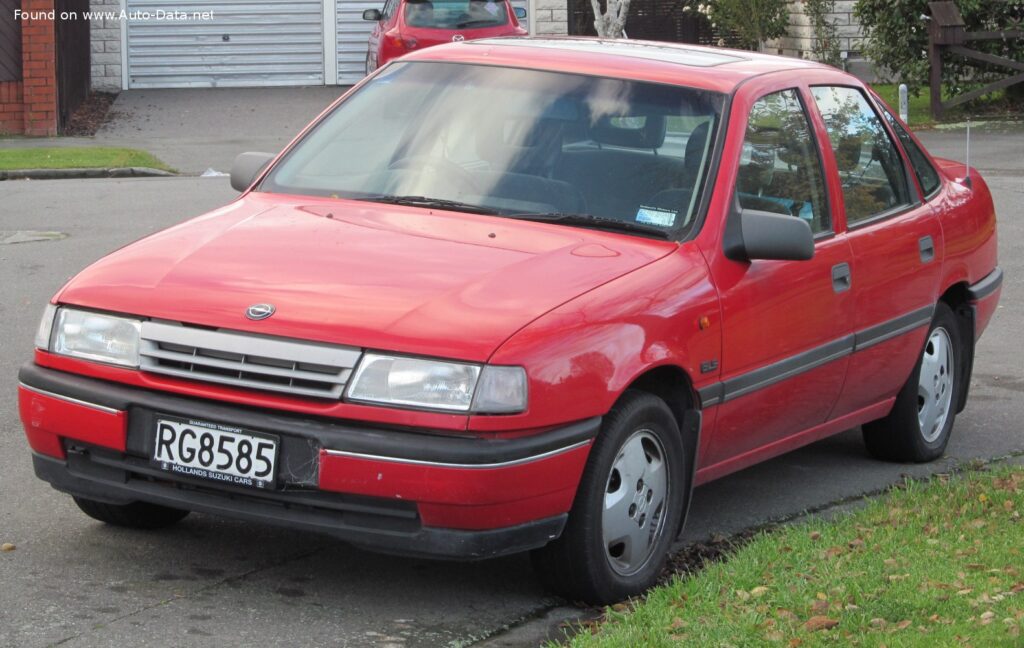
Introduction to the Opel Vectra A
The Opel Vectra A, introduced in October 1988, marked a pivotal moment for Opel, General Motors’ European subsidiary. This new model was designed to replace the venerable Opel Ascona, stepping into the highly competitive European mid-size family car segment. The Vectra A represented a significant modernization in design, engineering, and market positioning for the brand. It was conceived as a global car, though primarily sold in Europe, where it quickly became a staple on roads across the continent. This detailed analysis focuses on a specific variant from its initial production run, the Opel Vectra A 1.8 S (88 Hp) Automatic, which was available from October 1988 to June 1989. This model embodied the era’s blend of practicality, emerging aerodynamic efficiency, and accessible technology, targeting a broad demographic of buyers seeking a reliable and comfortable sedan.
The Opel Vectra A 1.8 S (88 Hp) Automatic: Engineering and Design Philosophy
The Vectra A’s development was rooted in a strategy to offer a more sophisticated and aerodynamically efficient vehicle than its predecessor. While not sold in the United States, the Vectra A played a crucial role in Opel’s strategy to compete with European rivals like the Ford Sierra and Volkswagen Passat. The design emphasized smooth lines and a low drag coefficient, a key trend in automotive engineering during the late 1980s, aiming to improve both fuel economy and interior quietness.
The specific Opel Vectra A 1.8 S (88 Hp) Automatic variant showcased a focus on comfortable, unfussy driving, making it a popular choice for families and fleet operators. Its powertrain was designed for durability and ease of maintenance, characteristic of European volume sellers of the period.
Engine and Performance
Under the hood, the Opel Vectra A 1.8 S (88 Hp) Automatic featured Opel’s E18NVR engine, a naturally aspirated 1.8-liter (1796 cm3 or 109.6 cu. in.) inline-four cylinder unit. This engine utilized an Overhead Camshaft (OHC) valvetrain with two valves per cylinder, a common and reliable configuration for its time. A notable characteristic of this particular variant was its fuel delivery system: a carburetor. While electronic fuel injection was gaining prominence in the late 1980s, carbureted engines still offered a cost-effective and simpler solution for many mainstream models, especially in lower-spec trims.
The engine produced a modest but adequate 88 horsepower at 5400 rpm, with a power-per-liter output of 49 horsepower per liter. Torque stood at 105.47 lb.-ft. (143 Nm) delivered at a relatively low 2800 rpm, indicating a focus on accessible pulling power for everyday driving rather than high-revving performance. This powertrain was mated to a 4-speed automatic transmission, which provided smooth, if not overtly sporty, gear changes. The drivetrain architecture was front-wheel drive, a configuration that had become standard for this segment, offering improved traction in adverse conditions and more interior space due to the lack of a transmission tunnel running through the cabin.
Performance figures for the Opel Vectra A 1.8 S (88 Hp) Automatic were respectable for a family sedan of its era. It could reach a maximum speed of 109.36 mph (176 km/h). Fuel economy was a strong point, with a combined rating of 31.8 US mpg (7.4 l/100 km), which was competitive for a carbureted 1.8-liter engine with an automatic transmission at the time. The 61-liter (16.11 US gallon) fuel tank provided a decent cruising range.
Design and Features
The Opel Vectra A was offered primarily as a 4-door sedan, which is the body type for the 1.8 S variant, and later as a 5-door hatchback (known as the Vectra A Caravan or station wagon in some markets). Its design was a radical departure from the boxier Ascona, featuring a sleek, wedge-shaped profile and flush-fitting glass that contributed to an impressive drag coefficient (Cd) of just 0.29. This was a leading figure for a mass-market sedan in 1988 and was instrumental in enhancing both its aesthetic appeal and its aerodynamic efficiency.
Dimensionally, the Vectra A was a substantial vehicle for its class, with a length of 174.49 inches (4432 mm), a width of 67.17 inches (1706 mm), and a height of 55.12 inches (1400 mm). The wheelbase measured 102.36 inches (2600 mm), which contributed to a comfortable ride and generous interior space for five occupants. The front and rear tracks were 55.91 inches (1420 mm) and 56.02 inches (1423 mm), respectively, providing a stable stance.
Inside, the Vectra A prioritized practicality and ergonomic design. The seating for five was comfortable, and the cabin was designed to be functional, with controls logically placed. A key feature for family buyers was the ample trunk space, ranging from a minimum of 18.72 cubic feet (530 liters) to a maximum of 29.66 cubic feet (840 liters) with the rear seats folded down (though this would be less relevant for a sedan, it indicates the overall cargo volume potential). This substantial cargo capacity further cemented its appeal as a versatile family vehicle. While advanced safety features like airbags were not standard across the range in 1988, the Vectra A’s body structure was designed with improved crash integrity compared to previous generations, reflecting evolving safety standards in Europe.
Technical Specifications: Opel Vectra A 1.8 S (88 Hp) Automatic
| Category | Specification |
|---|---|
| Brand | Opel |
| Model | Vectra A |
| Type (Engine) | 1.8 S (88 Hp) Automatic |
| Production Start | October, 1988 |
| Production End | June, 1989 |
| Powertrain Architecture | Internal Combustion Engine |
| Body Type | Sedan |
| Seats | 5 |
| Doors | 4 |
| Fuel Type | Petrol (Gasoline) |
| Fuel Consumption (Combined) | 31.8 US mpg (7.4 l/100 km) |
| Maximum Speed | 109.36 mph (176 km/h) |
| Power | 88 Hp @ 5400 rpm |
| Power per Liter | 49 Hp/l |
| Torque | 105.47 lb.-ft. (143 Nm) @ 2800 rpm |
| Engine Layout | Front, Transverse |
| Engine Model/Code | E18NVR |
| Engine Displacement | 1.8 liters (1796 cm3 / 109.6 cu. in.) |
| Number of Cylinders | 4 |
| Engine Configuration | Inline |
| Cylinder Bore | 3.34 in. (84.8 mm) |
| Piston Stroke | 3.13 in. (79.5 mm) |
| Compression Ratio | 9.2:1 |
| Valves per Cylinder | 2 |
| Fuel Injection System | Carburetor |
| Engine Aspiration | Naturally Aspirated |
| Valvetrain | OHC |
| Engine Oil Capacity | 4.23 US qt (4 l) |
| Coolant Capacity | 7.08 US qt (6.7 l) |
| Trunk Space (Minimum) | 18.72 cu. ft. (530 l) |
| Trunk Space (Maximum) | 29.66 cu. ft. (840 l) |
| Fuel Tank Capacity | 16.11 US gal (61 l) |
| Length | 174.49 in. (4432 mm) |
| Width | 67.17 in. (1706 mm) |
| Height | 55.12 in. (1400 mm) |
| Wheelbase | 102.36 in. (2600 mm) |
| Front Track | 55.91 in. (1420 mm) |
| Rear Track | 56.02 in. (1423 mm) |
| Drag Coefficient (Cd) | 0.29 |
| Drivetrain Architecture | Front-wheel drive (ICE drives front wheels) |
| Drive Wheel | Front-wheel drive |
| Gearbox | 4 gears, automatic transmission |
Legacy and Market Impact
The Opel Vectra A, including variants like the 1.8 S (88 Hp) Automatic, was a resounding commercial success for Opel in Europe. Its launch was critical for GM’s European operations, as it aimed to capture a significant share of the lucrative mid-size car market. The Vectra A was praised for its modern styling, comfortable ride, and practical interior. Its aerodynamic design was a particular highlight, setting new standards for the segment and contributing to its appeal as an efficient and refined vehicle.
In its primary European market, the Vectra A faced stiff competition from well-established rivals. Key competitors included the Ford Sierra, a car also known for its aerodynamic design, the Volkswagen Passat (B3 generation), which offered robust German engineering, and French contenders like the Renault 21 and Peugeot 405, known for their distinctive styling and comfortable suspensions. Despite this intense competition, the Vectra A carved out a strong niche, becoming a popular choice for both private buyers seeking a reliable family car and for company fleets due to its low running costs and perceived durability.
The 1.8 S (88 Hp) Automatic variant specifically appealed to buyers prioritizing convenience and smooth operation over outright performance. Its carbureted engine, while somewhat behind the curve compared to competitors adopting widespread fuel injection, offered simplicity and a proven track record of reliability. This made it an attractive option for those who valued traditional mechanics and ease of maintenance.
The Vectra A’s historical significance lies in its role as a benchmark for European family sedans of its era. It demonstrated Opel’s capability to produce a car that was both aesthetically pleasing and highly functional. It helped solidify Opel’s brand image as a producer of well-engineered, value-for-money vehicles. The Vectra A remained in production until 1995, undergoing several updates, and its success paved the way for subsequent generations of the Vectra, which continued to be a cornerstone of Opel’s lineup for many years. Its legacy is one of a practical, well-designed, and hugely popular car that defined a generation of European motoring.
