
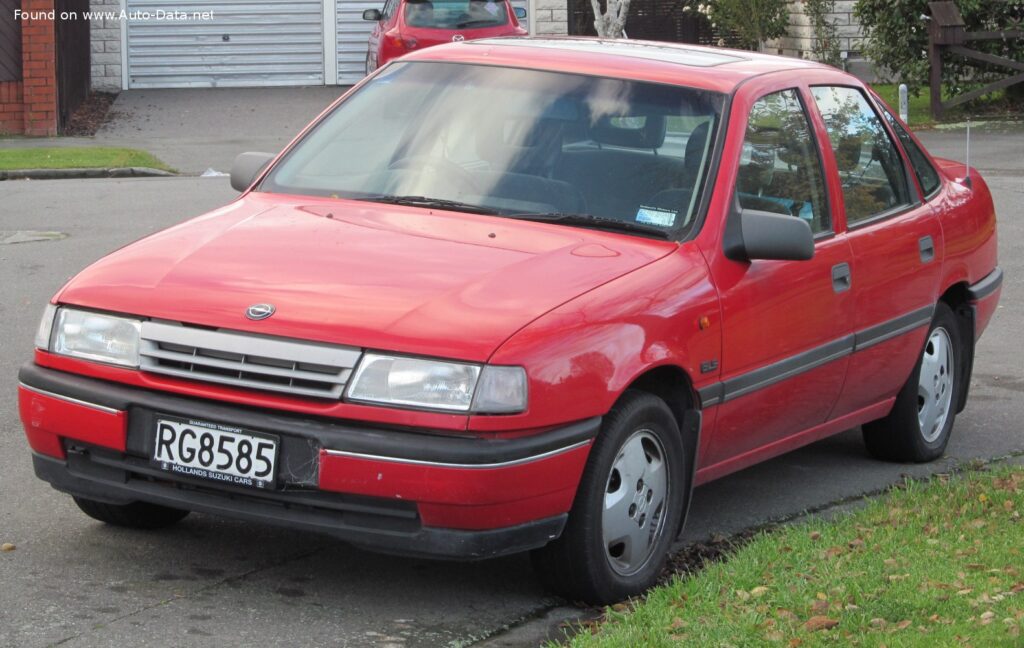
The Opel Vectra A 1.8i CAT (90 Hp) Automatic: A Pillar of European Motoring
The Opel Vectra A, introduced in 1988, marked a significant evolution for General Motors’ European subsidiary, Opel. Succeeding the long-running Ascona, the Vectra A represented a leap forward in design, aerodynamics, and technology for the mainstream mid-size segment. While never officially sold in the United States, the Vectra A established itself as a ubiquitous presence on European roads, a testament to its practical design, robust engineering, and competitive value. This detailed article focuses on the specific variant, the Opel Vectra A 1.8i CAT (90 Hp) Automatic, a popular choice for families and fleet operators seeking a comfortable, reliable, and efficient sedan from 1990 to 1992.
The Vectra A’s role was crucial for Opel, aiming to counter strong competition from rivals like the Ford Sierra and Volkswagen Passat. It arrived with a sleeker, more modern aesthetic compared to its predecessor, boasting an impressive drag coefficient that contributed to both fuel efficiency and reduced wind noise. The 1.8i CAT (Catalytic Converter) variant, specifically with its 90 horsepower engine and automatic transmission, exemplified a practical and accessible option for a broad spectrum of European buyers, prioritizing ease of use and everyday drivability over outright performance.
Engine & Performance: The Opel Vectra A 1.8i CAT (90 Hp) Automatic Powertrain
At the heart of the Opel Vectra A 1.8i CAT (90 Hp) Automatic lies the C18NZ engine, a naturally aspirated 1.8-liter (1796 cm3 or 109.6 cu. in.) inline-four gasoline unit. This engine was a common and well-regarded powerplant in Opel’s lineup during the late 1980s and early 1990s, known for its simplicity and reliability. Featuring a Single Overhead Camshaft (OHC) valvetrain and two valves per cylinder, the C18NZ utilized a single-point injection fuel system, a technology that was a step up from carburetors, offering better fuel metering and driveability while still being cost-effective to produce.
The engine delivered a respectable 90 horsepower at 5400 rpm, paired with 145 Nm (106.95 lb.-ft.) of torque peaking at a relatively low 3000 rpm. This torque delivery characteristic made the engine quite flexible in everyday driving, reducing the need for constant gear changes. Mated to a 4-speed automatic transmission, this powertrain configuration was geared towards comfort and convenience, particularly suited for urban commuting and relaxed highway cruising. The automatic gearbox, while not performance-oriented, provided smooth shifts, contributing to a pleasant driving experience.
In terms of performance, the Vectra A 1.8i CAT Automatic was a competent rather than a sporty performer. It achieved 0-60 mph in a calculated 14.3 seconds, with a top speed of approximately 110 mph (177 km/h). While these figures might seem modest by today’s standards, they were entirely adequate for a family sedan of its era. Fuel efficiency was a notable strong suit, with a combined cycle rating of 31.8 US mpg (7.4 l/100 km), demonstrating its economical nature, especially on extra-urban routes where it could achieve nearly 40 US mpg (5.9 l/100 km). This blend of practical performance and reasonable economy made it a compelling choice for its target market.
Design & Features: Aerodynamics and Practicality
The Opel Vectra A represented a significant stylistic departure from its predecessor, the boxier Ascona. Its design, characterized by smooth lines and a rounded silhouette, was a hallmark of late 1980s automotive aesthetics, emphasizing aerodynamics. With a remarkably low drag coefficient (Cd) of just 0.29, the Vectra A was one of the most aerodynamically efficient cars in its class when it launched. This sleek design not only contributed to its modern appearance but also played a practical role in reducing fuel consumption and wind noise at higher speeds.
As a 4-door sedan, the Vectra A prioritized interior space and practicality for up to five occupants. The cabin was designed with ergonomic principles in mind, offering a straightforward dashboard layout with easily accessible controls. While not luxurious, the interior materials were durable and built to withstand the rigors of family life. The car’s dimensions—174.49 inches in length, 67.17 inches in width, and 55.12 inches in height, with a 102.36-inch wheelbase—translated into a comfortable and spacious cabin for its class, particularly for rear passengers.
Practicality extended to its cargo capacity, with a generous trunk (boot) offering a minimum of 18.72 cu. ft. (530 liters) of space, expandable to 29.66 cu. ft. (840 liters) with the rear seats folded. This made the Vectra A a highly versatile vehicle for families, capable of handling everything from weekly groceries to vacation luggage. Key features for the era included hydraulic power steering, making maneuvering easier, and an Anti-lock Braking System (ABS), which was an important safety advancement for a mass-market vehicle in the early 1990s. The car rode on 175/70 R14 tires, with ventilated discs at the front and drum brakes at the rear, a common setup for the segment balancing cost and effective stopping power.
Technical Specifications: Opel Vectra A 1.8i CAT (90 Hp) Automatic
| Category | Specification |
|---|---|
| General Information | |
| Brand | Opel |
| Model | Vectra A |
| Type (Engine) | 1.8i CAT (90 Hp) Automatic |
| Production Start | 1990 |
| Production End | 1992 |
| Body Type | Sedan |
| Doors | 4 |
| Seats | 5 |
| Powertrain Architecture | Internal Combustion Engine (Front Wheel Drive) |
| Performance Specs | |
| Fuel Consumption (Urban) | 22.4 US mpg (10.5 l/100 km) |
| Fuel Consumption (Extra Urban) | 39.9 US mpg (5.9 l/100 km) |
| Fuel Consumption (Combined) | 31.8 US mpg (7.4 l/100 km) |
| Fuel Type | Petrol (Gasoline) |
| Acceleration 0-60 mph | 14.3 seconds |
| Maximum Speed | 110 mph (177 km/h) |
| Weight-to-Power Ratio | 11.8 kg/Hp (84.9 Hp/tonne) |
| Weight-to-Torque Ratio | 7.3 kg/Nm (136.8 Nm/tonne) |
| Engine Specs | |
| Power | 90 Hp @ 5400 rpm |
| Torque | 106.95 lb.-ft. @ 3000 rpm (145 Nm) |
| Engine Layout | Front, Transverse |
| Engine Model/Code | C18NZ |
| Engine Displacement | 1.8 liters (1796 cm3 / 109.6 cu. in.) |
| Number of Cylinders | 4 |
| Engine Configuration | Inline |
| Valves per Cylinder | 2 |
| Fuel Injection System | Single-point injection |
| Engine Aspiration | Naturally aspirated |
| Valvetrain | OHC (Overhead Camshaft) |
| Compression Ratio | 9.2:1 |
| Cylinder Bore | 3.34 in. (84.8 mm) |
| Piston Stroke | 3.13 in. (79.5 mm) |
| Engine Oil Capacity | 4.23 US qt (4 liters) |
| Coolant Capacity | 7.61 US qt (7.2 liters) |
| Dimensions, Volume & Weights | |
| Length | 174.49 in. (4432 mm) |
| Width | 67.17 in. (1706 mm) |
| Height | 55.12 in. (1400 mm) |
| Wheelbase | 102.36 in. (2600 mm) |
| Front Track | 56.57 in. (1437 mm) |
| Rear Track | 56.38 in. (1432 mm) |
| Kerb Weight | 2336.9 lbs. (1060 kg) |
| Max. Weight | 3549.44 lbs. (1610 kg) |
| Max Load | 1212.54 lbs. (550 kg) |
| Trunk (Boot) Space (Min) | 18.72 cu. ft. (530 liters) |
| Trunk (Boot) Space (Max) | 29.66 cu. ft. (840 liters) |
| Fuel Tank Capacity | 16.11 US gal (61 liters) |
| Drag Coefficient (Cd) | 0.29 |
| Drivetrain, Brakes & Suspension | |
| Drive Wheel | Front Wheel Drive |
| Gearbox Type | 4-speed Automatic Transmission |
| Front Suspension | Coil Spring |
| Rear Suspension | Coil Spring |
| Front Brakes | Ventilated Discs |
| Rear Brakes | Drum |
| Assisting Systems | ABS (Anti-lock Braking System) |
| Power Steering | Hydraulic Steering |
| Tire Size | 175/70 R14 |
| Wheel Rims Size | 14 inches |
Legacy & Market Impact: The Opel Vectra A’s Enduring Role
The Opel Vectra A, including the Opel Vectra A 1.8i CAT (90 Hp) Automatic variant, carved out a significant legacy in the highly competitive European mid-size segment. Launched at the tail end of the 1980s, it quickly established itself as a benchmark for practical, affordable family transportation. Its success was built on a foundation of modern design, reliable mechanics, and a strong value proposition, making it a common sight across continental Europe and the UK (where it was sold as the Vauxhall Cavalier Mk3).
In its primary markets, the Vectra A faced formidable rivals such as the Ford Sierra (later Mondeo), Volkswagen Passat, Renault 21 (later Laguna), and Peugeot 405. Opel positioned the Vectra A as a sensible, no-nonsense choice for families and business fleets, often emphasizing its low running costs, spacious interior, and improved safety features like the available ABS. The 1.8i CAT engine, in particular, was praised for its balance of adequate performance and excellent fuel economy, especially when paired with the convenient automatic transmission, making it a popular option for those seeking a relaxed driving experience without sacrificing efficiency.
The Vectra A’s impact was profound for Opel. It successfully modernized the brand’s image and sales in a crucial segment, demonstrating Opel’s commitment to contemporary design and engineering. Its robust build quality and straightforward maintenance contributed to its reputation for reliability, leading to strong resale values for many years after its production ceased in 1995. Even today, the Vectra A is remembered as a workhorse of its era, a car that reliably served millions of families and businesses, embodying the practical and efficient ethos of European automotive engineering from the early 1990s. Its influence can be seen in subsequent generations of Opel/Vauxhall mid-size cars, which continued to build upon the Vectra A’s success in blending practicality with modern automotive advancements.
