
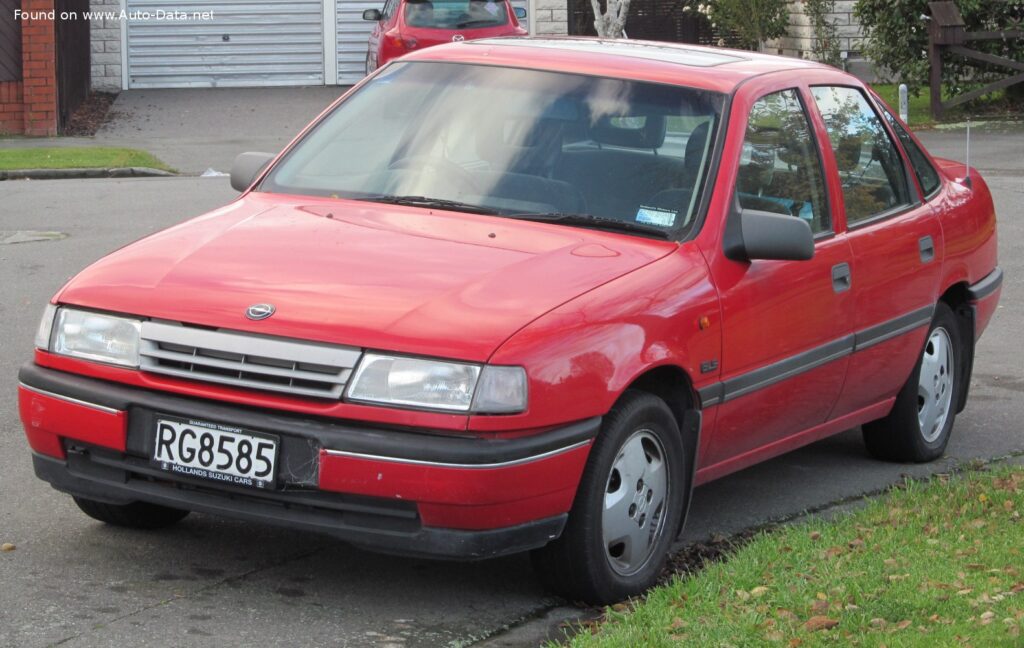
The Opel Vectra A 2.0 (101 Hp): A European Mainstay of the Late 1980s
The Opel Vectra A, introduced in 1988, represented a significant step forward for the German automaker Opel, then a subsidiary of General Motors. Positioned firmly in the competitive mid-size family car segment, the Vectra A was designed to replace the venerable Ascona, bringing with it a more modern design, improved aerodynamics, and a range of contemporary powertrains. The specific variant, the Opel Vectra A 2.0 (101 Hp), was a popular choice, offering a robust balance of performance and efficiency for the European market. Although not officially sold in the United States under the Opel badge, its underlying engineering principles and market segment mirrored those of contemporary American sedans like the Chevrolet Cavalier or Pontiac Grand Am, albeit with a distinct European flavor and design philosophy tailored for its primary audience. This first-generation Vectra quickly established itself as a reliable and practical vehicle, becoming a common sight on European roads throughout its production run.
Engine and Performance: The Opel Vectra A 2.0 (101 Hp) Powertrain
At the heart of the Opel Vectra A 2.0 (101 Hp) was a naturally aspirated, 2.0-liter (1998 cm³ or 121.93 cu. in.) inline four-cylinder gasoline engine, designated with the model code C20NEF. This engine was a testament to Opel’s engineering at the time, prioritizing durability and smooth power delivery for everyday driving. Featuring a single overhead camshaft (OHC) valvetrain with two valves per cylinder, it was a straightforward and reliable design that proved popular across various Opel models.
The engine produced a respectable 101 horsepower at 5200 revolutions per minute (rpm), providing ample power for navigating both urban environments and the autobahns of Europe. Its power per liter stood at 50.6 Hp/l, a solid figure for a non-turbocharged, two-valve-per-cylinder engine of its era. More notably, the engine delivered a healthy 158 Nm (116.53 lb.-ft.) of torque at a relatively low 2600 rpm. This low-end torque characteristic was particularly beneficial for daily usability, ensuring responsive acceleration from a standstill and strong pulling power without needing to constantly rev the engine high. Fuel delivery was managed by a multi-port manifold injection system, which was a common and efficient method for its time, offering better fuel control and emissions compared to older carburetor systems.
Power was sent to the front wheels via a standard 5-speed manual transmission, a typical setup for a mid-size European sedan, offering a good balance of performance and fuel economy. The engine’s bore and stroke were both 86 mm (3.39 inches), indicating a “square” engine design, often associated with a good balance between low-end torque and high-end power potential. With a compression ratio of 9.2:1, the engine was designed to run efficiently on standard gasoline grades available in Europe. The powertrain architecture, driving the front wheels, was a modern choice for the late 1980s, offering advantages in packaging, interior space, and handling predictability, especially in adverse weather conditions.
Design and Features of the Vectra A Sedan
The Opel Vectra A debuted with a sleek, aerodynamic design that was quite advanced for its time. The sedan body type, with four doors and seating for five occupants, was the cornerstone of its appeal as a practical family vehicle. Its most striking feature was its impressive drag coefficient (Cd) of just 0.29. This was a class-leading figure, rivaling many sports cars of the era and contributing significantly to better fuel efficiency and reduced wind noise at higher speeds. This aerodynamic efficiency was a key selling point, highlighting Opel’s commitment to modern design and engineering.
In terms of dimensions, the Vectra A measured 4432 mm (174.49 inches) in length, 1706 mm (67.17 inches) in width, and 1400 mm (55.12 inches) in height. Its wheelbase of 2600 mm (102.36 inches) provided a stable ride and contributed to a spacious cabin for its occupants. The front and rear tracks, at 1420 mm (55.91 inches) and 1423 mm (56.02 inches) respectively, ensured a confident stance on the road. The interior, while perhaps spartan by modern standards, was ergonomically laid out and built with durability in mind, a characteristic highly valued by European consumers.
Practicality was a strong suit for the Vectra A. The trunk (boot) offered a generous minimum capacity of 530 liters (18.72 cu. ft.), expanding to a substantial 840 liters (29.66 cu. ft.) with the rear seats folded, making it highly versatile for family trips or hauling cargo. The 61-liter (16.11 US gallon) fuel tank provided a decent cruising range, a crucial factor for long-distance European travel. While features like advanced infotainment or sophisticated driver-assist systems were decades away, the Vectra A focused on fundamental automotive qualities: reliable mechanics, comfortable seating, and a practical, well-designed cabin. Safety for the era included standard seatbelts and a robust body structure, typical for a mass-market vehicle of the late 1980s.
Technical Specifications: Opel Vectra A 2.0 (101 Hp)
| Category | Specification | Value |
|---|---|---|
| General Information | Brand | Opel |
| Model | Vectra | |
| Generation | Vectra A | |
| Type (Engine) | 2.0 (101 Hp) | |
| Start of Production | 1988 year | |
| End of Production | 1989 year | |
| Powertrain Architecture | Internal Combustion engine | |
| Body type | Sedan | |
| Seats | 5 | |
| Doors | 4 | |
| Performance Specs | ||
| Fuel Type | Petrol (Gasoline) | |
| Power | 101 Hp @ 5200 rpm. | |
| Power per liter | 50.6 Hp/l | |
| Torque | 158 Nm @ 2600 rpm (116.53 lb.-ft. @ 2600 rpm) | |
| Engine Model/Code | C20NEF | |
| Engine Displacement | 1998 cm³ (2.0 l / 121.93 cu. in.) | |
| Number of Cylinders | 4 | |
| Engine Configuration | Inline | |
| Cylinder Bore | 86 mm (3.39 in.) | |
| Piston Stroke | 86 mm (3.39 in.) | |
| Compression Ratio | 9.2:1 | |
| Number of Valves per Cylinder | 2 | |
| Fuel Injection System | Multi-port manifold injection | |
| Engine Aspiration | Naturally aspirated engine | |
| Valvetrain | OHC | |
| Engine Oil Capacity | 4 l (4.23 US qt) | |
| Engine Oil Specification | Not available in provided data | |
| Coolant Capacity | 7 l (7.4 US qt) | |
| Space, Volume and Weights | ||
| Trunk (boot) space – minimum | 530 l (18.72 cu. ft.) | |
| Trunk (boot) space – maximum | 840 l (29.66 cu. ft.) | |
| Fuel Tank Capacity | 61 l (16.11 US gal) | |
| Dimensions | ||
| Length | 4432 mm (174.49 in.) | |
| Width | 1706 mm (67.17 in.) | |
| Height | 1400 mm (55.12 in.) | |
| Wheelbase | 2600 mm (102.36 in.) | |
| Front Track | 1420 mm (55.91 in.) | |
| Rear (Back) Track | 1423 mm (56.02 in.) | |
| Drag Coefficient (Cd) | 0.29 | |
| Drivetrain, Brakes and Suspension Specs | ||
| Drivetrain Architecture | The Internal combustion engine (ICE) drives the front wheels of the vehicle. | |
| Drive Wheel | Front wheel drive | |
| Number of Gears and Type of Gearbox | 5 gears, manual transmission | |
Legacy and Market Impact of the Opel Vectra A
The Opel Vectra A, particularly variants like the 2.0 (101 Hp), carved out a significant niche in the highly competitive European mid-size sedan market during its production from 1988 to 1995. Its primary competitors included other European stalwarts such as the Ford Sierra (and later, the Mondeo), Volkswagen Passat, Renault 21, and Peugeot 405. The Vectra A distinguished itself with its modern, aerodynamic styling, reliable mechanicals, and practical interior packaging.
Opel, as a brand, was known for producing robust, no-nonsense vehicles that offered good value for money, and the Vectra A perfectly embodied this philosophy. It quickly gained a reputation as a dependable workhorse, popular with both families and fleet buyers across the continent. Its strong sales performance helped solidify Opel’s position as one of Europe’s leading automotive manufacturers. The 2.0-liter engine, in particular, was praised for its blend of adequate power, reasonable fuel consumption, and legendary longevity, contributing to the car’s appeal as a long-term ownership proposition.
The Vectra A’s impact extended beyond just sales figures. Its advanced aerodynamic design, evidenced by its low drag coefficient, influenced subsequent designs and set a benchmark for efficiency in its class. It demonstrated that a mainstream family sedan could also be aerodynamically optimized, contributing to a quieter ride and better fuel economy. The front-wheel-drive layout, combined with a well-tuned suspension, offered predictable and safe handling characteristics, appealing to a broad spectrum of drivers.
While the Opel Vectra A 2.0 (101 Hp) may not be a household name in the United States, its legacy in Europe is undeniable. It was a car that perfectly met the needs of its time and market, offering a compelling package of style, space, performance, and efficiency. It laid the groundwork for future generations of the Vectra and other Opel models, cementing the brand’s reputation for producing reliable and desirable family vehicles. Today, the first-generation Vectra is remembered as a classic example of late 1980s European automotive engineering, a testament to practical design and enduring mechanical quality.
