
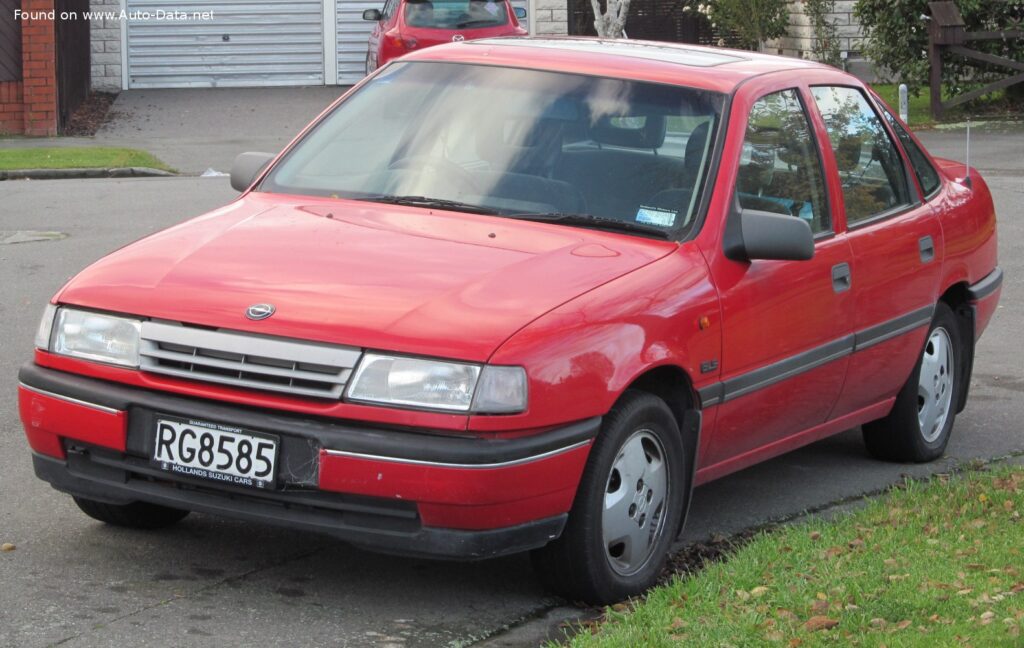
The Opel Vectra A 2.0i (115 Hp): A Pillar of European Motoring in the Late 1980s
The Opel Vectra A, introduced in 1988, marked a significant chapter for the German automaker Opel, a subsidiary of General Motors. Positioned as a direct successor to the venerable Opel Ascona C, the Vectra A aimed to modernize Opel’s offering in the highly competitive European mid-size family car segment. The particular variant under consideration, the Opel Vectra A 2.0i (115 Hp), represents a popular and well-balanced choice within the first generation’s initial lineup. While never officially sold in the United States, where GM offered its own platform derivatives like the Chevrolet Cavalier and Pontiac Sunfire, the Vectra A was a ubiquitous sight across European roads, known for its practicality, robust engineering, and accessible performance. It quickly established itself as a strong contender against rivals such as the Ford Sierra, Volkswagen Passat, and Renault 21, becoming a staple for families and fleet operators alike.
This generation of the Vectra, produced from 1988 to 1995, was recognized for its aerodynamic design, modern features for its era, and a strong emphasis on driving dynamics and comfort. The 2.0i model, with its 115 horsepower engine, offered a compelling blend of everyday usability and sufficient power for highway cruising, making it a highly attractive option in its primary markets. Its introduction showcased Opel’s commitment to innovation and efficiency, setting new benchmarks for the brand in terms of design language and mechanical refinement.
Engine & Performance: The Heart of the Opel Vectra A
At the core of the Opel Vectra A 2.0i (115 Hp) lies a robust and well-proven powertrain, a hallmark of Opel’s engineering philosophy during this period. The engine, identified by the code 20NE, is a 2.0-liter (1998 cm³ or 121.93 cu. in.) naturally aspirated inline four-cylinder unit. This powerplant was designed for reliability and efficient power delivery, characteristics highly valued in the European market. With an overhead camshaft (OHC) valvetrain and two valves per cylinder, the engine produced a respectable 115 horsepower at 5200 revolutions per minute (rpm).
Torque figures were equally impressive for its class and era, with 170 Nm (equivalent to 125.39 lb.-ft.) available at a relatively low 2600 rpm. This broad torque band ensured good responsiveness and flexibility in various driving conditions, whether navigating urban traffic or cruising on the Autobahn. The power was channeled to the front wheels via a smooth-shifting 5-speed manual transmission, a common and reliable setup for the time. This drivetrain architecture, with its front-engine, transverse layout and front-wheel drive, contributed to the car’s predictable handling and efficient packaging.
In terms of performance, the Vectra A 2.0i was capable of accelerating from 0 to 60 mph in approximately 10 seconds (0-100 km/h in 10.5 seconds), which was competitive for a family sedan of its size and power output. Its top speed reached 123.03 mph (198 km/h), allowing for comfortable long-distance travel. Fuel efficiency was also a key consideration, with a combined consumption figure of 7.1 liters per 100 kilometers (33.1 US mpg), demonstrating a good balance between performance and economy for a gasoline engine of its time.
Design & Features: Form Meets Function in the Opel Vectra A
The Opel Vectra A represented a significant departure from its predecessor, the Ascona, with a more modern and aerodynamic design. The vehicle was primarily offered as a 4-door sedan, which is the specific body type for the 2.0i (115 Hp) variant described. Its sleek lines and relatively low drag coefficient (Cd) of 0.29 were quite advanced for the late 1980s, contributing to both its visual appeal and its fuel efficiency at higher speeds.
Measuring 174.49 inches (4432 mm) in length, 67.17 inches (1706 mm) in width, and 55.12 inches (1400 mm) in height, the Vectra A provided ample interior space for five occupants. The wheelbase of 102.36 inches (2600 mm) ensured a comfortable ride and stable handling. The cabin, while not luxurious, was designed with practicality and ergonomics in mind, featuring clear instrumentation and logically placed controls. The seating arrangement comfortably accommodated five adults, making it an ideal family car.
Storage capacity was generous for its class, with a minimum trunk space of 15.89 cubic feet (450 liters), expandable to a maximum of 29.66 cubic feet (840 liters) with the rear seats folded down (or through access to the trunk from the passenger compartment in some configurations). This flexibility made the Vectra A highly versatile for daily chores, family vacations, or carrying larger items. The vehicle’s kerb weight stood at 2491.22 lbs (1130 kg), contributing to its agile feel and good power-to-weight ratio. Standard features for the 2.0i model included power steering, front ventilated disc brakes, and rear disc brakes, enhancing both driving ease and safety. The suspension system, featuring an independent McPherson type at the front and coil springs at the rear, provided a comfortable yet controlled ride, characteristic of European sedans of the era.
Technical Specifications
| Category | Specification |
|---|---|
| Brand | Opel |
| Model | Vectra A |
| Type (Engine) | 2.0i (115 Hp) |
| Production Start | 1988 |
| Production End | 1989 |
| Powertrain Architecture | Internal Combustion Engine, Front-Wheel Drive |
| Body Type | Sedan |
| Seats | 5 |
| Doors | 4 |
| Performance Specs | |
| Fuel Consumption (Urban) | 10.3 l/100 km (22.8 US mpg) |
| Fuel Consumption (Extra Urban) | 5.6 l/100 km (42 US mpg) |
| Fuel Consumption (Combined) | 7.1 l/100 km (33.1 US mpg) |
| Fuel Type | Petrol (Gasoline) |
| Acceleration 0-60 mph | 10 seconds |
| Acceleration 0-100 km/h | 10.5 seconds |
| Maximum Speed | 123.03 mph (198 km/h) |
| Weight-to-Power Ratio | 9.8 kg/Hp (101.8 Hp/tonne) |
| Weight-to-Torque Ratio | 6.6 kg/Nm (150.4 Nm/tonne) |
| Engine Specs | |
| Power | 115 Hp @ 5200 rpm |
| Power per Liter | 57.6 Hp/l |
| Torque | 170 Nm @ 2600 rpm (125.39 lb.-ft. @ 2600 rpm) |
| Engine Layout | Front, Transverse |
| Engine Model/Code | 20NE |
| Engine Displacement | 1998 cm³ (121.93 cu. in.) |
| Number of Cylinders | 4 |
| Engine Configuration | Inline |
| Cylinder Bore | 86 mm (3.39 in.) |
| Piston Stroke | 86 mm (3.39 in.) |
| Compression Ratio | 9.2:1 |
| Valves per Cylinder | 2 |
| Fuel Injection System | Multi-port manifold injection |
| Engine Aspiration | Naturally aspirated |
| Valvetrain | OHC |
| Engine Oil Capacity | 4 l (4.23 US qt) |
| Coolant Capacity | 7.2 l (7.61 US qt) |
| Space, Volume and Weights | |
| Kerb Weight | 1130 kg (2491.22 lbs) |
| Max. Weight | 1645 kg (3626.6 lbs) |
| Max Load | 515 kg (1135.38 lbs) |
| Trunk Space (Minimum) | 450 l (15.89 cu. ft.) |
| Trunk Space (Maximum) | 840 l (29.66 cu. ft.) |
| Fuel Tank Capacity | 61 l (16.11 US gal) |
| Dimensions | |
| Length | 4432 mm (174.49 in.) |
| Width | 1706 mm (67.17 in.) |
| Height | 1400 mm (55.12 in.) |
| Wheelbase | 2600 mm (102.36 in.) |
| Front Track | 1437 mm (56.57 in.) |
| Rear Track | 1432 mm (56.38 in.) |
| Drag Coefficient (Cd) | 0.29 |
| Minimum Turning Circle | 12 m (39.37 ft.) |
| Drivetrain, Brakes and Suspension Specs | |
| Drive Wheel | Front-wheel drive |
| Gearbox Type | 5 gears, manual transmission |
| Front Suspension | Independent type McPherson |
| Rear Suspension | Coil spring |
| Front Brakes | Ventilated discs |
| Rear Brakes | Disc |
| Steering Type | Steering rack and pinion |
| Power Steering | Hydraulic Steering |
| Tires Size | 195/60 R14 |
| Wheel Rims Size | 5.5J x 14 |
Legacy & Market Impact of the Opel Vectra A
The Opel Vectra A, particularly models like the 2.0i (115 Hp), carved out a significant legacy in the European automotive landscape. It was more than just a replacement for the Ascona; it was a statement of Opel’s direction for the 1990s – a commitment to modern design, improved aerodynamics, and refined driving dynamics. Its success was immediate and enduring, largely due to its balanced attributes that appealed to a wide demographic.
In its primary markets, the Vectra A faced stiff competition from other European mainstays. Its chief rivals included the Ford Sierra, which was also known for its aerodynamic styling, and the Volkswagen Passat B3, a car renowned for its build quality and spaciousness. French competitors like the Renault 21 and the Peugeot 405 also vied for market share, each offering their own blend of comfort and style. Against these formidable opponents, the Vectra A held its own by offering a compelling package of German engineering, reliable performance, and practical design. Its competitive pricing and low running costs further cemented its appeal among private buyers and especially fleet managers, making it a common sight as a company car across the continent.
The reputation of the Vectra A was built on its dependability and straightforward mechanics. The 2.0-liter engine, in particular, was lauded for its longevity and ease of maintenance, contributing to the car’s strong resale value in its early years. While perhaps not as dynamically exciting as some of its sportier rivals, its predictable handling, comfortable ride, and robust construction made it an ideal long-distance cruiser and a dependable family vehicle. The Vectra A also played a crucial role in shaping Opel’s brand image, helping to shed the somewhat conservative perception of the Ascona and ushering in a more contemporary era for the marque.
Over its production run, the Vectra A saw numerous updates and various engine options, including more powerful gasoline and economical diesel variants, as well as a more practical station wagon (Caravan) body style. However, the early 2.0i sedan remains a quintessential example of the first generation’s core philosophy. Its success paved the way for subsequent generations of the Vectra, which continued to be a cornerstone of Opel’s lineup for decades. Today, the Opel Vectra A is remembered as a workhorse that exemplified European family motoring in the late 1980s and early 1990s, a testament to practical design and solid engineering that delivered reliable transport to millions.
