
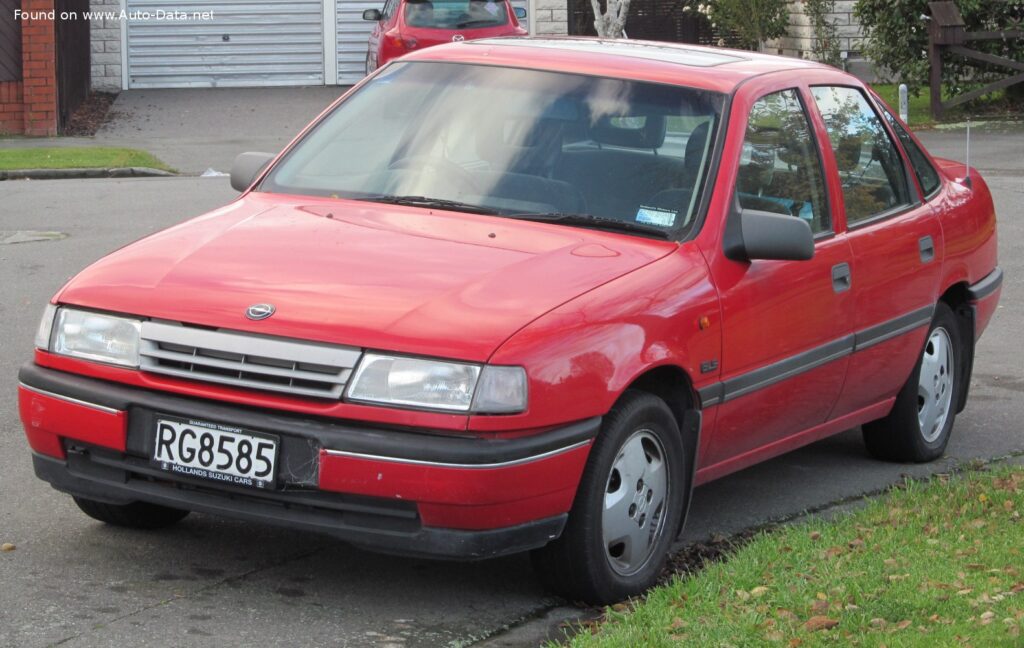
The Opel Vectra A 2.0i (115 Hp) Automatic: A European Mainstay (1988-1989)
The Opel Vectra A, introduced in 1988, marked a significant departure for the German automaker in the fiercely competitive European mid-size family car segment. Replacing the venerable Ascona, the first-generation Opel Vectra A (known as the Vauxhall Cavalier in the UK) ushered in a new era of aerodynamic design, improved safety, and modern powertrains for Opel. This particular variant, the 2.0i (115 Hp) Automatic, represented a popular choice for buyers seeking a blend of dependable performance, comfort, and the convenience of an automatic transmission. Produced between 1988 and 1989, this early iteration of the Vectra A quickly established itself as a strong contender against its rivals, becoming a common sight on European roads and a testament to Opel’s engineering prowess during that period. While never officially sold in the United States, the Vectra A’s influence and technological advancements were indicative of global automotive trends, offering a glimpse into European automotive engineering of the late 1980s.
Engine and Performance: The Heart of the Opel Vectra A
Powertrain Architecture and Engine Specifications
At the core of the Opel Vectra A 2.0i (115 Hp) Automatic lies a robust 2.0-liter (1998 cm3 or 121.93 cu. in.) naturally aspirated inline-four engine, designated with the code 20NE. This powerplant was mounted in a front, transverse layout, driving the front wheels – a common and efficient architecture for family sedans of its era. The engine featured a single overhead camshaft (OHC) valvetrain with two valves per cylinder, a configuration known for its simplicity and reliability. Fuel delivery was handled by a multi-port manifold injection system, a modern touch for 1988 that contributed to better fuel atomization and efficiency compared to older carburetor systems. With a compression ratio of 9.2:1, the engine was designed to run on standard gasoline.
The 2.0i engine produced a respectable 115 horsepower (Hp) at 5200 revolutions per minute (rpm), translating to a power output of 57.6 Hp per liter. Torque figures stood at 170 Newton-meters (Nm), or 125.39 lb.-ft., available at a relatively low 2600 rpm. This low-end torque characteristic made the vehicle feel responsive in everyday driving conditions, particularly when paired with an automatic transmission. The engine’s oil capacity was 4 liters (4.23 US quarts), and it required 7 liters (7.4 US quarts) of coolant, indicating a well-engineered cooling system for sustained operation.
Driving Dynamics and Fuel Economy
Power was transmitted to the front wheels via a 4-speed automatic transmission. While modern automatic transmissions boast more gears, a 4-speed unit was standard for a mid-range family car in 1988, offering a smooth and convenient driving experience, albeit with a slight compromise on ultimate performance and fuel efficiency compared to a manual gearbox. The Vectra A 2.0i Automatic could accelerate from 0 to 60 mph in a computed 11.4 seconds (or 0-62 mph in 12 seconds), and reach a maximum speed of 130.49 mph (210 km/h). These figures placed it competitively within its segment, offering adequate performance for highway cruising and overtaking.
Fuel economy, a significant consideration for European buyers, was rated at 31.4 US mpg combined (7.5 l/100 km). Urban driving yielded 21.8 US mpg (10.8 l/100 km), while extra-urban (highway) driving improved significantly to 39.2 US mpg (6 l/100 km). These numbers were quite respectable for a 2.0-liter sedan with an automatic transmission in the late 1980s, reflecting Opel’s efforts in engine efficiency. The car’s weight-to-power ratio was 9.8
