
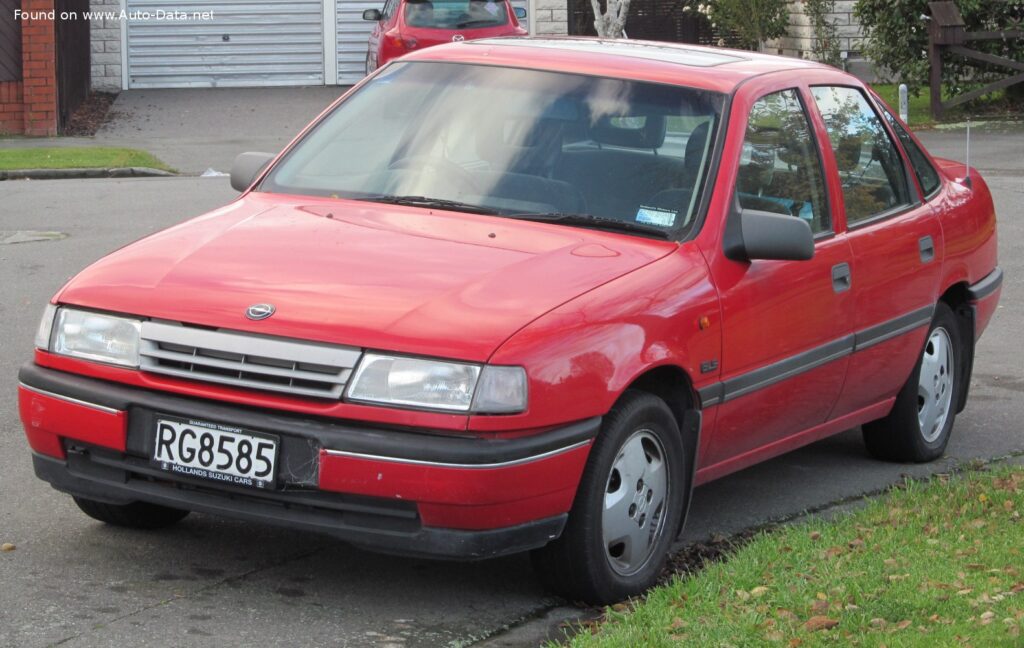
The Opel Vectra A 2.0i 16V: A European Mid-Size Contender
The Opel Vectra A, introduced in 1988, marked a significant evolution for Opel in the highly competitive European mid-size segment. Replacing the venerable Ascona, the Vectra A brought a more modern design, improved aerodynamics, and a range of new engines to the market. While never officially sold in the United States under the Opel badge, the Vectra A played a crucial role for General Motors’ European operations, serving as a platform that would eventually influence models sold globally. The specific variant, the Opel Vectra A 2.0i 16V with 150 horsepower, stood out as a performance-oriented option within the lineup, offering a blend of practicality and spirited driving dynamics characteristic of its era. Produced for a brief period between 1988 and 1989 in this initial high-performance configuration, it represented Opel’s commitment to offering advanced technology in its mainstream vehicles.
Engine & Performance: The Potent 2.0i 16V in the Opel Vectra A
At the heart of the performance-focused Opel Vectra A was the 2.0-liter 16-valve inline-four engine, designated by the code 20XEJ. This naturally aspirated powerplant was a marvel of engineering for its time, especially for a family sedan. Featuring a Double Overhead Camshaft (DOHC) valvetrain and multi-port manifold injection, it was designed for both efficiency and power delivery across the rev range. The engine produced a robust 150 horsepower at 6000 rpm, translating to an impressive 75.1 horsepower per liter, a strong figure for a non-turbocharged engine from the late 1980s. Torque output was equally competitive, peaking at 144.56 lb-ft (196 Nm) at 4600 rpm, ensuring responsive acceleration and ample passing power.
Power was delivered to the front wheels via a precise 5-speed manual transmission, a standard setup for performance-oriented sedans of the era. This combination allowed the Vectra A 2.0i 16V to achieve a 0 to 60 mph acceleration time of a brisk 8.1 seconds, with a top speed reaching 134.84 mph (217 km/h). These figures placed it firmly among the quicker sedans in its class, offering a genuinely engaging driving experience for enthusiasts. Despite its performance capabilities, the engine also demonstrated reasonable fuel economy for its time, with a combined rating of 31.8 US mpg (7.4 l/100 km), showcasing the balance Opel achieved between power and efficiency. The engine’s layout, front and transverse, contributed to the car’s balanced weight distribution and handling characteristics.
Design & Features of the Opel Vectra A
The Opel Vectra A debuted with a sleek, modern design that departed significantly from its predecessor. Its four-door sedan body type was characterized by smooth lines and an aerodynamic profile, boasting an impressive drag coefficient (Cd) of just 0.29. This was a critical factor in both fuel efficiency and high-speed stability, reflecting the growing importance of aerodynamics in automotive design during the late 1980s. The car measured 174.49 inches in length, 67.17 inches in width, and 55.12 inches in height, providing a spacious and comfortable cabin for five occupants.
Inside, the Vectra A offered a practical and well-appointed interior. Its 5-seat configuration and generous trunk space, ranging from 18.72 cubic feet (530 liters) to a maximum of 29.66 cubic feet (840 liters) with the rear seats folded, highlighted its functionality as a family vehicle. Key features for its time included hydraulic power steering, which provided a good balance of assist and road feel, and the availability of ABS (Anti-lock braking system) as an assisting system, a crucial safety innovation that was becoming more common in mainstream vehicles. The suspension system utilized coil springs at both the front and rear, tuned to provide a comfortable ride while maintaining competent handling. Braking power was supplied by ventilated discs at the front and disc brakes at the rear, offering reliable stopping performance for the vehicle’s capabilities. The car rode on 195/60 R15 tires, mounted on 15-inch wheel rims, providing a good balance of grip and ride comfort.
Technical Specifications
| Category | Specification |
|---|---|
| Brand | Opel |
| Model | Vectra A |
| Type (Engine) | 2.0i 16V (150 Hp) |
| Start of Production | 1988 |
| End of Production | 1989 |
| Body Type | Sedan |
| Seats | 5 |
| Doors | 4 |
| Fuel Type | Petrol (Gasoline) |
| Acceleration 0 – 60 mph | 8.1 sec |
| Maximum Speed | 134.84 mph (217 km/h) |
| Fuel Economy – Urban | 22.6 US mpg (10.4 l/100 km) |
| Fuel Economy – Extra Urban | 40.6 US mpg (5.8 l/100 km) |
| Fuel Economy – Combined | 31.8 US mpg (7.4 l/100 km) |
| Power | 150 Hp @ 6000 rpm |
| Torque | 144.56 lb-ft (196 Nm) @ 4600 rpm |
| Engine Layout | Front, Transverse |
| Engine Model/Code | 20XEJ |
| Engine Displacement | 121.93 cu. in. (1998 cm3) |
| Number of Cylinders | 4 |
| Engine Configuration | Inline |
| Cylinder Bore | 3.39 in. (86 mm) |
| Piston Stroke | 3.39 in. (86 mm) |
| Compression Ratio | 10.5:1 |
| Valves per Cylinder | 4 |
| Fuel Injection System | Multi-port manifold injection |
| Engine Aspiration | Naturally aspirated |
| Valvetrain | DOHC |
| Engine Oil Capacity | 4.76 US qt (4.5 l) |
| Coolant Capacity | 7.61 US qt (7.2 l) |
| Kerb Weight | 2678.62 lbs (1215 kg) |
| Max. Weight | 3791.95 lbs (1720 kg) |
| Max Load | 1113.33 lbs (505 kg) |
| Trunk Space (Min) | 18.72 cu. ft. (530 l) |
| Trunk Space (Max) | 29.66 cu. ft. (840 l) |
| Fuel Tank Capacity | 16.11 US gal (61 l) |
| Length | 174.49 in. (4432 mm) |
| Width | 67.17 in. (1706 mm) |
| Height | 55.12 in. (1400 mm) |
| Wheelbase | 102.36 in. (2600 mm) |
| Front Track | 56.57 in. (1437 mm) |
| Rear Track | 56.38 in. (1432 mm) |
| Drag Coefficient (Cd) | 0.29 |
| Drivetrain Architecture | Front-wheel drive, Internal Combustion Engine |
| Drive Wheel | Front-wheel drive |
| Gearbox | 5 gears, manual transmission |
| Front Suspension | Coil spring |
| Rear Suspension | Coil spring |
| Front Brakes | Ventilated discs |
| Rear Brakes | Disc |
| Assisting Systems | ABS (Anti-lock braking system) |
| Power Steering | Hydraulic Steering |
| Tires Size | 195/60 R15 |
| Wheel Rims Size | 15 inches |
Legacy & Market Impact of the Opel Vectra A
The Opel Vectra A, particularly its potent 2.0i 16V variant, carved out a significant niche in the European automotive landscape. As a direct successor to the Opel Ascona, it faced stiff competition from well-established rivals such as the Ford Sierra, Volkswagen Passat, Renault 21, and Peugeot 405. In this highly contested segment, the Vectra A distinguished itself with its modern styling, impressive aerodynamics, and a range of efficient yet powerful engines. The 150-horsepower 16-valve model, in particular, offered a compelling blend of performance and practicality that resonated with buyers looking for a more engaging driving experience without sacrificing everyday usability.
Its robust chassis, combined with the sophisticated 16-valve engine, earned the Vectra A a reputation for solid handling and reliable performance. This model helped solidify Opel’s position as a key player in the European mid-size sector, demonstrating the brand’s capability to integrate advanced technology into mass-market vehicles. The Vectra A’s success laid the groundwork for future generations of Opel’s mid-size offerings and contributed significantly to General Motors’ overall market presence in Europe. While not a household name in the US, its influence on global GM platforms and engineering practices was notable. The car’s strong sales performance throughout its production run cemented its place as a popular choice for European families and business users alike, becoming a ubiquitous sight on European roads. Its legacy continues as a testament to Opel’s engineering prowess during a period of rapid automotive innovation.
