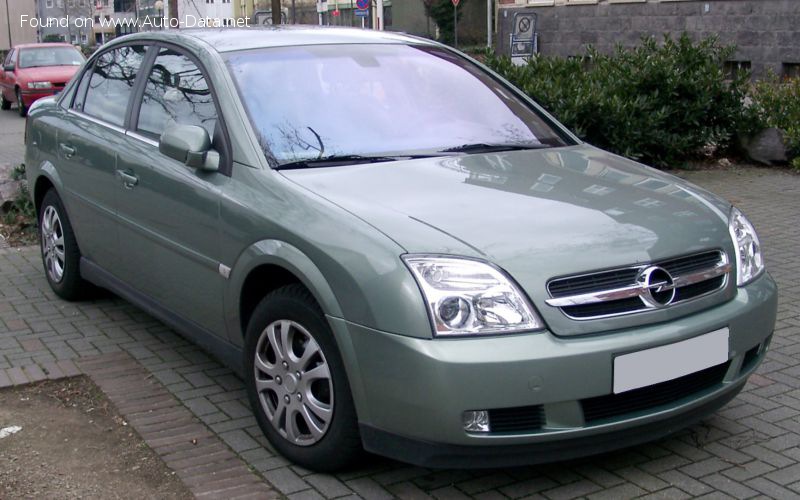
The Opel Vectra C CC 2.2i 16V DIRECT (155 Hp) represents a significant iteration within the third generation of Opel’s mid-size family car line, the Vectra C. Launched in January 2004 and produced through 2005, this specific model, with its “CC” designation, signified a five-door hatchback variant, offering a blend of sedan-like sophistication with enhanced practicality. The Vectra C generation itself debuted in 2002, building upon the success of its predecessors by offering a larger, more refined, and technologically advanced package. In its primary European market, the Vectra C competed in the fiercely contested D-segment, challenging rivals with its robust engineering, comfortable ride, and a range of efficient powertrains. The 2.2i 16V DIRECT engine was a notable offering, particularly for its advanced direct injection technology, a feature that was becoming increasingly prevalent in the early 2000s for optimizing fuel efficiency and performance. While the Opel brand was not directly sold in the United States during this period, General Motors, its parent company, often shared platforms and technologies across its global brands. The Vectra C, for instance, shared its Epsilon platform with vehicles such as the Saab 9-3 and the Chevrolet Malibu, demonstrating a concerted effort by GM to leverage global engineering expertise. This particular Opel Vectra C CC 2.2i 16V DIRECT (155 Hp) model aimed to provide a compelling option for European families and business users seeking a versatile vehicle that combined driving dynamics with everyday usability, underscored by its direct-injected gasoline engine and spacious hatchback configuration.
Engine and Performance of the Opel Vectra C CC 2.2i 16V DIRECT (155 Hp)
At the heart of the Opel Vectra C CC 2.2i 16V DIRECT (155 Hp) lies the Z22YH engine, a 2.2-liter (2198 cm3 or 134.13 cu. in.) inline four-cylinder powerplant that was advanced for its time, particularly due to its direct injection fuel system. This technology, where gasoline is injected directly into the combustion chamber rather than the intake manifold, allowed for more precise fuel delivery and improved combustion efficiency. The result was a better balance between power output and fuel economy, a critical consideration in the European market. The engine generates a respectable 155 horsepower at 5600 rpm, providing ample motivation for a vehicle of its size. Torque figures stand at 220 Nm, translating to 162.26 lb.-ft., delivered at a relatively accessible 3800 rpm. This broad torque band contributes to good drivability and responsiveness in various driving conditions, from city commuting to confident highway cruising.
Mated to a standard 5-speed manual transmission, the powertrain architecture employs a front, transverse engine layout, driving the front wheels. This conventional front-wheel-drive setup is characteristic of most family cars in its segment, offering predictable handling and efficient packaging. Performance metrics for the Opel Vectra C CC 2.2i 16V DIRECT are quite competitive for a non-performance-oriented family hatchback of its era. It can accelerate from 0 to 60 mph in a brisk 9.1 seconds, while the 0 to 100 km/h sprint is completed in 9.6 seconds. The vehicle boasts a maximum speed of 135.46 mph (218 km/h), making it well-suited for sustained highway speeds prevalent on European autobahns. Fuel efficiency was a key selling point for direct injection engines, and this Vectra delivers a combined fuel economy of 30.5 US mpg (7.7 l/100 km). Urban consumption is rated at 22.8 US mpg (10.3 l/100 km), while extra-urban driving yields an impressive 37.9 US mpg (6.2 l/100 km). These figures highlight the engine’s ability to balance performance with economic operation, making it an attractive choice for daily use. The high compression ratio of 12:1 further underscores the engine’s design for efficiency, extracting maximum energy from each combustion cycle. With a kerb weight of 3240.8 lbs. (1470 kg), the power-to-weight ratio stands at 105.4 Hp per tonne, contributing to its agile feel and capable performance across varied driving scenarios.
Design and Features of the Opel Vectra C CC
The Opel Vectra C CC, identified by its “CC” (Caravan Coupé) designation for the five-door hatchback, presented a visually distinct and highly practical body style within the Vectra C lineup. Unlike the traditional sedan, the hatchback offered significantly enhanced versatility, appealing to buyers who required greater cargo flexibility without opting for a full station wagon. With five doors and seating for five occupants, the Vectra C CC was designed as a capable family transporter. Its exterior dimensions – a length of 180.94 inches (4596 mm), a width of 70.79 inches (1798 mm) (or 80.16 inches / 2036 mm including mirrors), and a height of 57.48 inches (1460 mm) – positioned it firmly in the mid-size segment. The substantial wheelbase of 106.3 inches (2700 mm) provided a stable ride and contributed to a spacious interior, ensuring comfort for all passengers during both short commutes and