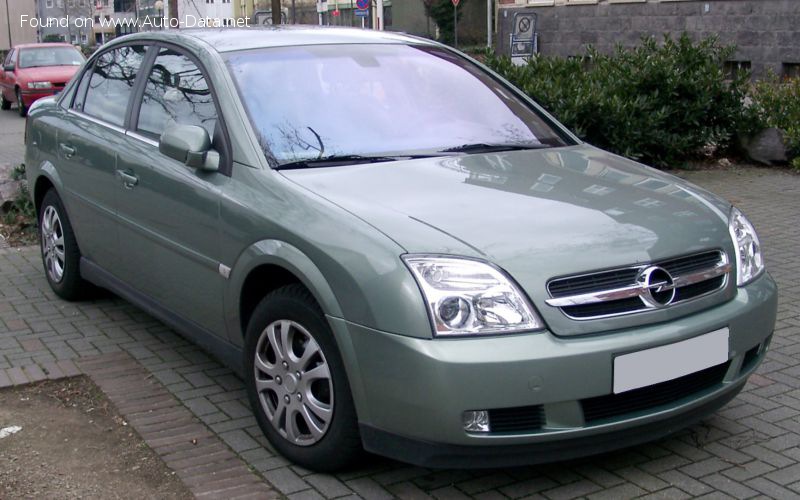
The Opel Vectra C CC 3.0 CDTI (177 Hp) represents a significant offering from General Motors’ European division during the mid-2000s, specifically from July 2003 to June 2005. As part of the third generation (Vectra C) of Opel’s popular mid-size family car, this particular variant distinguished itself with a powerful and efficient V6 common-rail diesel engine, combined with a five-door hatchback body style. While the Opel brand, and consequently the Vectra, was not directly sold in the United States, it served as a cornerstone of the European market, competing fiercely against rivals such as the Ford Mondeo, Volkswagen Passat, and Renault Laguna. The “CC” designation, often interpreted as “Caravan Coupé” in Opel’s nomenclature, denoted a sleek, fastback-like profile that offered the practicality of a hatchback with a more dynamic aesthetic, aiming to broaden its appeal beyond traditional sedan and wagon offerings. This generation of Vectra was designed to blend comfort, safety, and modern technology, making the 3.0 CDTI a compelling choice for consumers seeking robust performance coupled with diesel fuel economy in a versatile package.
Engine & Performance: The Opel Vectra C CC 3.0 CDTI (177 Hp) Powertrain
At the heart of the Opel Vectra C CC 3.0 CDTI (177 Hp) lies a sophisticated 3.0-liter V6 turbodiesel engine, identified by the internal code Y30DT. This powerplant, a testament to the advancements in diesel technology of its era, featured a DOHC (Double Overhead Camshaft) valvetrain with four valves per cylinder, ensuring efficient breathing and combustion. The engine utilized a common rail direct injection system, which precisely controls fuel delivery to each cylinder, optimizing both power output and fuel efficiency. Further enhancing its performance was a turbocharger coupled with an intercooler, which boosted air intake and consequently, power, across a wide RPM range.
The engine delivered a robust 177 horsepower at 4000 rpm, translating to a specific output of 59.8 horsepower per liter. More impressively, it produced a substantial 272.9 lb.-ft. of torque, available from a low 1900 rpm. This ample torque at low engine speeds was a hallmark of modern diesel engines, providing excellent drivability and effortless acceleration in everyday conditions. Mated to a precise 6-speed manual transmission, the front-wheel-drive architecture of the Vectra C CC allowed for efficient power transfer to the road.
In terms of pure performance, the Opel Vectra C CC 3.0 CDTI was capable of accelerating from 0 to 60 mph in a respectable 8.8 seconds, with 0 to 100 km/h achieved in 9.3 seconds. Its top speed was rated at 140.43 mph (226 km/h), making it a capable performer on European highways. Despite its strong performance, fuel economy remained a key advantage of this diesel variant. The combined fuel consumption was an impressive 33.1 US mpg (7.1 l/100 km), with extra-urban driving achieving an even more remarkable 42.8 US mpg (5.5 l/100 km). Even in urban environments, it managed 23.8 US mpg (9.9 l/100 km). These figures underscored the diesel engine’s inherent efficiency, offering a compelling balance between dynamic driving and economical operation for its segment and time. The vehicle’s weight-to-power ratio stood at 9.3 kg/Hp, or 107.3 Hp/tonne, further illustrating its balanced engineering.
Design & Features: Practicality and European Elegance
The Opel Vectra C CC 3.0 CDTI (177 Hp) was characterized by its distinctive five-door hatchback body type, a practical choice for European families and individuals who valued cargo flexibility without sacrificing a sleek profile. Measuring 180.94 inches (4596 mm) in length, 70.79 inches (1798 mm) in width (80.16 inches or 2036 mm including mirrors), and 57.48 inches (1460 mm) in height, the Vectra C CC presented a substantial yet elegant stance on the road. Its 106.3-inch (2700 mm) wheelbase contributed to a stable ride and generous interior space for its five occupants.
The design philosophy behind the Vectra C generation aimed for a blend of modern aesthetics and functional practicality. The “CC” variant, in particular, offered a more dynamic roofline compared to the traditional sedan, culminating in a large rear hatch that provided excellent access to the cargo area. The trunk (boot) space was highly versatile, offering a minimum of 17.66 cubic feet (500 liters) with the rear seats in place, which could expand significantly to 48.03 cubic feet (1360 liters) when the rear seats were folded down. This adaptability made the Vectra C CC an ideal vehicle for everything from daily commutes to family vacations, capable of accommodating substantial luggage or sports equipment.
Inside, the Vectra C CC was designed with comfort and ergonomics in mind, featuring seating for five passengers. The car’s robust chassis was complemented by a suspension system that utilized spring struts at the front and a multi-link setup with several levers and rods at the rear. This configuration was engineered to provide a comfortable ride quality while maintaining competent handling characteristics, a crucial aspect for European roads which often feature a mix of smooth highways and winding country lanes. Safety features for the era included an Anti-lock Braking System (ABS) as standard, enhancing control during emergency braking. The braking system itself consisted of ventilated discs at the front and solid discs at the rear, ensuring strong and consistent stopping power. The steering system was a responsive rack and pinion type, offering precise control. The vehicle rode on 215/55 R16 tires mounted on 6.5J x 16 wheel rims, a common and practical size that offered a good balance of grip, comfort, and tire availability. With a fuel tank capacity of 16.11 US gallons (61 liters), the Vectra C CC 3.0 CDTI offered a considerable cruising range, further cementing its credentials as a capable long-distance cruiser.
Technical Specifications
| Brand | Opel |
| Model | Vectra |
| Generation | Vectra C CC |
| Type (Engine) | 3.0 CDTI (177 Hp) |
| Start of production | July, 2003 year |
| End of production | June, 2005 year |
| Powertrain Architecture | Internal Combustion engine |
| Body type | Hatchback |
| Seats | 5 |
| Doors | 5 |
| Fuel consumption (economy) – urban | 9.9 l/100 km (23.8 US mpg) |
| Fuel consumption (economy) – extra urban | 5.5 l/100 km (42.8 US mpg) |
| Fuel consumption (economy) – combined | 7.1 l/100 km (33.1 US mpg) |
| Fuel Type | Diesel |
| Acceleration 0 – 60 mph | 8.8 sec |
| Acceleration 0 – 100 km/h | 9.3 sec |
| Maximum speed | 226 km/h (140.43 mph) |
| Weight-to-power ratio | 9.3 kg/Hp (107.3 Hp/tonne) |
| Weight-to-torque ratio | 4.5 kg/Nm (224.2 Nm/tonne) |
| Power | 177 Hp @ 4000 rpm |
| Power per litre | 59.8 Hp/l |
| Torque | 370 Nm @ 1900 rpm (272.9 lb.-ft. @ 1900 rpm) |
| Engine layout | Front, Transverse |
| Engine Model/Code | Y30DT |
| Engine displacement | 2958 cm3 (180.51 cu. in.) |
| Number of cylinders | 6 |
| Engine configuration | V-engine |
| Cylinder Bore | 87.5 mm (3.44 in.) |
| Piston Stroke | 82 mm (3.23 in.) |
| Compression ratio | 18.5:1 |
| Number of valves per cylinder | 4 |
| Fuel injection system | Diesel Commonrail |
| Engine aspiration | Turbocharger, Intercooler |
| Valvetrain | DOHC |
| Engine oil capacity | 7.25 l (7.66 US qt) |
| Coolant | 8.3 l (8.77 US qt) |
| Kerb Weight | 1650 kg (3637.63 lbs) |
| Max. weight | 2125 kg (4684.82 lbs) |
| Max load | 475 kg (1047.2 lbs) |
| Trunk (boot) space – minimum | 500 l (17.66 cu. ft.) |
| Trunk (boot) space – maximum | 1360 l (48.03 cu. ft.) |
| Fuel tank capacity | 61 l (16.11 US gal) |
| Length | 4596 mm (180.94 in.) |
| Width | 1798 mm (70.79 in.) |
| Width including mirrors | 2036 mm (80.16 in.) |
| Height | 1460 mm (57.48 in.) |
| Wheelbase | 2700 mm (106.3 in.) |
| Front track | 1523 mm (59.96 in.) |
| Rear (Back) track | 1513 mm (59.57 in.) |
| Front overhang | 905 mm (35.63 in.) |
| Rear overhang | 991 mm (39.02 in.) |
| Drivetrain Architecture | The Internal combustion engine (ICE) drives the front wheels of the vehicle. |
| Drive wheel | Front wheel drive |
| Number of gears and type of gearbox | 6 gears, manual transmission |
| Front suspension | Spring Strut |
| Rear suspension | Several levers and rods |
| Front brakes | Ventilated discs |
| Rear brakes | Disc |
| Assisting systems | ABS (Anti-lock braking system) |
| Steering type | Steering rack and pinion |
| Tires size | 215/55 R16 |
| Wheel rims size | 6.5J x 16 |