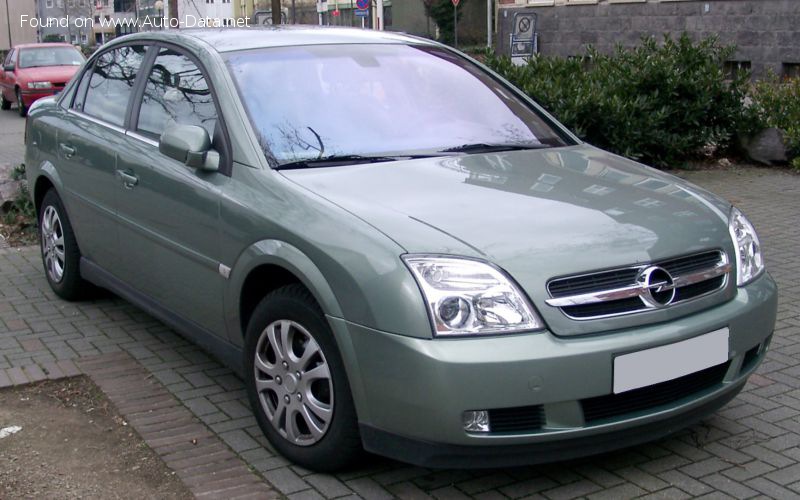
The Opel Vectra C CC 3.2i V6 ECOTEC (211 Hp) represents a significant offering from the German automaker Opel within the European D-segment, or mid-size class, during its production run from January 2004 to June 2005. As a key model for General Motors’ European operations, the Vectra C generation sought to combine refined driving dynamics with practical versatility, targeting a broad audience ranging from families to business users. This particular variant, designated as a “CC” (Caravan Coupe), distinguished itself with a sleek five-door hatchback body style that offered a more dynamic profile than its sedan counterpart while retaining considerable cargo flexibility. While Opel vehicles were not directly sold in the United States under their original branding, the Vectra’s underlying engineering often found its way into North American models, making its technical specifications and design philosophy relevant to a broader automotive understanding. This iteration, powered by a robust 3.2-liter V6 engine, positioned itself as a performance-oriented option within the Vectra lineup, balancing spirited acceleration with the practical demands of daily European motoring.
Powertrain and Performance: The Opel Vectra C CC 3.2i V6 ECOTEC (211 Hp) Experience
At the heart of the Opel Vectra C CC 3.2i V6 ECOTEC (211 Hp) lies its formidable 3.2-liter V6 engine, a naturally aspirated powerplant engineered for a balance of power, efficiency, and refinement. Bearing the “ECOTEC” designation, this engine, identified by the Z32SE code, reflected Opel’s commitment to optimized combustion and reduced emissions for its era. With an engine displacement of 3175 cubic centimeters (193.75 cubic inches), this V-engine configuration features six cylinders and a sophisticated DOHC (Double Overhead Camshaft) valvetrain with four valves per cylinder, ensuring efficient gas flow for responsive performance. The multi-port manifold injection system precisely meters fuel, contributing to both power output and fuel economy.
The engine delivers a peak power output of 211 horsepower at 6200 rpm, translating to a specific power output of 66.5 horsepower per liter. This substantial power is complemented by a robust torque figure of 221.27 pound-feet (300 Nm) available at a relatively accessible 4000 rpm, providing strong mid-range acceleration. The power and torque characteristics contribute to the vehicle’s impressive straight-line performance for its class and time. The Vectra C CC 3.2i V6 ECOTEC can accelerate from 0 to 60 miles per hour in a brisk 7.1 seconds (0-100 km/h in 7.5 seconds), making it a capable performer on highways and for overtaking maneuvers. Its maximum speed is rated at 154.1 mph (248 km/h).
Power is delivered to the front wheels via a five-speed manual transmission, a choice that emphasizes driver engagement and allows for precise control over the engine’s output. The powertrain architecture, with the internal combustion engine driving the front wheels, is a common and efficient layout for this segment, offering predictable handling characteristics. Despite its performance credentials, the ECOTEC engine also aimed for reasonable fuel economy. The combined cycle fuel consumption is rated at 24 US mpg (9.8 l/100 km), with extra-urban driving achieving 32.2 US mpg (7.3 l/100 km), and urban driving at 16.8 US mpg (14 l/100 km). These figures, while not groundbreaking by modern standards, were competitive for a powerful V6 engine in a mid-size car of its generation, showcasing the balance Opel sought between performance and everyday usability.
Design and Ergonomics
The Opel Vectra C CC, while designated as a hatchback, presented a distinctive design within the Vectra C lineup. Its “Caravan Coupe” moniker hinted at a sportier, more flowing roofline compared to a traditional sedan or wagon, blending the practicality of a five-door body with a more dynamic aesthetic. Measuring 180.94 inches (4596 mm) in length, 70.79 inches (1798 mm) in width (80.16 inches or 2036 mm including mirrors), and 57.48 inches (1460 mm) in height, the Vectra C CC possessed a substantial road presence. The generous wheelbase of 106.3 inches (2700 mm) was a key factor in providing a stable ride and a spacious cabin, accommodating five occupants comfortably across two rows of seating.
The interior design focused on functionality and comfort, typical of European mid-size vehicles. The five-door configuration ensured easy access for both passengers and cargo. A standout feature of the hatchback body was its impressive cargo capacity. The trunk (boot) offered a minimum volume of 17.66 cubic feet (500 liters) with all seats in place, making it highly practical for daily errands or luggage for a family trip. When the rear seats were folded, the cargo volume expanded significantly to a cavernous 48.03 cubic feet (1360 liters), allowing for the transport of larger items, a testament to its versatility. This flexibility was a major selling point in markets where a single vehicle often served multiple purposes.
In terms of safety, the Vectra C CC 3.2i V6 ECOTEC (211 Hp) was equipped with standard features for its time, including an Anti-lock Braking System (ABS) to prevent wheel lock-up during hard braking, enhancing control and reducing stopping distances. The overall design reflected a blend of Opel’s contemporary styling cues, emphasizing clean lines and a purposeful stance, making it an attractive option for consumers seeking a vehicle that was both engaging to drive and eminently practical.
Engineering and Chassis Dynamics
The chassis of the Opel Vectra C CC 3.2i V6 ECOTEC (211 Hp) was engineered to provide a balanced driving experience, combining comfort for long journeys with confident handling. The front suspension utilized a proven spring strut design, a common choice for front-wheel-drive vehicles due to its compact nature and effective damping characteristics. At the rear, the vehicle employed a more sophisticated multi-link suspension system, featuring several levers and rods. This independent rear suspension setup was crucial for enhancing ride comfort, improving wheel articulation, and providing superior road holding, especially when navigating uneven surfaces or during dynamic maneuvers. This advanced rear suspension contributed significantly to the Vectra C’s reputation for refined ride quality and stable handling.
Braking performance was handled by a robust system designed to match the vehicle’s performance capabilities. The front wheels were equipped with ventilated disc brakes, which offer superior heat dissipation and consistent braking power under demanding conditions. The rear wheels featured solid disc brakes, providing ample stopping force and contributing to the overall stability of the braking system, especially in conjunction with the standard ABS. The steering system utilized a rack and pinion setup, offering precise and direct feedback to the driver, which is essential for a vehicle of this size and performance potential.
The vehicle rode on tires sized 215/55 R16, mounted on 6.5J x 16-inch wheel rims. This tire and wheel combination provided a good balance between grip, ride comfort, and aesthetic appeal. The kerb weight of the Vectra C CC 3.2i V6 ECOTEC stood at 3207.73 pounds (1455 kg), contributing to a favorable weight-to-power ratio of 6.9 kg per horsepower (145 Hp/tonne). The maximum permissible weight was 4464.36 pounds (2025 kg), allowing for a maximum load of 1256.63 pounds (570 kg). The fuel tank capacity was 16.11 US gallons (61 liters), providing a decent cruising range. These engineering choices underscored Opel’s commitment to delivering a well-rounded and capable vehicle that could handle diverse driving conditions across Europe.
Technical Specifications
| Brand | Opel |
| Model | Vectra |
| Generation | Vectra C CC |
| Type (Engine) | 3.2i V6 ECOTEC (211 Hp) |
| Start of production | January, 2004 year |
| End of production | June, 2005 year |
| Powertrain Architecture | Internal Combustion engine |
| Body type | Hatchback |
| Seats | 5 |
| Doors | 5 |
| Fuel consumption (economy) – urban | 14 l/100 km / 16.8 US mpg |
| Fuel consumption (economy) – extra urban | 7.3 l/100 km / 32.2 US mpg |
| Fuel consumption (economy) – combined | 9.8 l/100 km / 24 US mpg |
| Fuel Type | Petrol (Gasoline) |
| Acceleration 0 – 100 km/h | 7.5 sec |
| Acceleration 0 – 60 mph | 7.1 sec |
| Maximum speed | 248 km/h / 154.1 mph |
| Weight-to-power ratio | 6.9 kg/Hp, 145 Hp/tonne |
| Weight-to-torque ratio | 4.9 kg/Nm, 206.2 Nm/tonne |
| Power | 211 Hp @ 6200 rpm. |
| Power per litre | 66.5 Hp/l |
| Torque | 300 Nm @ 4000 rpm. / 221.27 lb.-ft. @ 4000 rpm. |
| Engine layout | Front, Transverse |
| Engine Model/Code | Z32SE |
| Engine displacement | 3175 cm3 / 193.75 cu. in. |
| Number of cylinders | 6 |
| Engine configuration | V-engine |
| Cylinder Bore | 87.5 mm / 3.44 in. |
| Piston Stroke | 88 mm / 3.46 in. |
| Compression ratio | 10:1 |
| Number of valves per cylinder | 4 |
| Fuel injection system | Multi-port manifold injection |
| Engine aspiration | Naturally aspirated engine |
| Valvetrain | DOHC |
| Engine oil capacity | 4.75 l / 5.02 US qt |
| Coolant | 6.9 l / 7.29 US qt |
| Kerb Weight | 1455 kg / 3207.73 lbs. |
| Max. weight | 2025 kg / 4464.36 lbs. |
| Max load | 570 kg / 1256.63 lbs. |
| Trunk (boot) space – minimum | 500 l / 17.66 cu. ft. |
| Trunk (boot) space – maximum | 1360 l / 48.03 cu. ft. |
| Fuel tank capacity | 61 l / 16.11 US gal |
| Length | 4596 mm / 180.94 in. |
| Width | 1798 mm / 70.79 in. |
| Width including mirrors | 2036 mm / 80.16 in. |
| Height | 1460 mm / 57.48 in. |
| Wheelbase | 2700 mm / 106.3 in. |
| Front track | 1523 mm / 59.96 in. |
| Rear (Back) track | 1512 mm / 59.53 in. |
| Front overhang | 905 mm / 35.63 in. |
| Rear overhang | 991 mm / 39.02 in. |
| Drivetrain Architecture | The Internal combustion engine (ICE) drives the front wheels of the vehicle. |
| Drive wheel | Front wheel drive |
| Number of gears and type of gearbox | 5 gears, manual transmission |
| Front suspension | Spring Strut |
| Rear suspension | Several levers and rods |
| Front brakes | Ventilated discs |
| Rear brakes | Disc |
| Assisting systems | ABS (Anti-lock braking system) |
| Steering type | Steering rack and pinion |
| Tires size | 215/55 R16 |
| Wheel rims size | 6.5J x 16 |