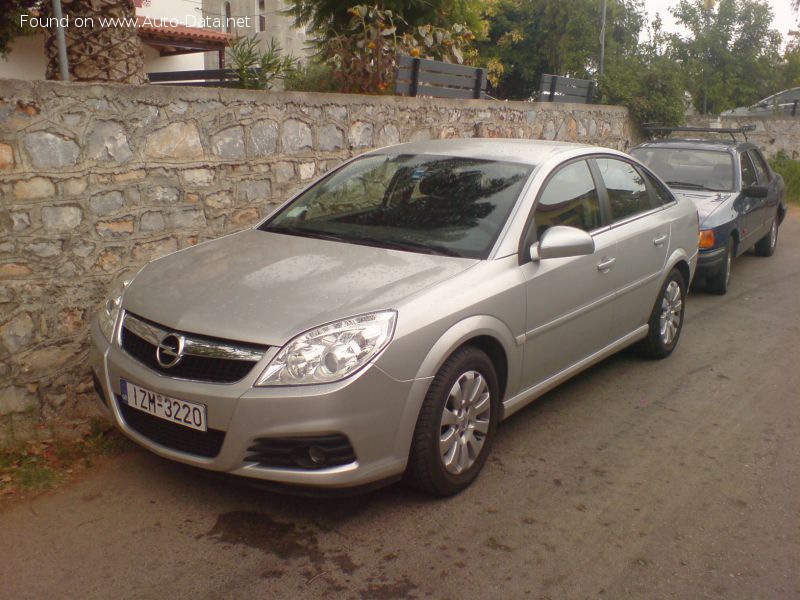
The Opel Vectra C CC (facelift 2005) 1.6i 16V (105 Hp) represents a significant iteration of Opel’s mid-size vehicle offering, primarily targeted at the discerning European market. As a brand under the General Motors umbrella during this period, Opel served as GM’s mainstream European division, known for producing reliable, practical, and well-engineered cars designed to compete in the highly competitive D-segment. This particular model, a facelifted variant of the third-generation Vectra C, was introduced in November 2005 and remained in production until August 2008. The “CC” designation, while sometimes implying “Caravan Coupe” in other Opel contexts, refers here to its 5-door hatchback body style, offering a blend of sedan-like comfort with enhanced practicality. Though not officially sold in the United States, the Vectra C shared underlying platforms and technologies with several global GM products, reflecting a period of significant international collaboration within the corporation. This specific 1.6-liter, 16-valve variant was positioned as an economical yet capable option within the Vectra lineup, designed to appeal to buyers seeking a balance of fuel efficiency, adequate performance, and family-friendly utility in a stylish package.
Engine and Performance: The Opel Vectra C CC 1.6i 16V (105 Hp)
At the heart of the Opel Vectra C CC 1.6i 16V (105 Hp) lies a robust and efficient naturally aspirated four-cylinder engine, designated with the internal code Z16XEP. This inline engine features a displacement of 1,598 cubic centimeters, or approximately 97.52 cubic inches, highlighting its design for balanced performance and economy. Equipped with a double overhead camshaft (DOHC) valvetrain and four valves per cylinder, the engine is engineered for optimized airflow and combustion efficiency, a common characteristic of modern Opel powertrains from this era. Fuel delivery is managed by a multi-port manifold injection system, ensuring precise fuel atomization and mixture control for consistent power output and reduced emissions.
The Z16XEP engine generates a respectable 105 horsepower at a peak of 6,000 revolutions per minute. This power output translates to 65.7 horsepower per liter, indicating a well-tuned naturally aspirated unit. Torque delivery is equally important for everyday drivability, and this engine provides 150 Newton-meters, which converts to a solid 110.63 pound-feet of torque, available at 3,900 rpm. This relatively low peak torque rpm suggests good mid-range responsiveness, making the vehicle feel competent in urban driving and highway cruising alike, even with its modest power figures.
Performance metrics for the 1.6i 16V variant position it as a practical rather than a performance-oriented choice. The Opel Vectra C CC accelerates from 0 to 60 miles per hour in an estimated 12 seconds, or 0 to 62 mph (100 km/h) in 12.6 seconds. While not blistering, this acceleration is perfectly adequate for merging onto highways and overtaking in typical European driving conditions. The maximum speed attainable is 120.55 miles per hour (194 km/h), demonstrating its capability for sustained high-speed travel on autobahns or similar roadways.
Fuel efficiency was a key consideration for this model, especially in markets where fuel prices are higher than in the U.S. The Opel Vectra C CC achieved notable fuel economy figures: an urban consumption of 25.8 US mpg (9.1 liters per 100 km), an impressive extra-urban consumption of 42.8 US mpg (5.5 liters per 100 km), and a combined cycle rating of 34.6 US mpg (6.8 liters per 100 km). These figures underscore the engine’s efficiency, making it an economical choice for daily commuting and longer journeys. The powertrain architecture is a conventional front-wheel-drive setup, with the engine mounted transversely, sending power through a precise 5-speed manual transmission. This combination offers a direct and engaging driving experience, typical of European family cars, while emphasizing reliability and ease of maintenance.
Design and Features of the Opel Vectra C CC
The Opel Vectra C CC (facelift 2005) presented a contemporary and functional design, characteristic of Opel’s aesthetic language during the mid-2000s. As a 5-door hatchback, it expertly blended the sleek lines often associated with sedans with the practical utility of a wagon. The facelift introduced subtle yet effective updates to the exterior styling, typically involving revised front fascias, grilles, headlamps, and taillights, giving the car a fresher and more modern appearance that aligned with Opel’s evolving design identity. Its overall dimensions – a length of 181.54 inches, a width of 70.79 inches (80.16 inches including mirrors), and a height of 57.48 inches – placed it firmly within the competitive D-segment, offering ample interior space for five occupants.
The interior of the Vectra C CC was designed with comfort and ergonomics in mind, providing a well-appointed cabin suitable for long journeys. With seating for five, the vehicle prioritized passenger space and accessibility, particularly for rear-seat occupants, thanks to its generous 106.3-inch wheelbase. The hatchback body style was a significant advantage in terms of versatility, offering a substantial trunk (boot) space of 17.66 cubic feet (500 liters). This cargo capacity could typically be expanded further by folding down the rear seats, creating a cavernous area suitable for larger items, making it an ideal choice for families, active individuals, or those requiring flexible cargo solutions.
Underneath its practical exterior, the Vectra C CC featured a sophisticated chassis designed to deliver a comfortable yet engaging ride. Both the front and rear suspensions employed independent coil spring setups, providing a refined ride quality by effectively absorbing road imperfections while maintaining composure during dynamic maneuvers. This independent suspension architecture contributed to the car’s stable handling characteristics, enhancing driver confidence. Braking performance was handled by disc brakes on all four wheels, augmented by an Anti-lock Braking System (ABS) as a standard assisting system. ABS was a crucial safety feature for the era, preventing wheel lock-up under hard braking and allowing the driver to maintain steering control, particularly in adverse conditions.
The vehicle rode on 195/65 R15 tires mounted on 15-inch wheel