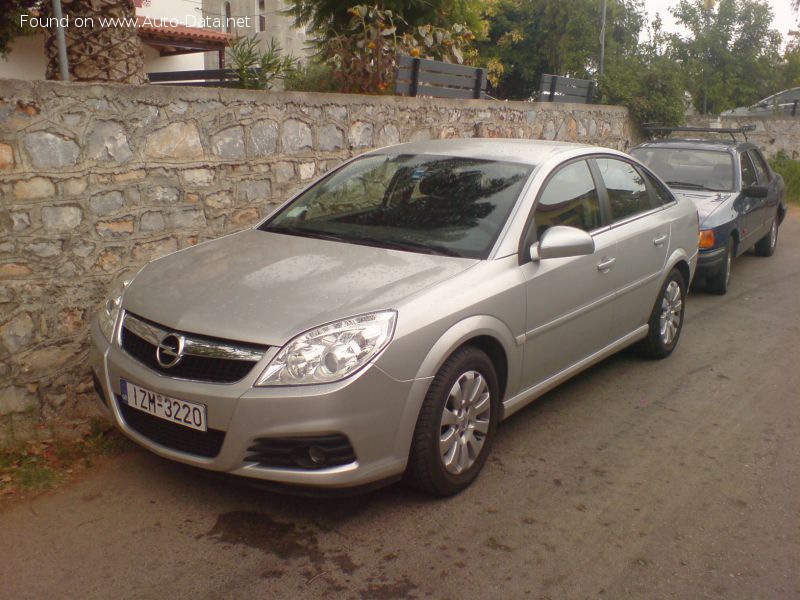
The Opel Vectra C CC (facelift 2005) represents a significant iteration of Opel’s mid-size vehicle offering, primarily targeting the competitive European D-segment. While the Opel brand is not typically retailed in the United States, its vehicles, like the Vectra, have historically served as mainstream family and executive transport across Europe and other international markets, often under different General Motors badges such as Vauxhall in the UK or Holden in Australia. This particular variant, produced from July 2005 to October 2006, is a facelifted model of the third-generation Vectra C, designated as a “CC” or Compact Coupe/Comfort Coupe, which translates to a five-door hatchback body style. The 2.8i V6 24V Turbo (230 Hp) engine specification denotes a potent, performance-oriented version within the Vectra lineup, designed to offer a blend of everyday practicality with engaging driving dynamics. This model was a direct competitor to vehicles like the Ford Mondeo, Volkswagen Passat, and Renault Laguna, aiming to capture buyers seeking a refined yet powerful family car.
Engine and Performance of the Opel Vectra C CC (facelift 2005)
At the heart of this specific Opel Vectra C CC (facelift 2005) variant lies a robust 2.8-liter V6 24V Turbo engine, identified by the internal code Z28NEL. This powertrain architecture utilizes an internal combustion engine, positioned transversely at the front, driving the front wheels. The V6 configuration, with its six cylinders, is inherently balanced, contributing to smoother operation and a refined power delivery characteristic of more premium offerings. With a displacement of 2792 cubic centimeters (170.38 cubic inches), the engine is equipped with a turbocharger and intercooler, a crucial combination that significantly boosts its output compared to naturally aspirated counterparts. The turbocharger forces more air into the engine, allowing for a greater combustion charge, while the intercooler cools this compressed air, increasing its density and preventing premature detonation, thus maximizing efficiency and power.
The engine generates a substantial 230 horsepower at 5500 revolutions per minute, translating to an impressive 82.4 horsepower per liter of displacement. More critically for real-world driving, it delivers a robust 330 Newton-meters (243.4 lb.-ft.) of torque across a broad and accessible rev range, from 1800 to 4500 rpm. This wide torque band ensures strong acceleration and flexible power delivery, making the car responsive in various driving conditions, from city traffic to highway cruising. Power is channeled through a precise 6-speed manual transmission, offering drivers direct control over the engine’s output and enhancing the sporty feel of the vehicle. This combination allows the {original_focus_keyword} to accelerate from 0 to 60 miles per hour in a brisk 6.9 seconds, with a top speed electronically limited to 155.34 mph (250 km/h), firmly placing it in the realm of performance-oriented mid-size cars.
Despite its performance capabilities, Opel engineered this Vectra variant with an eye towards efficiency, relative to its power output. The combined fuel economy is rated at 11.2 liters per 100 kilometers, which translates to approximately 21 US miles per gallon. Urban driving sees a consumption of 15.4 l/100 km (15.3 US mpg), while extra-urban (highway) driving is significantly more economical at 7.3 l/100 km (32.2 US mpg). These figures were competitive for a turbocharged V6 engine in its class during that era. The engine’s specifications include a compression ratio of 9.5:1 and four valves per cylinder, optimizing combustion efficiency. Fuel is delivered via a multi-port manifold injection system. The vehicle’s weight-to-power ratio stands at 6.5 kg per horsepower (153.8 Hp/tonne), and its weight-to-torque ratio is 4.5 kg per Newton-meter (220.7 Nm/tonne), indicating a well-balanced power-to-weight profile for spirited driving.
Design and Features
The Opel Vectra C CC (facelift 2005) adopts a stylish and practical five-door hatchback body, a common and popular choice in European markets for its versatility. While the “CC” designation might suggest a coupe-cabriolet in some contexts, for the Vectra, it signified a distinct liftback/hatchback variant that offered a more dynamic profile compared to the traditional sedan, often marketed as a “Sport Hatch” in some regions. The facelift in 2005 introduced refreshed styling cues, including updated front and rear fascias, lighting elements, and interior refinements, giving the car a more modern and assertive look. Its dimensions are substantial for a mid-size vehicle, with a length of 181.54 inches (4611 mm), a width of 70.79 inches (1798 mm), and a height of 57.48 inches (1460 mm). The generous wheelbase of 106.3 inches (2700 mm) contributes to a stable ride and ample interior space.
Inside, the Vectra C CC provides seating for five occupants, designed with comfort and ergonomics in mind for long journeys. The hatchback design offers excellent cargo flexibility, boasting a maximum trunk (boot) space of 500 liters (17.66 cubic feet), which is highly practical for families and individuals needing to carry bulky items. The fuel tank capacity of 61 liters (16.11 US gallons) ensures a reasonable cruising range. The vehicle’s kerb weight is 3295.91 lbs (1495 kg), with a maximum permissible weight of 4497.43 lbs (2040 kg), allowing for a maximum payload of 1201.52 lbs (545 kg).
From a chassis perspective, the Vectra C CC is equipped with independent coil spring suspension both at the front and rear, a sophisticated setup that provides a good balance between ride comfort and handling precision. Stopping power is managed by ventilated disc brakes on both the front and rear axles, which are superior to solid discs in dissipating heat during heavy use, thus ensuring consistent braking performance. An Anti-lock Braking System (ABS) is a standard assisting system, enhancing safety by preventing wheel lock-up during emergency braking. The car rides on 16-inch wheel rims fitted with 215/55 R16 tires, providing a good compromise between grip, ride comfort, and aesthetic appeal. Overall, the Opel Vectra C CC (facelift 2005) combines a practical hatchback body with a potent engine and a well-engineered chassis, making it a compelling option in its segment for those seeking a blend of performance, space, and European refinement.
Technical Specifications
| Brand | Opel |
| Model | Vectra |
| Generation | Vectra C CC (facelift 2005) |
| Type (Engine) | 2.8i V6 24V Turbo (230 Hp) |
| Start of production | July, 2005 year |
| End of production | October, 2006 year |
| Powertrain Architecture | Internal Combustion engine |
| Body type | Hatchback |
| Seats | 5 |
| Doors | 5 |
| Fuel consumption (economy) – urban | 15.4 l/100 km (15.3 US mpg) |
| Fuel consumption (economy) – extra urban | 7.3 l/100 km (32.2 US mpg) |
| Fuel consumption (economy) – combined | 11.2 l/100 km (21 US mpg) |
| Fuel Type | Petrol (Gasoline) |
| Acceleration 0 – 100 km/h | 7.3 sec |
| Acceleration 0 – 62 mph | 7.3 sec |
| Acceleration 0 – 60 mph (Calculated) | 6.9 sec |
| Maximum speed | 250 km/h (155.34 mph) |
| Weight-to-power ratio | 6.5 kg/Hp (153.8 Hp/tonne) |
| Weight-to-torque ratio | 4.5 kg/Nm (220.7 Nm/tonne) |
| Power | 230 Hp @ 5500 rpm |
| Power per litre | 82.4 Hp/l |
| Torque | 330 Nm @ 1800-4500 rpm (243.4 lb.-ft.) |
| Engine layout | Front, Transverse |
| Engine Model/Code | Z28NEL |
| Engine displacement | 2792 cm3 (170.38 cu. in.) |
| Number of cylinders | 6 |
| Engine configuration | V-engine |
| Cylinder Bore | 89 mm (3.5 in.) |
| Piston Stroke | 74.8 mm (2.94 in.) |
| Compression ratio | 9.5:1 |
| Number of valves per cylinder | 4 |
| Fuel injection system | Multi-port manifold injection |
| Engine aspiration | Turbocharger, Intercooler |
| Engine oil capacity | 6 l (6.34 US qt) |
| Coolant | 7.5 l (7.93 US qt) |
| Kerb Weight | 1495 kg (3295.91 lbs) |
| Max. weight | 2040 kg (4497.43 lbs) |
| Max load | 545 kg (1201.52 lbs) |
| Trunk (boot) space – maximum | 500 l (17.66 cu. ft.) |
| Fuel tank capacity | 61 l (16.11 US gal) |
| Length | 4611 mm (181.54 in.) |
| Width | 1798 mm (70.79 in.) |
| Width including mirrors | 2036 mm (80.16 in.) |
| Height | 1460 mm (57.48 in.) |
| Wheelbase | 2700 mm (106.3 in.) |
| Front track | 1536 mm (60.47 in.) |
| Rear (Back) track | 1525 mm (60.04 in.) |
| Drivetrain Architecture | Internal combustion engine (ICE) drives the front wheels |
| Drive wheel | Front wheel drive |
| Number of gears and type of gearbox | 6 gears, manual transmission |
| Front suspension | Independent coil spring |
| Rear suspension | Independent coil spring |
| Front brakes | Ventilated discs |
| Rear brakes | Ventilated discs |
| Assisting systems | ABS (Anti-lock braking system) |
| Tires size | 215/55 R16 |
| Wheel rims size | 16 |