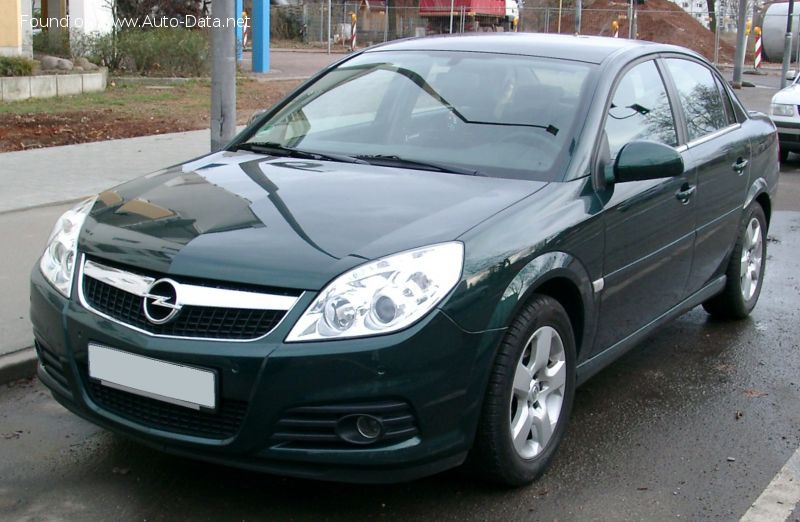
The Opel Vectra C, particularly in its 2005 facelift guise with the 2.2i 16V DIRECT (155 Hp) engine, represented a significant contender in Europe’s highly competitive mid-size family car segment. As a product of General Motors’ German subsidiary, Opel, the Vectra C was never officially sold in the United States, yet it played a crucial role in Opel’s strategy to offer a sophisticated, well-equipped, and efficient vehicle to European consumers. Launched in 2002, the third-generation Vectra C received a substantial refresh in 2005, aiming to sharpen its aesthetics, refine its driving dynamics, and enhance its technological offerings. This particular variant, the 2.2i 16V DIRECT, stood out for its advanced direct-injection gasoline engine, a technology that was gaining traction for its promise of improved fuel economy and performance at the time. Positioned as a practical four-door sedan, it offered a compelling package for families and business users seeking a blend of comfort, space, and modern engineering, competing directly with established rivals like the Ford Mondeo, Volkswagen Passat, and Renault Laguna across the continent. The facelifted model sought to inject a more dynamic and contemporary appeal into the Vectra’s design, ensuring its relevance in a market increasingly demanding both style and substance from its vehicles. The introduction of the ‘DIRECT’ engine underscored Opel’s commitment to innovation, providing a more refined and responsive driving experience compared to its predecessors.
Engine and Performance: The Opel Vectra C (facelift 2005) 2.2i 16V DIRECT (155 Hp) Powertrain
At the heart of this particular Opel Vectra C (facelift 2005) 2.2i 16V DIRECT (155 Hp) model was a sophisticated 2.2-liter (2198 cm3 or 134.13 cu. in.) inline four-cylinder gasoline engine, designated with the code Z22YH. This powerplant distinguished itself with its “DIRECT” moniker, indicating the use of direct fuel injection. This technology, relatively advanced for mainstream vehicles in the mid-2000s, allowed for more precise fuel delivery directly into the combustion chambers, leading to improved fuel atomization, better combustion efficiency, and ultimately, enhanced power output and fuel economy. The engine, naturally aspirated and featuring a Double Overhead Camshaft (DOHC) valvetrain with four valves per cylinder, produced a respectable 155 horsepower at 5600 rpm. Its maximum torque figure stood at 220 Newton-meters (equivalent to 162.26 lb.-ft.) delivered at a relatively accessible 3800 rpm, providing a strong mid-range pull for everyday driving.
Power was efficiently transmitted to the front wheels via a five-speed manual transmission, a common and reliable setup for European family sedans of its era. This combination allowed the Vectra C to achieve a 0-60 mph acceleration time of approximately 9 seconds, with 0-100 km/h completed in 9.5 seconds. The car’s top speed was rated at 218 km/h (135.46 mph), making it capable of comfortable cruising on the German autobahns or other European motorways. The performance figures were competitive for its class, offering a good balance between spirited driving and practical usability. The engine’s compression ratio of 12:1 further highlighted its modern design, optimized for efficiency. With an engine oil capacity of 5 liters (5.28 US quarts) and a coolant capacity of 7.1 liters (7.5 US quarts), maintenance was straightforward and typical for a vehicle of its segment.
Fuel efficiency was a key selling point for the direct-injection engine. The Opel Vectra C (facelift 2005) 2.2i 16V DIRECT (155 Hp) achieved a combined fuel economy of 7.5 liters per 100 kilometers, translating to an impressive 31.4 US miles per gallon. In urban driving conditions, it returned 10.3 l/100 km (22.8 US mpg), while on the highway (extra-urban), it managed 6.0 l/100 km (39.2 US mpg). These figures demonstrated the real-world benefits of direct injection, offering a compelling blend of performance and economy for consumers in a market where fuel prices were a significant consideration. The vehicle’s weight-to-power ratio was 9.4 kg/Hp, or 106.5 Hp per tonne, underscoring its solid, yet not overly sporty, performance characteristics.
Design and Features: The Facelifted Opel Vectra C Sedan
The 2005 facelift brought a refreshed aesthetic to the Opel Vectra C, enhancing its visual appeal and modernizing its interior. The vehicle retained its practical four-door sedan body type, accommodating five occupants comfortably. With a length of 4511 mm (177.6 inches), a width of 1798 mm (70.79 inches), and a height of 1460 mm (57.48 inches), the Vectra C presented a substantial and commanding presence on the road. The 2700 mm (106.3 inches) wheelbase was generous, contributing to a stable ride and ample interior space for both front and rear passengers. The facelifted model featured revised front and rear bumpers, a new grille design, and updated headlamps and taillights, giving it a sharper, more contemporary look that aligned with Opel’s evolving design language of the mid-2000s.
Inside, the Vectra C aimed for a functional yet comfortable environment. While specific luxury features are not detailed in the provided data, a European family sedan of this caliber typically included air conditioning, power windows, central locking, and a competent audio system as standard or readily available options. The emphasis was on ergonomic design and quality materials, providing a pleasant cabin for long journeys. Practicality was a strong suit, with a substantial trunk space ranging from 500 liters (17.66 cu. ft.) with the rear seats in place, expanding to a generous 1050 liters (37.08 cu. ft.) when the rear seats were folded