
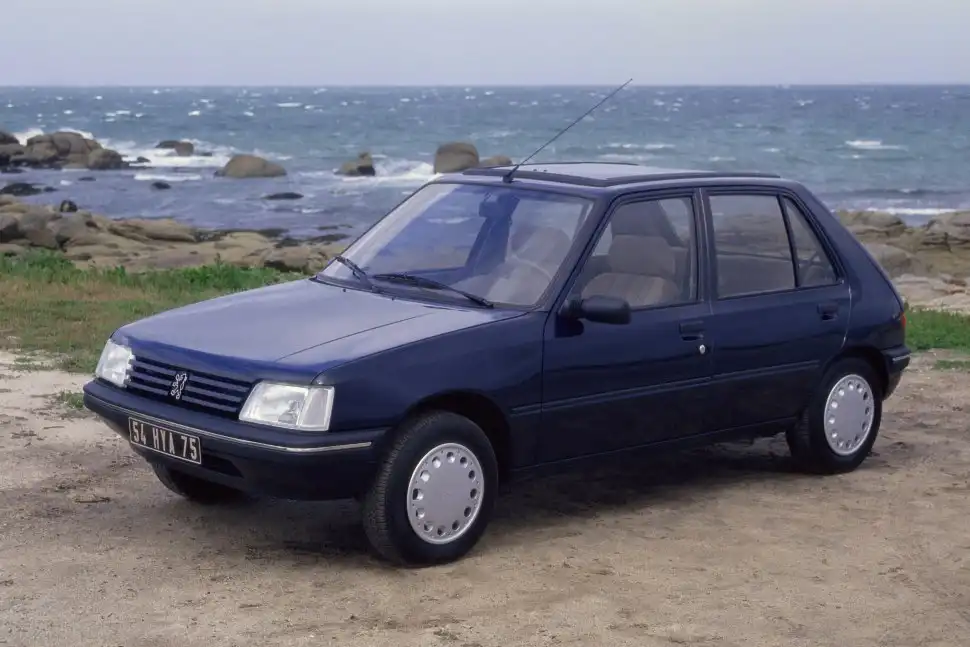
The Peugeot 205 I 1.4 i (75 hp) represents a significant iteration within the highly successful 205 series, produced from 1988 to 1998. This variant, part of the 20A/C facelift generation, occupied a crucial position in Peugeot’s lineup as an affordable and practical entry point into the supermini segment. The 205, launched in 1983, quickly became a European benchmark for small cars, praised for its nimble handling and efficient design. The 1.4 i model, with its modest power output and automatic transmission option, catered to buyers prioritizing ease of use and fuel economy over outright performance. It was a common sight on European roads, serving as a reliable and economical daily driver.
Technical Specifications
| Brand | Peugeot |
| Model | 205 |
| Generation | 205 I (20A/C, facelift 1987) |
| Type (Engine) | 1.4 i (75 Hp) |
| Start of production | 1988 |
| End of production | 1998 |
| Powertrain Architecture | Internal Combustion engine |
| Body type | Hatchback |
| Seats | 5 |
| Doors | 3-5 |
| Fuel consumption (urban) | 8.4 l/100 km (28 US mpg) |
| Fuel consumption (extra urban) | 5.2 l/100 km (45.2 US mpg) |
| Fuel Type | Petrol (Gasoline) |
| Acceleration 0 – 100 km/h | 10.6 sec |
| Acceleration 0 – 62 mph | 10.6 sec |
| Acceleration 0 – 60 mph | 10.1 sec |
| Maximum speed | 170 km/h (105.63 mph) |
| Weight-to-power ratio | 10.9 kg/Hp |
| Weight-to-torque ratio | 7.4 kg/Nm |
| Power | 75 Hp @ 5800 rpm |
| Torque | 111 Nm @ 3400 rpm (81.87 lb.-ft. @ 3400 rpm) |
| Engine layout | Front, Transverse |
| Engine Model/Code | TU3M |
| Engine displacement | 1361 cm3 (83.05 cu. in.) |
| Number of cylinders | 4 |
| Engine configuration | Inline |
| Cylinder Bore | 75 mm (2.95 in.) |
| Piston Stroke | 77 mm (3.03 in.) |
| Compression ratio | 9.3:1 |
| Number of valves per cylinder | 2 |
| Fuel injection system | Single-point injection |
| Engine aspiration | Naturally aspirated |
| Valvetrain | OHC |
| Engine oil capacity | 3.2 l (3.38 US qt | 2.82 UK qt) |
| Coolant capacity | 5.8 l (6.13 US qt | 5.1 UK qt) |
| Kerb Weight | 820 kg (1807.79 lbs.) |
| Max. weight | 1275 kg (2810.89 lbs.) |
| Max load | 455 kg (1003.1 lbs.) |
| Trunk (boot) space – minimum | 290 l (10.24 cu. ft.) |
| Trunk (boot) space – maximum | 585 l (20.66 cu. ft.) |
| Fuel tank capacity | 50 l (13.21 US gal | 11 UK gal) |
| Length | 3705 mm (145.87 in.) |
| Width | 1560 mm (61.42 in.) |
| Height | 1375 mm (54.13 in.) |
| Wheelbase | 2420 mm (95.28 in.) |
| Front track | 1350 mm (53.15 in.) |
| Rear track | 1300 mm (51.18 in.) |
| Drivetrain | Front wheel drive |
| Number of gears | 5 |
| Gearbox type | Automatic transmission |
| Front suspension | Independent, McPherson with coil spring and anti-roll bar |
| Rear suspension | Torsion |
| Front brakes | Disc |
| Rear brakes | Drum |
| Steering type | Steering rack and pinion |
| Tires size | 165/70 R13 |
| Wheel rims size | 13 |
Introduction
The Peugeot 205 I 1.4 i (75 hp) was a mainstay of the 205 range, produced from 1988 until the end of production in 1998. It built upon the success of the original 205, benefiting from the 1987 facelift (20A/C) which brought subtle styling revisions and improvements to interior refinement. Positioned as a more accessible option, the 1.4 i model offered a balance between affordability, practicality, and Peugeot’s renowned driving characteristics. It was a popular choice for families and individuals seeking a reliable and economical supermini.
Powertrain & Engine Architecture
At the heart of the 205 1.4 i lies the TU3M engine, a 1361cc inline-four cylinder petrol engine. This engine, a staple of Peugeot and Citroën vehicles of the era, featured a single overhead camshaft (OHC) and two valves per cylinder. The TU3M utilized single-point fuel injection, a relatively simple system compared to multi-point injection, contributing to its cost-effectiveness. While not known for blistering performance, the TU3M was praised for its durability and ease of maintenance. The 75 horsepower output was achieved at 5800 rpm, with a torque figure of 111 Nm (81.87 lb-ft) available at 3400 rpm. The engine was transversely mounted, driving the front wheels. The automatic transmission, typically a three-speed unit, was designed for smooth operation and ease of use, prioritizing comfort over sporty driving dynamics.
Driving Characteristics
The 1.4 i automatic version of the 205 offered a distinctly different driving experience compared to its more powerful siblings, such as the 1.6 or 1.9 GTI. Acceleration was modest, taking around 10.6 seconds to reach 62 mph, and the top speed was limited to 105.63 mph. The three-speed automatic transmission, while providing convenience, resulted in noticeable gear changes and a less engaging driving experience. The gear ratios were optimized for fuel efficiency rather than rapid acceleration. However, the 205’s inherent agility and well-tuned suspension still provided a comfortable and predictable ride. The steering, a rack and pinion system, remained precise and responsive, making the car enjoyable to drive around town.
Equipment & Trim Levels
The 1.4 i model typically came equipped with a basic but functional level of equipment. Standard features included cloth upholstery, a simple dashboard layout, and manual windows. Power steering was often an optional extra. Higher trim levels, such as the ‘Look’ or ‘Griffe’ variants, added features like alloy wheels, upgraded interior trim, and potentially a sunroof. Central locking and an upgraded stereo system were also available as options. The interior was designed with practicality in mind, offering a reasonable amount of space for passengers and luggage, with a trunk capacity ranging from 290 to 585 liters depending on the rear seats’ configuration.
Chassis & Braking
The 205 1.4 i utilized a McPherson strut front suspension with a coil spring and anti-roll bar, providing a good balance between comfort and handling. The rear suspension employed a torsion beam setup, a cost-effective and space-saving solution. Braking was handled by disc brakes on the front wheels and drum brakes on the rear. This configuration was typical for vehicles in this weight class and provided adequate stopping power for everyday driving. The 165/70 R13 tires, mounted on 13-inch steel wheels, contributed to the car’s overall grip and stability.
Market Reception & Comparison
The 205 1.4 i automatic was generally well-received by critics as a sensible and affordable option. While not a performance car, it was praised for its fuel efficiency, reliability, and ease of driving. Compared to the more powerful 1.6 or GTI models, the 1.4 i offered significantly lower running costs and a more relaxed driving experience. The automatic transmission appealed to drivers who preferred convenience over sporty engagement. However, some critics noted the lack of performance and the somewhat dated automatic gearbox. Against competitors like the Renault Clio and Volkswagen Polo, the 205 1.4 i held its own, offering a compelling combination of value and practicality.
Legacy
The Peugeot 205 1.4 i, particularly with the automatic transmission, has proven to be a remarkably durable vehicle. Many examples are still on the road today, testament to the robustness of the TU3M engine and the overall build quality of the 205. In the used car market, these models are often sought after as affordable and reliable transportation. While not highly collectible like the GTI variants, well-maintained 1.4 i models represent a piece of automotive history and a reminder of a time when small cars prioritized practicality and affordability. The TU3M engine, while simple, is known for its longevity and relatively low maintenance costs, making it a popular choice for those seeking a classic French hatchback.
