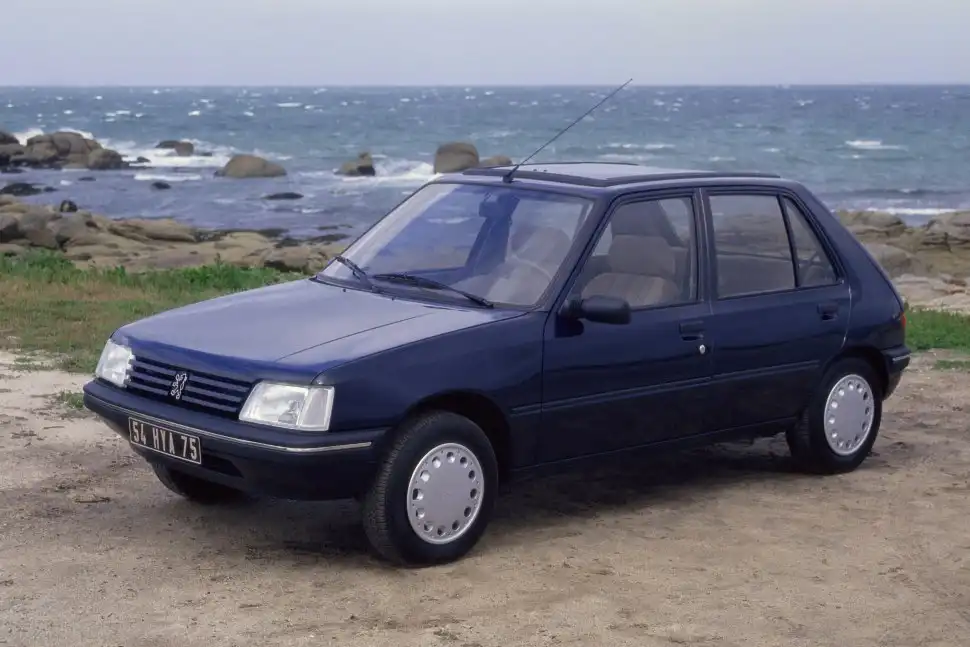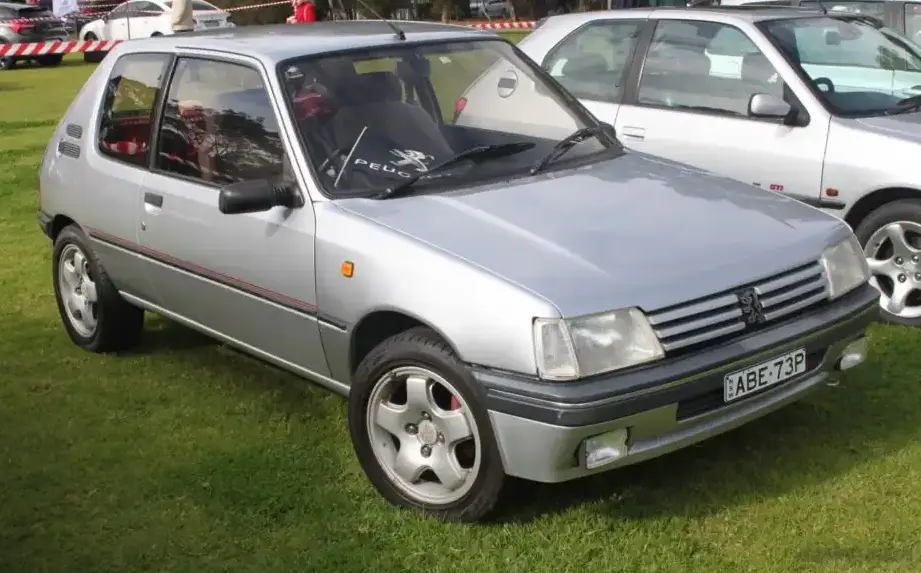
The Peugeot 205 1.3 Rallye, produced from 1987 to 1990, was a performance-oriented variant of Peugeot’s hugely successful 205 supermini. Positioned as an affordable and engaging driver’s car, the Rallye occupied a unique space within the 205 range, bridging the gap between the standard models and the more potent 205 GTI. It was part of the facelifted 205 I series (20A/C), benefitting from minor cosmetic and mechanical updates compared to earlier versions. The Rallye was primarily sold in Europe, capitalizing on the growing demand for small, sporty hatchbacks.
Technical Specifications
| Brand | Peugeot |
| Model | 205 |
| Generation | 205 I (20A/C, facelift 1987) 3-door |
| Type (Engine) | 1.3 Rallye (101 Hp) |
| Start of production | 1987 |
| End of production | 1990 |
| Powertrain Architecture | Internal Combustion engine |
| Body type | Hatchback |
| Seats | 5 |
| Doors | 3 |
| Fuel consumption (urban) | 9.6 l/100 km (24.5 US mpg, 29.4 UK mpg, 10.4 km/l) |
| Fuel consumption (extra urban) | 5.5 l/100 km (42.8 US mpg, 51.4 UK mpg, 18.2 km/l) |
| Fuel consumption (combined) | 7.6 l/100 km (30.9 US mpg, 37.2 UK mpg, 13.2 km/l) |
| Fuel Type | Petrol (Gasoline) |
| Acceleration 0 – 100 km/h | 9.6 sec |
| Acceleration 0 – 62 mph | 9.6 sec |
| Acceleration 0 – 60 mph | 9.1 sec |
| Maximum speed | 190 km/h (118.06 mph) |
| Weight-to-power ratio | 7.8 kg/Hp, 127.8 Hp/tonne |
| Weight-to-torque ratio | 6.7 kg/Nm, 149.4 Nm/tonne |
| Power | 101 Hp @ 6800 rpm |
| Power per litre | 78.1 Hp/l |
| Torque | 118 Nm @ 5000 rpm (87.03 lb.-ft. @ 5000 rpm) |
| Engine layout | Front, Transverse |
| Engine Model/Code | TU24 |
| Engine displacement | 1294 cm3 (78.96 cu. in.) |
| Number of cylinders | 4 |
| Engine configuration | Inline |
| Cylinder Bore | 75 mm (2.95 in.) |
| Piston Stroke | 73.2 mm (2.88 in.) |
| Compression ratio | 9.6:1 |
| Number of valves per cylinder | 2 |
| Fuel injection system | Carburettor |
| Engine aspiration | Naturally aspirated engine |
| Valvetrain | OHC |
| Engine oil capacity | 3.2 l (3.38 US qt | 2.82 UK qt) |
| Coolant capacity | 5.8 l (6.13 US qt | 5.1 UK qt) |
| Kerb Weight | 790 kg (1741.65 lbs.) |
| Max. weight | 1220 kg (2689.64 lbs.) |
| Max load | 430 kg (947.99 lbs.) |
| Trunk (boot) space – minimum | 290 l (10.24 cu. ft.) |
| Trunk (boot) space – maximum | 585 l (20.66 cu. ft.) |
| Fuel tank capacity | 50 l (13.21 US gal | 11 UK gal) |
| Length | 3705 mm (145.87 in.) |
| Width | 1560 mm (61.42 in.) |
| Height | 1375 mm (54.13 in.) |
| Wheelbase | 2420 mm (95.28 in.) |
| Front track | 1350 mm (53.15 in.) |
| Rear track | 1300 mm (51.18 in.) |
| Drivetrain Architecture | Front wheel drive |
| Number of gears and type of gearbox | 5 gears, manual transmission |
| Front suspension | Independent, type McPherson with coil spring and anti-roll bar |
| Rear suspension | Torsion |
| Front brakes | Disc |
| Rear brakes | Drum |
| Steering type | Steering rack and pinion |
| Tires size | 165/70 R13 |
| Wheel rims size | 13 |
Powertrain & Engine Architecture
The 1.3 Rallye was powered by the Peugeot TU24 engine, a 1294cc inline-four cylinder unit. This engine, while relatively small, was tuned for performance, producing 101 horsepower at 6800 rpm and 118 Nm (87 lb-ft) of torque at 5000 rpm. The TU24 featured a single overhead camshaft (OHC) valvetrain with two valves per cylinder. Notably, the Rallye utilized a Weber 32 DRT carburetor, a somewhat archaic fuel delivery system for the late 1980s, but one that contributed to the engine’s responsive character. The engine’s relatively high compression ratio of 9.6:1 further aided its performance. The engine was transversely mounted, driving the front wheels through a five-speed manual transmission. This transmission featured relatively short gear ratios, optimized for acceleration rather than outright top speed.
Driving Characteristics
The 1.3 Rallye offered a distinctly engaging driving experience. While not brutally fast, its light weight (approximately 790 kg or 1742 lbs) and punchy engine provided brisk acceleration. The 0-60 mph sprint took around 9.1 seconds, and it could reach a top speed of 190 km/h (118 mph). The short gearing of the five-speed gearbox meant the engine was frequently kept in its powerband, encouraging spirited driving. Compared to the standard 205 models, the Rallye felt noticeably more responsive. However, it lacked the outright performance of the 205 GTI, which boasted larger engines and more sophisticated suspension. The carbureted engine required a bit more finesse than fuel-injected alternatives, needing careful throttle control to avoid stumbling at low speeds.
Equipment & Trim Levels
The Rallye was a relatively spartan vehicle, reflecting its focus on driving enjoyment. Standard equipment included steel wheels with hubcaps, basic cloth upholstery, and a simple dashboard layout. It featured a three-spoke steering wheel and a basic instrument cluster. Air conditioning and power windows were typically not available, or were rare options. The interior was functional and durable, prioritizing practicality over luxury. The Rallye’s trim level was positioned above the base 205 models but below the more luxurious and well-equipped GTI. Optional extras included a sunroof and upgraded stereo systems.
Chassis & Braking
The 205 Rallye benefited from a well-tuned chassis. It featured independent McPherson strut suspension at the front and a torsion beam rear suspension. The suspension was firmer than that of the standard 205, providing improved handling and reduced body roll. Brakes consisted of disc brakes at the front and drum brakes at the rear. While adequate for the car’s performance, the rear drum brakes were a point of criticism compared to the all-disc setup found on the GTI. The steering was a rack-and-pinion system, providing precise and responsive control.
Market Reception & Comparison
The Peugeot 205 1.3 Rallye was well-received by automotive journalists and enthusiasts alike. It was praised for its affordability, engaging driving dynamics, and overall fun factor. Critics noted that it offered a compelling alternative to more expensive hot hatches. Compared to the 205 GTI, the Rallye was less powerful and lacked some of the GTI’s refinement. However, it was also significantly cheaper to buy and maintain. The carbureted engine, while responsive, was less fuel-efficient than the fuel-injected engines found in other 205 variants. The Rallye’s simplicity and affordability made it a popular choice for young drivers and those seeking a practical yet enjoyable car.
Legacy
The Peugeot 205 1.3 Rallye has become a sought-after classic among enthusiasts. Its relatively low production numbers and engaging driving characteristics have contributed to its collectibility. The TU24 engine, while not known for exceptional longevity, is generally reliable if properly maintained. Rust is a common issue with these cars, particularly in regions with harsh winters. Today, well-preserved examples of the 205 Rallye command a premium in the used car market, appealing to those who appreciate its classic styling, nimble handling, and affordable performance. It remains a testament to Peugeot’s ability to create engaging and enjoyable cars that punch above their weight.