
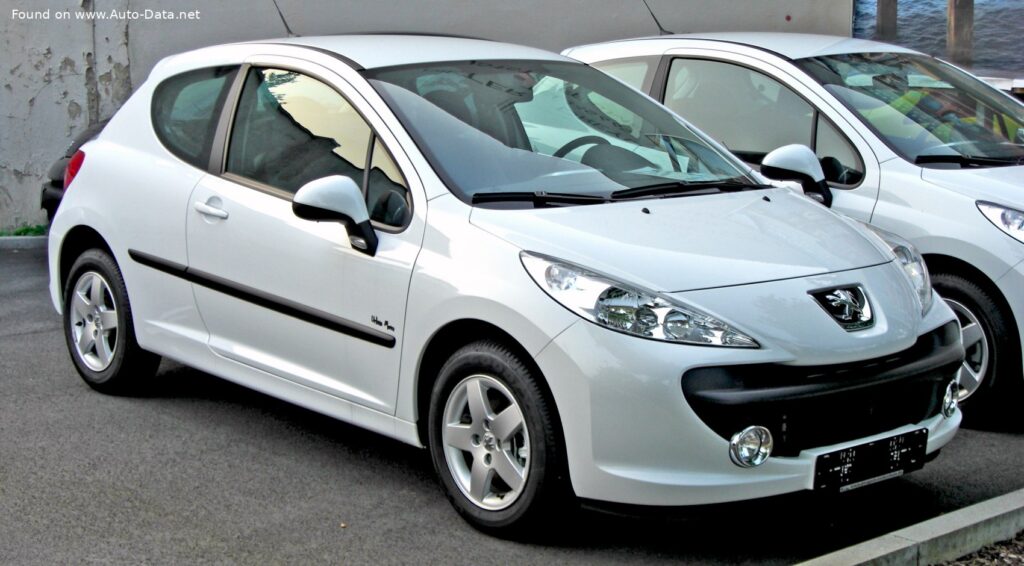
The Peugeot 207 1.4 i (75 Hp): A Pillar of European Compact Motoring (2006-2009)
The Peugeot 207, launched in 2006, represented a significant evolution in the French automaker’s highly successful supermini segment, aiming to build upon the formidable legacy of its predecessor, the 206. Positioned as a stylish and practical compact car for the European market, the 207 quickly became a common sight on urban streets and highways across the continent. Among its various powertrain options, the Peugeot 207 1.4 i (75 Hp) variant stood out as a popular entry-level choice, offering a balanced blend of affordability, fuel efficiency, and adequate performance for daily commuting. Produced between 2006 and 2009, this particular model, with its naturally aspirated 1.4-liter gasoline engine, embodied the pragmatic design and driving dynamics that Peugeot aimed to deliver to a broad consumer base.
While the Peugeot 207 was never officially sold in the United States, its impact in its primary European market was substantial. It competed fiercely in the B-segment, a highly contested category known for its emphasis on compact dimensions, low running costs, and versatile interior packaging. The 1.4 i (75 Hp) model, specifically, catered to drivers seeking an economical vehicle for city driving and occasional longer journeys, without sacrificing the characteristic French flair in design and a comfortable ride quality.
Engine and Performance of the Peugeot 207
At the heart of the Peugeot 207 1.4 i (75 Hp) lay Peugeot’s venerable TU3A engine, a naturally aspirated 1.4-liter (1360 cm3 or 82.99 cu. in.) inline four-cylinder gasoline unit. This engine, known for its robustness and simplicity, delivered 75 horsepower at 5400 rpm, translating to a power-per-liter ratio of 55.1 Hp/l. Torque output was rated at 90 Nm (66.38 lb.-ft.) at a relatively low 3300 rpm, providing decent low-end grunt for urban maneuverability.
Power was sent to the front wheels via a standard 5-speed manual transmission, a common and reliable setup for compact cars of this era. While not designed for outright speed, the 207 1.4 i offered respectable performance for its class. It could accelerate from 0 to 60 mph in a calculated 14.8 seconds, with a top speed of 103.77 mph (167 km/h). These figures underscored its role as a practical commuter rather than a performance-oriented hot hatch.
Fuel economy was a key selling point for this variant. The combined fuel consumption was an economical 6.3 liters per 100 km, which translates to approximately 37.3 US mpg. In urban driving, it achieved 8.4 l/100 km (28 US mpg), while on extra-urban cycles, it could reach an impressive 5 l/100 km (47 US mpg). These efficiency numbers made it an attractive option for budget-conscious drivers in a market where fuel costs were a significant consideration.
Driving Dynamics and Efficiency
The 207’s powertrain architecture, featuring a front, transverse engine layout and front-wheel drive, contributed to predictable handling and efficient packaging. The car’s weight-to-power ratio of 15.2 kg/Hp (or 65.9 Hp/tonne) and a weight-to-torque ratio of 12.6 kg/Nm (79.1 Nm/tonne) further illustrate its design priorities towards efficiency and everyday usability. The steering system utilized a rack and pinion setup, offering direct feedback, while the suspension comprised an independent McPherson strut system with coil springs and an anti-roll bar up front, paired with a semi-independent elastic beam and coil springs at the rear. This setup provided a comfortable ride characteristic of French cars, soaking up road imperfections while maintaining stable handling.
Design and Features
The Peugeot 207, available in both 3-door and 5-door hatchback configurations, showcased a more assertive and modern design language compared to its predecessor. Its distinctively large, swept-back headlights and prominent grille gave it a more substantial and upscale appearance. With a length of 158.66 inches (4030 mm), a width of 67.72 inches (1720 mm), and a height of 57.95 inches (1472 mm), the 207 was noticeably larger than the 206, translating into improved interior space and stability. The wheelbase measured 100 inches (2540 mm), contributing to a more composed ride.
Inside, the 207 offered seating for five occupants. The cabin reflected a more refined approach, with improved material quality and ergonomics for its segment. While specific trim levels and features varied by market, common amenities for a 2006-2009 compact car in Europe would have included power steering, power windows, central locking, and potentially air conditioning, depending on the specification. Safety features were also a focus, with ABS (Anti-lock Braking System) being a standard assisting system for the 1.4 i (75 Hp) model, enhancing braking control.
Practicality was a strong suit, with a minimum trunk capacity of 9.53 cubic feet (270 liters), expandable to a generous 32.6 cubic feet (923 liters) with the rear seats folded down. This flexibility made the 207 suitable for everything from grocery runs to weekend trips. The fuel tank capacity of 13.21 US gallons (50 liters) provided a good cruising range, complementing its fuel-efficient engine. The car’s relatively low drag coefficient (Cd) of 0.30 also contributed to its aerodynamic efficiency and reduced wind noise at higher speeds.
Technical Specifications
The following table provides a comprehensive overview of the technical specifications for the Peugeot 207 1.4 i (75 Hp) from its production run between 2006 and 2009:
| Category | Specification |
|---|---|
| Brand | Peugeot |
| Model | 207 |
| Generation | 207 |
| Engine Type | 1.4 i (75 Hp) |
| Production Start | 2006 year |
| Production End | 2009 year |
| Powertrain Architecture | Internal Combustion engine |
| Body Type | Hatchback |
| Seats | 5 |
| Doors | 3-5 |
| Performance Specs | |
| Fuel Consumption (Urban) | 8.4 l/100 km (28 US mpg) |
| Fuel Consumption (Extra Urban) | 5 l/100 km (47 US mpg) |
| Fuel Consumption (Combined) | 6.3 l/100 km (37.3 US mpg) |
| Fuel Type | Petrol (Gasoline) |
| Acceleration 0-60 mph | 14.8 sec |
| Acceleration 0-100 km/h | 15.6 sec |
| Maximum Speed | 167 km/h (103.77 mph) |
| Weight-to-Power Ratio | 15.2 kg/Hp (65.9 Hp/tonne) |
| Weight-to-Torque Ratio | 12.6 kg/Nm (79.1 Nm/tonne) |
| Engine Specs | |
| Power | 75 Hp @ 5400 rpm |
| Power per liter | 55.1 Hp/l |
| Torque | 90 Nm @ 3300 rpm (66.38 lb.-ft. @ 3300 rpm) |
| Engine Layout | Front, Transverse |
| Engine Model/Code | KFV TU3A |
| Engine Displacement | 1360 cm3 (82.99 cu. in.) |
| Number of Cylinders | 4 |
| Engine Configuration | Inline |
| Cylinder Bore | 75 mm (2.95 in.) |
| Piston Stroke | 77 mm (3.03 in.) |
| Number of Valves per Cylinder | 2 |
| Fuel Injection System | Multi-port manifold injection |
| Engine Aspiration | Naturally aspirated engine |
| Engine Oil Capacity | 3.25 l (3.43 US qt) |
| Coolant Capacity | 5.3 l (5.6 US qt) |
| Space, Volume and Weights | |
| Curb Weight | 1138 kg (2508.86 lbs.) |
| Trunk Space (Minimum) | 270 l (9.53 cu. ft.) |
| Trunk Space (Maximum) | 923 l (32.6 cu. ft.) |
| Fuel Tank Capacity | 50 l (13.21 US gal) |
| Dimensions | |
| Length | 4030 mm (158.66 in.) |
| Width | 1720 mm (67.72 in.) |
| Width with Mirrors Folded | 1818 mm (71.57 in.) |
| Width Including Mirrors | 1972 mm (77.64 in.) |
| Height | 1472 mm (57.95 in.) |
| Wheelbase | 2540 mm (100 in.) |
| Front Track | 1475 mm (58.07 in.) |
| Rear Track | 1466 mm (57.72 in.) |
| Drag Coefficient (Cd) | 0.30 |
| Minimum Turning Circle | 10.4 m (34.12 ft.) |
| Drivetrain, Brakes and Suspension | |
| Drivetrain Architecture | Front-wheel drive, Internal Combustion engine |
| Drive Wheel | Front wheel drive |
| Number of Gears and Type | 5 gears, manual transmission |
| Front Suspension | Independent, McPherson with coil spring and anti-roll bar |
| Rear Suspension | Semi-independent, coil spring, Elastic beam |
| Front Brakes | Ventilated discs |
| Rear Brakes | Drum |
| Assisting Systems | ABS (Anti-lock braking system) |
| Steering Type | Steering rack and pinion |
| Tires Size | 185/65 R15 |
Legacy and Market Impact
The Peugeot 207 1.4 i (75 Hp) played a crucial role in maintaining Peugeot’s strong presence in the highly competitive European supermini segment during its production years (2006-2009). It faced stiff competition from segment rivals such as the Renault Clio, Ford Fiesta, Opel Corsa, and Volkswagen Polo, all of which offered compelling packages in terms of styling, features, and powertrain options. Despite the intense competition, the 207 managed to carve out a significant market share, consistently ranking among Europe’s best-selling cars.
Its reputation was built on several key attributes: a distinctive and appealing design that stood out from the crowd, a comfortable and well-appointed interior for its class, and a generally compliant ride quality that made it well-suited for varied European road conditions. The 1.4 i (75 Hp) model, in particular, was lauded for its low running costs, decent fuel economy, and ease of driving in urban environments, making it a popular choice for first-time car buyers, small families, and those seeking an economical second car.
The 207 represented a period of transition for Peugeot, moving towards larger, more refined vehicles while still retaining the brand’s core values of style and driving enjoyment. While it may not have been the most dynamically thrilling variant, the 1.4 i (75 Hp) was a workhorse that reliably fulfilled its purpose. Its legacy is one of a practical, stylish, and efficient compact car that successfully carried the torch from the iconic 206, contributing significantly to Peugeot’s brand image and sales volume in the global automotive landscape, particularly within its primary European market.
