
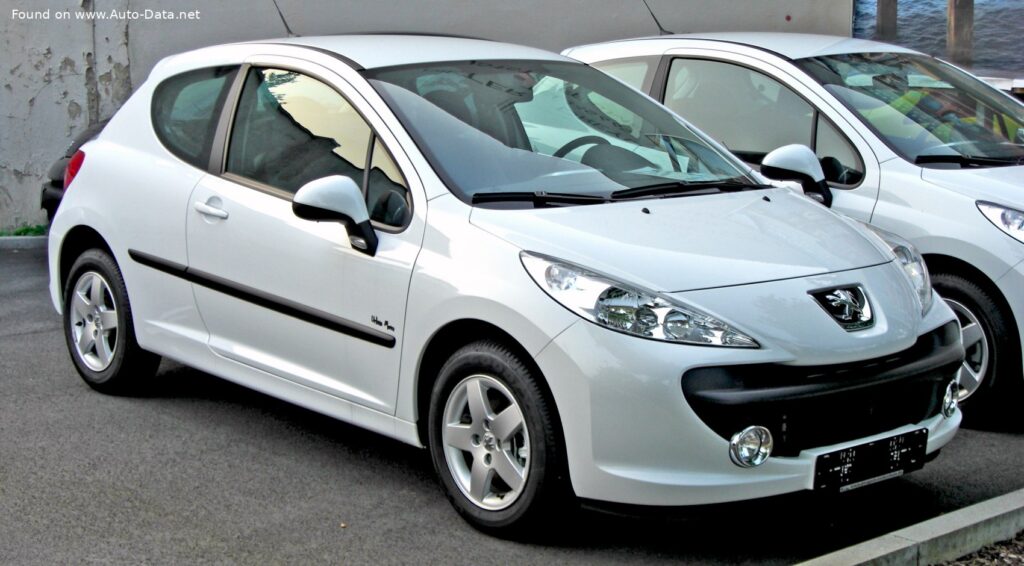
The Peugeot 207 1.6 i 16V (120 Hp): A European Supermini Standard-Bearer
The Peugeot 207, introduced in 2006, represented a significant evolution in Peugeot’s highly successful supermini lineage, succeeding the immensely popular 206. Designed primarily for the European market, where small, fuel-efficient, and stylish hatchbacks dominate sales, the 207 aimed to build upon its predecessor’s legacy while offering enhanced sophistication, safety, and driving dynamics. This particular variant, the Peugeot 207 1.6 i 16V (120 Hp), produced between 2007 and 2009, stood out in its segment for its lively gasoline engine, balanced performance, and a comprehensive suite of features typical of the era. Positioned as a versatile and practical offering in the highly competitive B-segment, it catered to a broad demographic of European drivers seeking a blend of urban agility and highway capability.
Engine and Performance
At the heart of the Peugeot 207 1.6 i 16V (120 Hp) lies a robust 1.6-liter (1598 cm3 or 97.52 cu. in.) naturally aspirated inline four-cylinder engine, designated by the code 5FW EP6. This powerplant was a product of the collaboration between PSA Peugeot Citroën and BMW, specifically the Prince engine family, known for its advanced design and efficiency. Featuring a Double Overhead Camshaft (DOHC) valvetrain with 16 valves (four per cylinder) and multi-port manifold fuel injection, the engine was engineered to deliver a responsive and smooth power delivery across the rev range. It produced a respectable 120 horsepower at 6000 rpm, translating to a power-per-liter output of 75.1 HP/l, a strong figure for a naturally aspirated engine of its size.
Torque output for this variant stood at 118.01 lb.-ft. (160 Nm) peaking at 4250 rpm, providing ample pulling power for both city driving and highway cruising. This engine was mated to a 5-speed manual transmission, directing power to the front wheels, a common and efficient setup for a vehicle in this class. The performance figures were commendable for its segment: the 207 1.6 i 16V could accelerate from 0 to 60 mph in a brisk 9.1 seconds, with a top speed of 124.27 mph (200 km/h). These numbers placed it favorably against many of its direct competitors, offering a more engaging driving experience than some of its more economy-focused stablemates.
Fuel efficiency was also a strong suit, particularly for a gasoline engine of its output. The combined fuel economy was rated at 38.6 US mpg (6.1 l/100 km), with urban consumption at 28 US mpg (8.4 l/100 km) and an impressive extra-urban figure of 49 US mpg (4.8 l/100 km). This efficiency, coupled with a 13.21 US gallon (50 l) fuel tank, provided a practical range for daily commutes and longer journeys. The vehicle complied with the Euro 4 emission standard, reflecting its commitment to environmental considerations at the time of its production.
Design and Features
The Peugeot 207 represented a significant departure in design from its predecessor, adopting a more assertive and contemporary aesthetic. Available in both 3-door and 5-door hatchback configurations, it featured a distinctive, large front grille and swept-back headlamps, giving it a sophisticated and somewhat aggressive stance. Its dimensions, with a length of 158.66 inches (4030 mm) and a width of 67.72 inches (1720 mm), made it larger than many of its rivals, contributing to a more substantial road presence and improved interior space. The wheelbase of 100 inches (2540 mm) also played a crucial role in providing a stable ride and generous cabin room for its five occupants.
Inside, the 207 offered a well-appointed cabin with an emphasis on comfort and ergonomics. The materials used were generally of a higher quality than the 206, and the dashboard layout was clear and intuitive. Practicality was a key consideration, with a minimum trunk (boot) space of 9.53 cu. ft. (270 liters), expandable to a substantial 32.6 cu. ft. (923 liters) with the rear seats folded, making it versatile for various cargo needs. The vehicle’s kerb weight of 2810.89 lbs. (1275 kg) contributed to its solid feel on the road.
In terms of chassis and safety, the 207 was equipped with a well-engineered suspension system, featuring an independent McPherson strut setup with coil springs and an anti-roll bar at the front, and a semi-independent, coil spring, elastic beam arrangement at the rear. This configuration provided a comfortable ride while maintaining agile handling characteristics, a hallmark of Peugeot vehicles. Braking was handled by ventilated discs at the front and drum brakes at the rear, augmented by an Anti-lock Braking System (ABS) as a standard assisting system, enhancing stopping power and control. The steering system was a precise rack and pinion type, contributing to the car’s responsive feel. The vehicle was fitted with 195/55 R16 tires, offering a good balance of grip and ride comfort.
Technical Specifications
| Category | Specification |
|---|---|
| General Information | |
| Brand | Peugeot |
| Model | 207 |
| Generation | 207 |
| Engine Type | 1.6 i 16V (120 Hp) |
| Production Start | 2007 |
| Production End | 2009 |
| Powertrain Architecture | Internal Combustion Engine |
| Body Type | Hatchback |
| Seats | 5 |
| Doors | 3-5 |
| Performance Specs | |
| Fuel Consumption (Urban) | 8.4 l/100 km (28 US mpg) |
| Fuel Consumption (Extra Urban) | 4.8 l/100 km (49 US mpg) |
| Fuel Consumption (Combined) | 6.1 l/100 km (38.6 US mpg) |
| Fuel Type | Petrol (Gasoline) |
| Acceleration 0-60 mph | 9.1 sec |
| Acceleration 0-100 km/h | 9.6 sec |
| Maximum Speed | 124.27 mph (200 km/h) |
| Emission Standard | Euro 4 |
| Weight-to-Power Ratio | 10.6 kg/Hp (94.1 Hp/tonne) |
| Weight-to-Torque Ratio | 8 kg/Nm (125.5 Nm/tonne) |
| Engine Specs | |
| Power | 120 Hp @ 6000 rpm |
| Power per Liter | 75.1 Hp/l |
| Torque | 118.01 lb.-ft. @ 4250 rpm (160 Nm) |
| Engine Layout | Front, Transverse |
| Engine Model/Code | 5FW EP6 |
| Engine Displacement | 1598 cm3 (97.52 cu. in.) |
| Number of Cylinders | 4 |
| Engine Configuration | Inline |
| Cylinder Bore | 3.03 in. (77 mm) |
| Piston Stroke | 3.38 in. (85.8 mm) |
| Compression Ratio | 11:1 |
| Valves per Cylinder | 4 |
| Fuel Injection System | Multi-port manifold injection |
| Engine Aspiration | Naturally aspirated |
| Valvetrain | DOHC |
| Engine Oil Capacity | 4.25 l (4.49 US qt) |
| Coolant Capacity | 5.4 l (5.71 US qt) |
| Space, Volume, and Weights | |
| Kerb Weight | 2810.89 lbs. (1275 kg) |
| Max. Weight | 3615.58 lbs. (1640 kg) |
| Max Load | 804.69 lbs. (365 kg) |
| Trunk Space (Minimum) | 9.53 cu. ft. (270 l) |
| Trunk Space (Maximum) | 32.6 cu. ft. (923 l) |
| Fuel Tank Capacity | 13.21 US gal (50 l) |
| Dimensions | |
| Length | 158.66 in. (4030 mm) |
| Width | 67.72 in. (1720 mm) |
| Width with Mirrors Folded | 71.57 in. (1818 mm) |
| Width Including Mirrors | 77.64 in. (1972 mm) |
| Height | 57.95 in. (1472 mm) |
| Wheelbase | 100 in. (2540 mm) |
| Front Track | 58.07 in. (1475 mm) |
| Rear Track | 57.72 in. (1466 mm) |
| Drag Coefficient (Cd) | 0.30 |
| Minimum Turning Circle | 34.12 ft. (10.4 m) |
| Drivetrain, Brakes, and Suspension | |
| Drivetrain Architecture | Front-wheel drive, Internal Combustion Engine |
| Drive Wheel | Front wheel drive |
| Gearbox Type | 5 gears, manual transmission |
| Front Suspension | Independent, McPherson with coil spring and anti-roll bar |
| Rear Suspension | Semi-independent, coil spring, Elastic beam |
| Front Brakes | Ventilated discs |
| Rear Brakes | Drum |
| Assisting Systems | ABS (Anti-lock braking system) |
| Steering Type | Steering rack and pinion |
| Tires Size | 195/55 R16 |
Legacy and Market Impact
The Peugeot 207, including the 1.6 i 16V (120 Hp) variant, was a critically important model for Peugeot in its primary European markets. It entered a fiercely competitive segment dominated by other strong contenders like the Renault Clio, Ford Fiesta, Volkswagen Polo, and Opel Corsa. Despite the intense competition, the 207 managed to carve out a significant market share, largely due to its appealing design, comfortable ride, and a reputation for solid build quality compared to some of its predecessors. Its slightly larger dimensions than many rivals also contributed to its appeal, offering a perceived step up in class and interior room.
The 1.6-liter 120 HP engine, in particular, was praised for its refined operation and energetic performance, making the 207 a more engaging drive than some of the smaller engine options. It provided a good balance of power and efficiency, making it suitable for a wide range of uses from urban commuting to longer trips. The car’s safety features, including standard ABS and a robust body structure, also contributed to its strong sales performance and positive perception among consumers.
While the Peugeot 207 was never officially sold in the United States, due to Peugeot’s withdrawal from the North American market decades prior, its impact across Europe was undeniable. It continued Peugeot’s tradition of producing successful and stylish superminis, maintaining the brand’s presence as a key player in one of the continent’s most vital automotive segments. The 207’s legacy is defined by its role as a comfortable, practical, and dynamically capable small car that successfully navigated the evolving demands of the European automotive landscape during its production run, setting the stage for its successor, the 208.
