
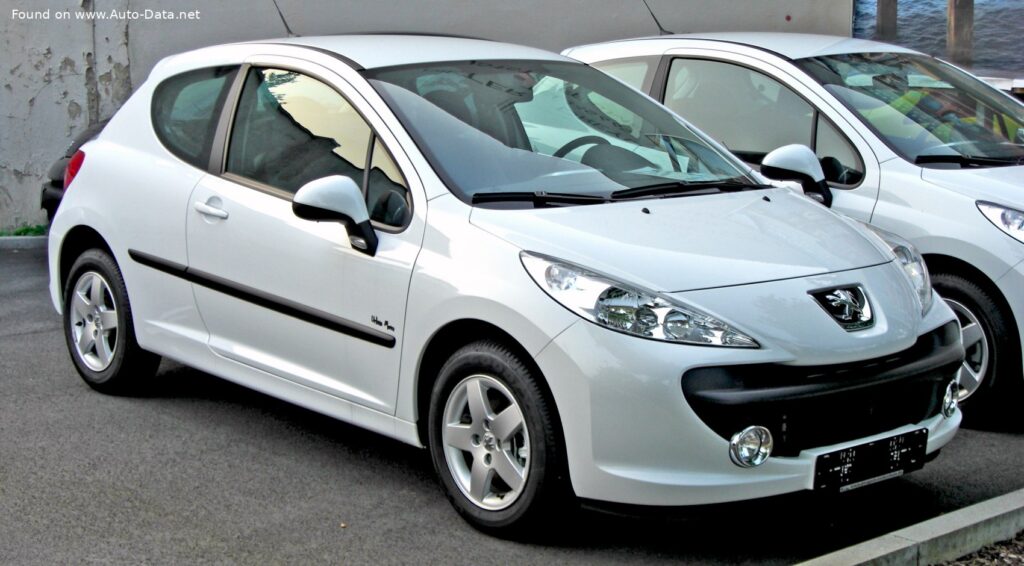
The Peugeot 207: A European Supermini Standard-Bearer
The Peugeot 207 1.6 THP (150 Hp) represents a significant chapter in the history of the European B-segment, or supermini, market. Produced by the French automaker Peugeot from 2006 to 2009 for this specific powertrain variant, the 207 was designed to build upon the immense success of its predecessor, the iconic Peugeot 206. While never officially sold in the United States, the 207 played a crucial role in Peugeot’s global strategy, particularly across European and Asian markets, where it competed fiercely against other popular compact cars.
Launched in 2006, the Peugeot 207 was a larger, more sophisticated vehicle than the 206, boasting enhanced safety features, more refined driving dynamics, and a contemporary design language. The 1.6 THP (Turbo High Pressure) engine variant, with its robust 150 horsepower, positioned the 207 as a lively and engaging option within its class, offering a compelling blend of performance, efficiency, and everyday practicality in a stylish hatchback package. It was available in both 3-door and 5-door configurations, catering to a wide range of consumer needs.
Engine and Performance of the Peugeot 207 1.6 THP (150 Hp)
At the heart of the sporty Peugeot 207 1.6 THP (150 Hp) was an advanced 1.6-liter (1598 cm3 or 97.52 cu. in.) inline-four gasoline engine, internally designated as the 5FX EP6DT. This engine was a product of a collaborative effort between PSA Peugeot Citroën and BMW, a partnership that yielded the critically acclaimed “Prince” engine family. Key to its performance was the integration of a turbocharger and intercooler, ensuring a strong power delivery across the rev range. Further enhancing its efficiency and responsiveness were technologies like direct fuel injection and a DOHC-VVT (Double Overhead Camshaft with Variable Valve Timing) valvetrain.
The engine produced a healthy 150 horsepower at 6000 rpm, translating to an impressive power-per-liter output of 93.9 Hp/l. More remarkably for a car of its size, it delivered 177.01 lb.-ft. of torque, available from a remarkably low 1400 rpm and sustained up to 3500 rpm. This broad torque band contributed significantly to the car’s agile feel and excellent real-world drivability, minimizing the need for frequent downshifts in its 5-speed manual transmission.
Performance figures for the 1.6 THP variant were quite strong for its segment. The car could accelerate from 0 to 60 mph in a swift 7.7 seconds (0-100 km/h in 8.1 seconds) and reach a top speed of 130.49 mph (210 km/h). Despite its spirited performance, the engine also offered respectable fuel economy, with a combined rating of 33.6 US mpg (7 l/100 km). Its CO2 emissions were rated at 166 g/km, adhering to the Euro 4 emission standard, which was competitive for its time. The engine’s layout was front, transverse, driving the front wheels, a typical and efficient setup for a vehicle in this class.
Design and Features: Form Meets Function
The Peugeot 207, particularly in its hatchback form, showcased a design language that was both contemporary and distinctly French. It adopted a larger, more assertive stance compared to the 206, characterized by its prominent, wide-mouth grille and large, swept-back headlamps that dominated the front fascia. The overall silhouette was sleek and aerodynamic, contributing to a drag coefficient (Cd) of 0.30. The car’s dimensions—158.66 inches in length, 67.72 inches in width (77.64 inches including mirrors), and 57.95 inches in height—provided a noticeable increase in interior space and presence over its predecessor.
Inside, the 207 offered a comfortable cabin designed for five occupants. While specific luxury features varied by trim level, the 1.6 THP model often came equipped with a sportier interior ambiance. Trunk space was practical for a supermini, ranging from 9.53 cubic feet (270 liters) with the rear seats up, expanding to a generous 32.6 cubic feet (923 liters) with the seats folded down. The car’s curb weight stood at 2824.12 lbs (1281 kg), giving it a favorable weight-to-power ratio of 8.5 kg/Hp.
From a chassis perspective, the 207 featured an independent McPherson strut front suspension with coil springs and an anti-roll bar, providing responsive handling and good ride comfort. The rear utilized a semi-independent setup with coil springs and an elastic beam. Braking performance was handled by ventilated discs at the front and solid discs at the rear, complemented by an Anti-lock Braking System (ABS) for enhanced safety. The car rode on 17-inch wheel rims fitted with 205/45 R17 tires, further underscoring its sporty intentions and contributing to its agile turning circle of 34.12 feet (10.4 meters).
Technical Specifications for the Peugeot 207 1.6 THP (150 Hp)
| Category | Specification |
|---|---|
| General Information | |
| Brand | Peugeot |
| Model | 207 |
| Generation | 207 |
| Type (Engine) | 1.6 THP (150 Hp) |
| Start of Production | 2006 year |
| End of Production | 2009 year |
| Powertrain Architecture | Internal Combustion engine |
| Body type | Hatchback |
| Seats | 5 |
| Doors | 3-5 |
| Performance Specs | |
| Fuel consumption (economy) – urban | 9.3 l/100 km (25.3 US mpg) |
| Fuel consumption (economy) – extra urban | 5.6 l/100 km (42 US mpg) |
| Fuel consumption (economy) – combined | 7 l/100 km (33.6 US mpg) |
| CO2 emissions | 166 g/km |
| Fuel Type | Petrol (Gasoline) |
| Acceleration 0 – 60 mph (Calculated) | 7.7 sec |
| Acceleration 0 – 100 km/h | 8.1 sec |
| Maximum speed | 210 km/h (130.49 mph) |
| Emission standard | Euro 4 |
| Weight-to-power ratio | 8.5 kg/Hp (117.1 Hp/tonne) |
| Weight-to-torque ratio | 5.3 kg/Nm (187.4 Nm/tonne) |
| Engine Specs | |
| Power | 150 Hp @ 6000 rpm |
| Power per liter | 93.9 Hp/l |
| Torque | 240 Nm @ 1400-3500 rpm (177.01 lb.-ft.) |
| Engine layout | Front, Transverse |
| Engine Model/Code | 5FX EP6DT |
| Engine displacement | 1598 cm3 (97.52 cu. in.) |
| Number of cylinders | 4 |
| Engine configuration | Inline |
| Cylinder Bore | 77 mm (3.03 in.) |
| Piston Stroke | 85.8 mm (3.38 in.) |
| Compression ratio | 10.5:1 |
| Number of valves per cylinder | 4 |
| Fuel injection system | Direct injection |
| Engine aspiration | Turbocharger, Intercooler |
| Valvetrain | DOHC-VVT |
| Engine oil capacity | 4.25 l (4.49 US qt) |
| Coolant | 5.3 l (5.6 US qt) |
| Space, Volume and Weights | |
| Kerb Weight | 1281 kg (2824.12 lbs.) |
| Max. weight | 1700 kg (3747.86 lbs.) |
| Max load | 419 kg (923.74 lbs.) |
| Trunk (boot) space – minimum | 270 l (9.53 cu. ft.) |
| Trunk (boot) space – maximum | 923 l (32.6 cu. ft.) |
| Fuel tank capacity | 50 l (13.21 US gal) |
| Permitted trailer load with brakes (12%) | 1150 kg (2535.32 lbs.) |
| Permitted trailer load without brakes | 600 kg (1322.77 lbs.) |
| Dimensions | |
| Length | 4030 mm (158.66 in.) |
| Width | 1720 mm (67.72 in.) |
| Width with mirrors folded | 1818 mm (71.57 in.) |
| Width including mirrors | 1972 mm (77.64 in.) |
| Height | 1472 mm (57.95 in.) |
| Wheelbase | 2540 mm (100 in.) |
| Front track | 1475 mm (58.07 in.) |
| Rear (Back) track | 1468 mm (57.8 in.) |
| Drag coefficient (Cd) | 0.30 |
| Minimum turning circle (turning diameter) | 10.4 m (34.12 ft.) |
| Drivetrain, Brakes and Suspension Specs | |
| Drivetrain Architecture | Front wheel drive |
| Drive wheel | Front wheel drive |
| Number of gears and type of gearbox | 5 gears, manual transmission |
| Front suspension | Independent, type McPherson with coil spring and anti-roll bar |
| Rear suspension | Semi-independent, coil spring, Elastic beam |
| Front brakes | Ventilated discs |
| Rear brakes | Disc |
| Assisting systems | ABS (Anti-lock braking system) |
| Steering type | Steering rack and pinion |
| Tires size | 205/45 R17 |
| Wheel rims size | 17 |
Legacy and Market Impact
The Peugeot 207 entered a highly competitive segment dominated by well-established rivals such as the Renault Clio, Ford Fiesta, Volkswagen Polo, Opel Corsa, and Fiat Grande Punto. Its predecessor, the 206, had been a sales phenomenon, and the 207 was tasked with maintaining Peugeot’s strong position in the supermini category. It largely succeeded, becoming a significant volume seller for the brand across Europe and other international markets.
The 1.6 THP engine variant, in particular, helped cement the 207’s reputation as a car that could blend everyday usability with genuine driving enjoyment. It offered a more premium feel and performance compared to many of its naturally aspirated competitors. The collaboration with BMW on the “Prince” engine family also lent a degree of technical credibility and helped Peugeot offer engines that were both powerful and relatively efficient for their time, especially with the direct injection and turbocharging technology.
The Peugeot 207’s legacy is characterized by its stylish French design, comfortable ride quality, and the availability of sophisticated powertrains like the 1.6 THP. While it faced criticism for being somewhat heavier and less nimble than the 206, it ultimately offered a more mature and refined driving experience, along with improved safety. Its success laid the groundwork for its eventual replacement, the Peugeot 208, which continued the brand’s evolution in the crucial B-segment. Though never a sight on American roads, the 207 remains a significant model in the global automotive landscape, showcasing Peugeot’s engineering and design prowess during the late 2000s.
