The Peugeot 207 CC 1.6 THP (150 Hp): A European Compact Convertible
The Peugeot 207 CC 1.6 THP (150 Hp) represents a significant offering in the European compact convertible segment, building upon the success of its predecessor, the pioneering 206 CC. Launched in 2006 and produced until 2009, this generation of Peugeot’s “Coupe-Cabriolet” aimed to combine the practicality and security of a fixed-roof coupe with the open-air exhilaration of a convertible. While never officially sold in the United States, the 207 CC carved out a notable niche in its primary European market, appealing to buyers seeking an affordable, stylish, and versatile vehicle for varied driving conditions. It capitalized on Peugeot’s established reputation for creating engaging small cars, adding the allure of a retractable hardtop that could transform the car’s character at the touch of a button.
The 207 CC was more than just a 207 hatchback with a folding roof; it featured a distinct design and engineering tailored for its convertible purpose. Its market positioning was clear: provide a more sophisticated, safer, and refined experience than previous soft-top convertibles in its class, without venturing into the premium price bracket. The 1.6 THP (Turbo High Pressure) engine variant, with its 150 horsepower output, was particularly noteworthy, offering a spirited performance that complemented the car’s youthful and dynamic aesthetics.
Engine and Performance of the Peugeot 207 CC
Under the hood of the Peugeot 207 CC 1.6 THP (150 Hp) lies a sophisticated 1.6-liter turbocharged inline-four engine, a product of the collaboration between PSA Peugeot Citroën and BMW. This powertrain, designated with the internal code 5FX EP6DT, was a highlight of the 207 CC lineup, offering a compelling blend of power and efficiency for its class. With a displacement of 1598 cubic centimeters (97.52 cubic inches), this compact engine delivered a robust 150 horsepower at 6000 rpm, translating to an impressive 93.9 horsepower per liter.
What truly set this engine apart was its torque delivery. Thanks to direct injection, a turbocharger, and an intercooler, it produced a substantial 240 Nm (177.01 lb.-ft.) of torque, available across a broad rev range from a low 1400 rpm up to 3500 rpm. This wide torque band ensured excellent responsiveness and flexibility in daily driving, making the 207 CC feel eager and capable whether navigating city streets or cruising on the highway. Power was sent to the front wheels via a precise 5-speed manual transmission, a common setup for compact European vehicles of this era, emphasizing driver engagement.
In terms of raw performance, the 1.6 THP engine allowed the 207 CC to accelerate from 0 to 60 mph in a respectable 8.2 seconds (0-100 km/h in 8.6 seconds). Its top speed reached 130.49 mph (210 km/h), making it one of the faster options in its segment. Despite its sporty demeanor, the engine also delivered reasonable fuel economy for a turbocharged gasoline unit of its time. The combined fuel consumption was rated at 7.2 liters per 100 km, which translates to approximately 32.7 US mpg. CO2 emissions stood at 171 g/km, adhering to the Euro 4 emission standard, reflecting a conscious effort towards environmental responsibility in its design.
Design and Features
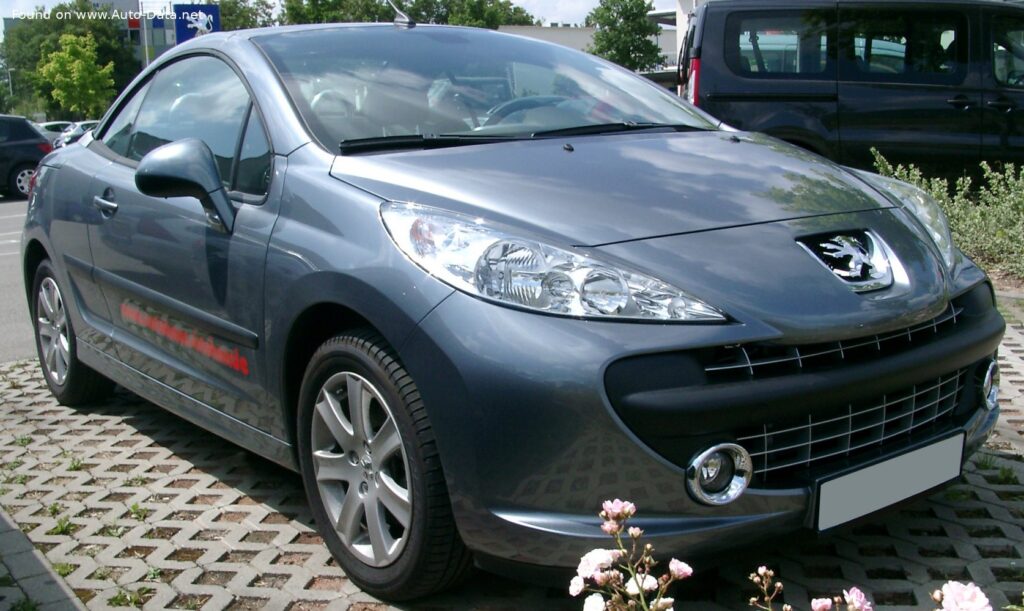
The Peugeot 207 CC‘s most defining characteristic is its coupe-cabriolet body type. This innovative design, pioneered by Peugeot, features a retractable hardtop that transforms the vehicle from a stylish coupe into an open-air convertible in a matter of seconds. This dual-purpose nature offered significant advantages over traditional soft-top convertibles, including enhanced security, better acoustic insulation, and improved weather protection when the roof was up. The 207 CC, with its two doors and four seats, maintained the distinctive “smiley” grille and swept-back headlights that were characteristic of the 207 hatchback, giving it a modern and appealing look.
Dimensionally, the 207 CC measured 158.94 inches in length, 68.82 inches in width (excluding mirrors), and 55 inches in height, positioning it firmly within the compact car segment. Its 100-inch wheelbase contributed to a stable ride and allowed for the packaging of the complex roof mechanism. The car rode on 17-inch wheels fitted with 205/45 R17 tires, providing a good balance of grip and ride comfort.
Inside, the 207 CC offered a cockpit-like feel, with a dashboard design that was contemporary for the mid-2000s. While technically a four-seater, the rear seats were notably compact, typical for small 2+2 convertibles, and were best suited for short journeys or additional luggage. The trunk space varied significantly depending on the roof’s position: a modest 6.6 cubic feet (187 liters) with the roof stowed, expanding to a more practical 15.86 cubic feet (449 liters) when the roof was up and the car was in coupe mode. Safety features for the era included ABS (Anti-lock Braking System) as standard, along with a robust body structure designed to protect occupants in the event of a rollover, which was a key advantage of the hardtop design.
Technical Specifications
| Peugeot 207 CC 1.6 THP (150 Hp) – Technical Specifications | |
|---|---|
| General Information | |
| Brand | Peugeot |
| Model | 207 CC |
| Generation | 207 CC |
| Engine Type | 1.6 THP (150 Hp) |
| Production Start | 2006 year |
| Production End | 2009 year |
| Powertrain Architecture | Internal Combustion Engine |
| Body Type | Coupe – Cabriolet |
| Seats | 4 |
| Doors | 2 |
| Performance Specifications | |
| Fuel Consumption (Urban) | 9.6 l/100 km (24.5 US mpg) |
| Fuel Consumption (Extra Urban) | 5.8 l/100 km (40.6 US mpg) |
| Fuel Consumption (Combined) | 7.2 l/100 km (32.7 US mpg) |
| CO2 Emissions | 171 g/km |
| Fuel Type | Gasoline |
| Acceleration 0 – 60 mph | 8.2 sec |
| Acceleration 0 – 100 km/h | 8.6 sec |
| Maximum Speed | 210 km/h (130.49 mph) |
| Emission Standard | Euro 4 |
| Weight-to-Power Ratio | 9.5 kg/Hp (105.8 Hp/tonne) |
| Weight-to-Torque Ratio | 5.9 kg/Nm (169.3 Nm/tonne) |
| Engine Specifications | |
| Power | 150 Hp @ 6000 rpm |
| Power per Liter | 93.9 Hp/l |
| Torque | 240 Nm (177.01 lb.-ft.) @ 1400-3500 rpm |
| Engine Layout | Front, Transverse |
| Engine Model/Code | 5FX EP6DT |
| Engine Displacement | 1598 cm3 (97.52 cu. in.) |
| Number of Cylinders | 4 |
| Engine Configuration | Inline |
| Cylinder Bore | 77 mm (3.03 in.) |
| Piston Stroke | 85.8 mm (3.38 in.) |
| Compression Ratio | 10.5:1 |
| Valves per Cylinder | 4 |
| Fuel Injection System | Direct injection |
| Engine Aspiration | Turbocharger, Intercooler |
| Valvetrain | DOHC-VVT |
| Engine Oil Capacity | 4.25 l (4.49 US qt) |
| Coolant Capacity | 5.3 l (5.6 US qt) |
| Dimensions, Volume, and Weights | |
| Kerb Weight | 1418 kg (3126.15 lbs.) |
| Max. Weight (GVWR) | 1760 kg (3880.14 lbs.) |
| Max Load | 342 kg (753.98 lbs.) |
| Trunk Space (Minimum) | 187 l (6.6 cu. ft.) |
| Trunk Space (Maximum) | 449 l (15.86 cu. ft.) |
| Fuel Tank Capacity | 50 l (13.21 US gal) |
| Permitted Trailer Load (with brakes) | 1060 kg (2336.9 lbs.) |
| Permitted Trailer Load (without brakes) | 600 kg (1322.77 lbs.) |
| Length | 4037 mm (158.94 in.) |
| Width | 1748 mm (68.82 in.) |
| Width with Mirrors Folded | 1818 mm (71.57 in.) |
| Width Including Mirrors | 1972 mm (77.64 in.) |
| Height | 1397 mm (55 in.) |
| Wheelbase | 2540 mm (100 in.) |
| Front Track | 1469 mm (57.83 in.) |
| Rear Track | 1470 mm (57.87 in.) |
| Minimum Turning Circle | 10.8 m (35.43 ft.) |
| Drivetrain, Brakes, and Suspension | |
| Drivetrain Architecture | Front-wheel drive, Internal Combustion Engine |
| Drive Wheel | Front wheel drive |
| Gearbox Type | 5 gears, manual transmission |
| Front Suspension | Independent type McPherson |
| Rear Suspension | Semi-independent, coil spring |
| Front Brakes | Ventilated discs |
| Rear Brakes | Disc |
| Assisting Systems | ABS (Anti-lock braking system) |
| Steering Type | Steering rack and pinion |
| Tires Size | 205/45 R17 |
| Wheel Rims Size | 17 inches |
Legacy and Market Impact of the Peugeot 207 CC
The Peugeot 207 CC, particularly the 1.6 THP (150 Hp) variant, solidified Peugeot’s position as a leader in the European compact coupe-cabriolet segment. It effectively built upon the groundbreaking success of the 206 CC, which had democratized the retractable hardtop for a wider audience. The 207 CC brought increased refinement, better build quality, and more sophisticated engine options to the table, making it a highly competitive choice for buyers in Europe looking for a blend of style, open-air motoring, and everyday usability.
Its primary competitors in the European market included other small hardtop convertibles such as the Opel Tigra TwinTop, Nissan Micra C+C, and the Mitsubishi Colt CZC. However, the 207 CC often distinguished itself with its more mature styling, superior chassis dynamics (compared to some rivals), and the potent THP engine, which offered a distinct performance advantage over many naturally aspirated alternatives. The collaboration with BMW on the THP engine also lent it a degree of engineering prestige.
Historically, the 207 CC played a crucial role in mainstreaming the coupe-cabriolet concept, demonstrating that a retractable hardtop wasn’t exclusive to luxury marques. It offered a compelling proposition for those who desired the security and insulation of a fixed roof during colder months, coupled with the joy of open-top driving when the weather permitted. Its reputation was generally positive, lauded for its stylish design, comfortable ride (for its class), and the appeal of its transforming roof. While the rear seats were often criticized for their limited space, this was a common compromise in the 2+2 convertible segment.
The 207 CC’s production run from 2006 to 2009 saw it navigate a period of evolving consumer tastes and increasing environmental awareness. Its Euro 4 emissions compliance was a standard requirement for the time, reflecting the industry’s gradual shift towards cleaner powertrains. Ultimately, the Peugeot 207 CC 1.6 THP (150 Hp) stands as a testament to Peugeot’s ingenuity in creating niche vehicles that resonate with specific market demands, offering a blend of French flair, practical innovation, and engaging performance that made it a memorable part of the European automotive landscape.