The Peugeot 207 (facelift 2009): A European Subcompact with Diesel Efficiency
The Peugeot 207, a prominent player in the European B-segment (subcompact car market), received a significant refresh in 2009, aiming to bolster its appeal and maintain competitiveness. This particular variant, the Peugeot 207 (facelift 2009) 1.4 HDi (68 Hp), represents a quintessential European approach to personal transportation: compact dimensions, practical utility, and exceptional fuel economy, especially with its diesel powertrain. Manufactured between 2009 and 2012, this iteration of the 207 was designed primarily for urban environments and longer-distance commuting where efficiency was paramount. While never officially sold in the United States, the 207 played a crucial role in Peugeot’s global strategy, serving as a reliable and economical choice for millions of drivers across Europe and other international markets.
Engine and Performance Characteristics of the Peugeot 207 (facelift 2009)
Under the hood of this particular Peugeot 207 (facelift 2009) lies Peugeot’s well-regarded 1.4-liter HDi (High-Pressure Direct Injection) diesel engine. Coded as 8HR DV4C or 8HZ DV4TD, this four-cylinder, inline powerplant features a Single Overhead Camshaft (SOHC) valvetrain with two valves per cylinder, optimizing it for efficiency and low-end torque. The engine displacement measures 1398 cubic centimeters (85.31 cubic inches). A key to its performance and economy is the Diesel Commonrail fuel injection system, paired with a turbocharger and intercooler, which significantly boosts power delivery while maintaining fuel efficiency.
The engine produces a modest 68 horsepower at 4000 rpm, translating to 48.6 horsepower per liter. More importantly for a diesel of this size, it generates a robust 118.01 lb.-ft. of torque at a low 2000 rpm. This torque delivery makes the 207 feel responsive in city traffic despite its relatively low horsepower figure. Power is sent to the front wheels via a smooth-shifting 5-speed manual transmission, a common and reliable setup for vehicles in this segment.
Performance figures reflect its focus on economy rather than outright speed. The 207 1.4 HDi accelerates from 0 to 60 mph in 14.3 seconds, with a top speed of 103.15 mph. These numbers are perfectly adequate for its intended use as a daily driver in European road conditions. Where this powertrain truly shines is in its fuel economy. The combined fuel consumption is an impressive 4.2 liters per 100 kilometers, which translates to an outstanding 56 US mpg. Urban driving yields 46.1 US mpg, while extra-urban (highway) driving can achieve an exceptional 63.6 US mpg. This remarkable efficiency, coupled with a 13.21 US gallon fuel tank, provides a substantial driving range, reducing frequent stops at the pump. The vehicle also meets the Euro 5 emission standard, producing 110 g/km of CO2, a competitive figure for its time.
Design and Features: Practicality Meets European Styling
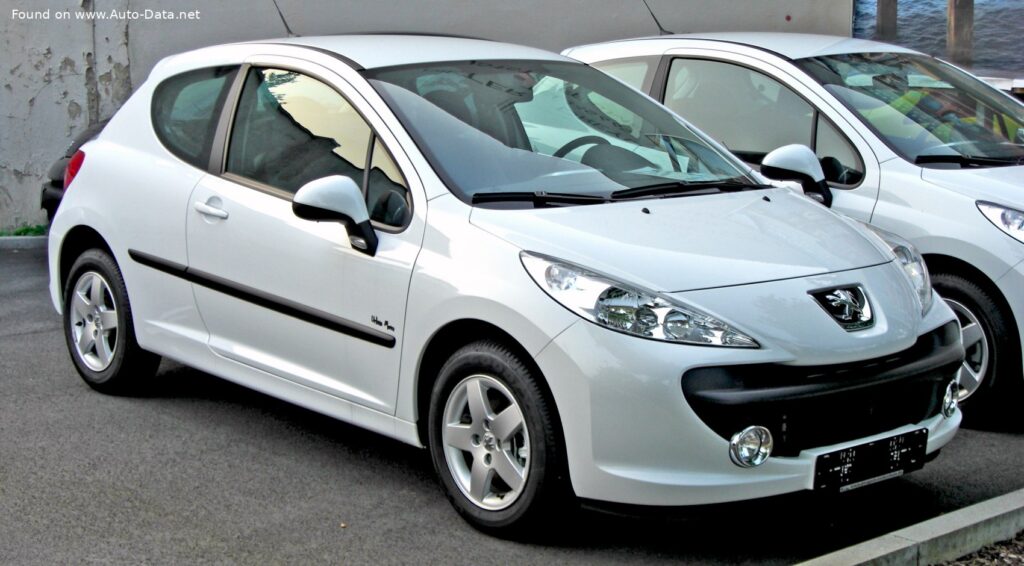
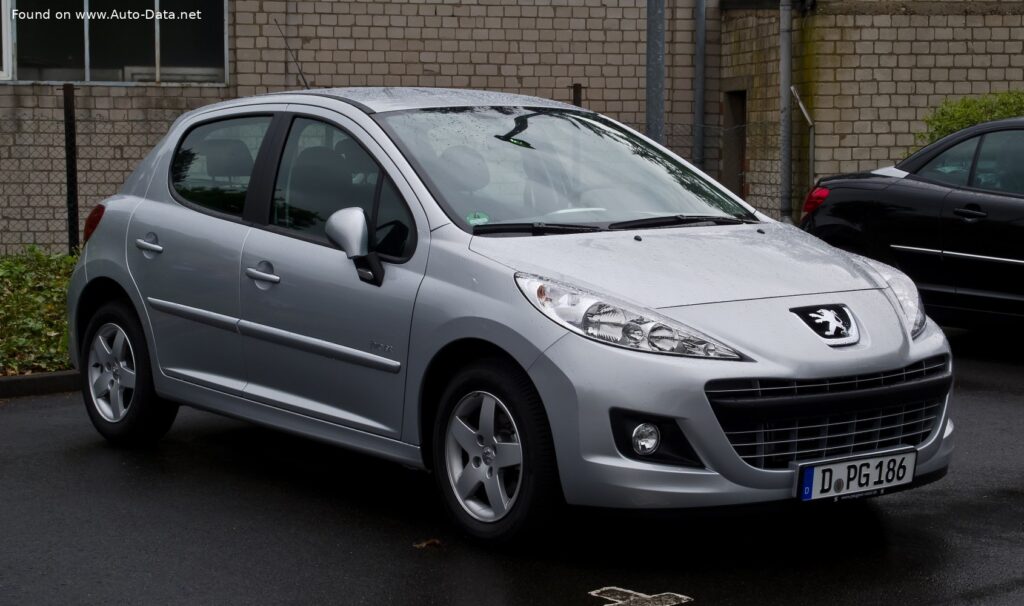
The Peugeot 207 (facelift 2009) retained the core design philosophy of its pre-facelift predecessor but introduced subtle yet effective updates to keep its aesthetic fresh. Available in both 3-door and 5-door hatchback configurations, the 207 offered flexibility for various buyer needs, from singles and couples to small families. The overall design is characteristic of Peugeot during this era: a distinctive, somewhat aggressive front fascia with a large grille, swept-back headlights, and a cohesive, flowing silhouette. The facelift brought revised bumpers, updated lighting signatures, and new wheel designs, refining its appearance without a radical departure.
With a length of 159.25 inches, a width of 68.82 inches (77.64 inches including mirrors), and a height of 57.95 inches, the 207 is ideally sized for navigating narrow European city streets and parking in tight spaces. Its 100-inch wheelbase contributes to a stable ride quality for a car of its size. The drag coefficient of 0.30 indicates a relatively aerodynamic body, further aiding its fuel efficiency.
Inside, the 207 offers seating for five occupants, emphasizing practicality and comfort. The interior design is functional and ergonomic, with controls logically placed. Cargo capacity is respectable for a subcompact, offering 9.53 cubic feet of trunk space with the rear seats up, expandable to a generous 32.6 cubic feet when the rear seats are folded down. This flexibility makes the 207 surprisingly versatile for hauling groceries, luggage, or other items.
In terms of features, the 207 1.4 HDi came equipped with standard safety systems for its segment, including an Anti-lock Braking System (ABS), which was becoming increasingly common and expected during this period. The braking system comprises ventilated discs at the front for effective stopping power and drum brakes at the rear, a cost-effective and adequate solution for the vehicle’s weight and performance. The steering utilizes a rack and pinion system, providing direct and predictable handling, while the front suspension features an independent McPherson strut setup with coil springs and an anti-roll bar, paired with a semi-independent rear suspension with coil springs and an elastic beam. This configuration offers a good balance between ride comfort and handling stability, essential for diverse road conditions. The car rides on 185/65 R15 tires, mounted on 15-inch wheel rims.
Technical Specifications: Peugeot 207 (facelift 2009) 1.4 HDi (68 Hp)
| Specification | Value |
|---|---|
| General Information | |
| Brand | Peugeot |
| Model | 207 |
| Generation | 207 (facelift 2009) |
| Type (Engine) | 1.4 HDi (68 Hp) |
| Start of production | 2009 |
| End of production | 2012 |
| Powertrain Architecture | Internal Combustion engine |
| Body type | Hatchback |
| Seats | 5 |
| Doors | 3-5 |
| Performance Specs | |
| Fuel consumption (economy) – urban | 5.1 l/100 km (46.1 US mpg) |
| Fuel consumption (economy) – extra urban | 3.7 l/100 km (63.6 US mpg) |
| Fuel consumption (economy) – combined | 4.2 l/100 km (56 US mpg) |
| CO2 emissions | 110 g/km |
| Fuel Type | Diesel |
| Acceleration 0 – 60 mph | 14.3 sec |
| Maximum speed | 103.15 mph |
| Emission standard | Euro 5 |
| Weight-to-power ratio | 17.6 kg/Hp (56.8 Hp/tonne) |
| Weight-to-torque ratio | 7.5 kg/Nm (133.6 Nm/tonne) |
| Engine Specs | |
| Power | 68 Hp @ 4000 rpm |
| Power per liter | 48.6 Hp/l |
| Torque | 118.01 lb.-ft. @ 2000 rpm |
| Engine layout | Front, Transverse |
| Engine Model/Code | 8HR DV4C, 8HZ DV4TD |
| Engine displacement | 1398 cm3 (85.31 cu. in.) |
| Number of cylinders | 4 |
| Engine configuration | Inline |
| Cylinder Bore | 2.9 in. |
| Piston Stroke | 3.23 in. |
| Compression ratio | 17.9:1 |
| Number of valves per cylinder | 2 |
| Fuel injection system | Diesel Commonrail |
| Engine aspiration | Turbocharger, Intercooler |
| Valvetrain | SOHC |
| Engine oil capacity | 3.75 l (3.96 US qt) |
| Engine oil specification | Not publicly available (varies by region/service) |
| Coolant | 5.6 l (5.92 US qt) |
| Engine systems | Particulate filter |
| Space, Volume and Weights | |
| Kerb Weight | 2641.14 lbs. |
| Max. weight | 3619.99 lbs. |
| Max load | 978.85 lbs. |
| Trunk (boot) space – minimum | 270 l (9.53 cu. ft.) |
| Trunk (boot) space – maximum | 923 l (32.6 cu. ft.) |
| Fuel tank capacity | 50 l (13.21 US gal) |
| Permitted trailer load with brakes | 1873.93 lbs. |
| Permitted trailer load without brakes | 1322.77 lbs. |
| Dimensions | |
| Length | 159.25 in. |
| Width | 68.82 in. |
| Width with mirrors folded | 71.57 in. |
| Width including mirrors | 77.64 in. |
| Height | 57.95 in. |
| Wheelbase | 100 in. |
| Front track | 58.07 in. |
| Rear (Back) track | 57.8 in. |
| Drag coefficient (Cd) | 0.30 |
| Minimum turning circle (turning diameter) | 35.43 ft. |
| Drivetrain, Brakes and Suspension Specs | |
| Drivetrain Architecture | Front-wheel drive Internal Combustion engine |
| Drive wheel | Front wheel drive |
| Number of gears and type of gearbox | 5 gears, manual transmission |
| Front suspension | Independent, McPherson with coil spring and anti-roll bar |
| Rear suspension | Semi-independent, coil spring, Elastic beam |
| Front brakes | Ventilated discs |
| Rear brakes | Drum |
| Assisting systems | ABS (Anti-lock braking system) |
| Steering type | Steering rack and pinion |
| Tires size | 185/65 R15 |
| Wheel rims size | 15 |
Legacy and Market Impact in the European Subcompact Segment
The Peugeot 207, particularly the facelifted 2009 model with its 1.4 HDi engine, carved out a significant niche in the highly competitive European subcompact market. It followed in the footsteps of highly successful Peugeot models like the 205 and 206, which had established Peugeot’s reputation for producing engaging, practical, and stylish small cars. The 207 continued this legacy, offering a blend of French flair, a comfortable ride, and, crucially, outstanding fuel economy.
In its primary markets, the 207 faced stiff competition from formidable rivals such as the Ford Fiesta, Renault Clio, Volkswagen Polo, Opel Corsa, and Fiat Punto. Against these competitors, the 207 distinguished itself with its distinctive styling, particularly its prominent front end, and a generally comfortable, well-insulated cabin for its class. The diesel variants, like the 1.4 HDi, were particularly popular due to the prevailing tax structures and higher fuel prices in Europe, which heavily favored diesel powertrains for their efficiency. The low CO2 emissions and excellent mpg figures made it an attractive option for both private buyers and fleet operators looking to minimize running costs.
The 207’s market impact was considerable, consistently ranking among the top-selling vehicles in several European countries during its production run. Its success underscored the importance of the B-segment in the European automotive landscape and Peugeot’s ability to deliver a product that met the evolving demands for efficiency, practicality, and contemporary design. The 2009 facelift ensured the model remained fresh and relevant until it was eventually succeeded by the Peugeot 208 in 2012, which further refined the formula of compact dimensions, modern technology, and a continued emphasis on fuel efficiency. The Peugeot 207 (facelift 2009) 1.4 HDi (68 Hp) stands as a testament to Peugeot’s engineering prowess in creating an economical and dependable vehicle for the masses, a true workhorse of European roads.