The Peugeot 207 (facelift 2009) 1.6 HDi (112 Hp): A European Supermini Standard-Bearer
The Peugeot 207, launched in 2006 as a successor to the immensely popular 206, represented Peugeot’s continued commitment to the highly competitive European supermini segment. The generation relevant here, the Peugeot 207 (facelift 2009) 1.6 HDi (112 Hp), introduced a mid-cycle refresh that refined its aesthetics, improved its interior, and updated its powertrain offerings for enhanced efficiency and performance. While never officially sold in the United States, the 207 was a ubiquitous sight on European roads, embodying the practicality, style, and fuel economy that define its class. This particular variant, equipped with the 1.6-liter HDi diesel engine producing 112 horsepower, was a prime example of a balanced package, offering spirited performance for its size combined with remarkable fuel efficiency, making it a compelling choice for European consumers seeking a versatile and economical daily driver from 2009 to 2012.
Engine & Performance of the Peugeot 207 (facelift 2009) 1.6 HDi (112 Hp)
At the heart of this specific Peugeot 207 (facelift 2009) 1.6 HDi (112 Hp) model lies a sophisticated 1.6-liter (1560 cm3 or 95.2 cu. in.) inline four-cylinder diesel engine, designated with the model code 9HR DV6C. This powerplant utilizes a common rail direct fuel injection system, a hallmark of modern diesel technology, ensuring precise fuel delivery for optimal combustion. Further enhancing its performance and efficiency, the engine is equipped with a turbocharger and an intercooler, which together boost power output and improve thermal efficiency. With a compression ratio of 17.6:1 and a SOHC (Single Overhead Camshaft) valvetrain featuring two valves per cylinder, this engine generates a respectable 112 horsepower at 3600 rpm.
Perhaps even more impactful for a vehicle of this size is its torque output: a robust 270 Nm (199.14 lb.-ft.) delivered at a low 1750 rpm. This ample torque, available early in the rev range, contributes significantly to the car’s responsive feel and ease of driving, particularly in urban environments or when overtaking. Power is sent to the front wheels via a smooth-shifting 6-speed manual transmission, a pairing that allows the driver to extract the most from the engine’s capabilities.
In terms of raw performance, the Peugeot 207 (facelift 2009) 1.6 HDi (112 Hp) is capable of accelerating from 0 to 60 mph in a brisk 10.1 seconds, with a top speed reaching 119.92 mph. These figures were competitive within its class and provided a satisfying driving experience for its target audience. Where this powertrain truly shined, however, was in its fuel economy. The combined cycle fuel consumption was an impressive 51.1 US mpg, dropping to an exceptional 58.8 US mpg on the extra-urban cycle. This efficiency, combined with CO2 emissions of just 119 g/km and compliance with Euro 5 emission standards, underlined its environmental consciousness for the era, further aided by the inclusion of a particulate filter. The 13.21 US gallon fuel tank also provided a substantial cruising range, a key advantage for European long-distance travel.
Design & Features of the Peugeot 207 (facelift 2009)
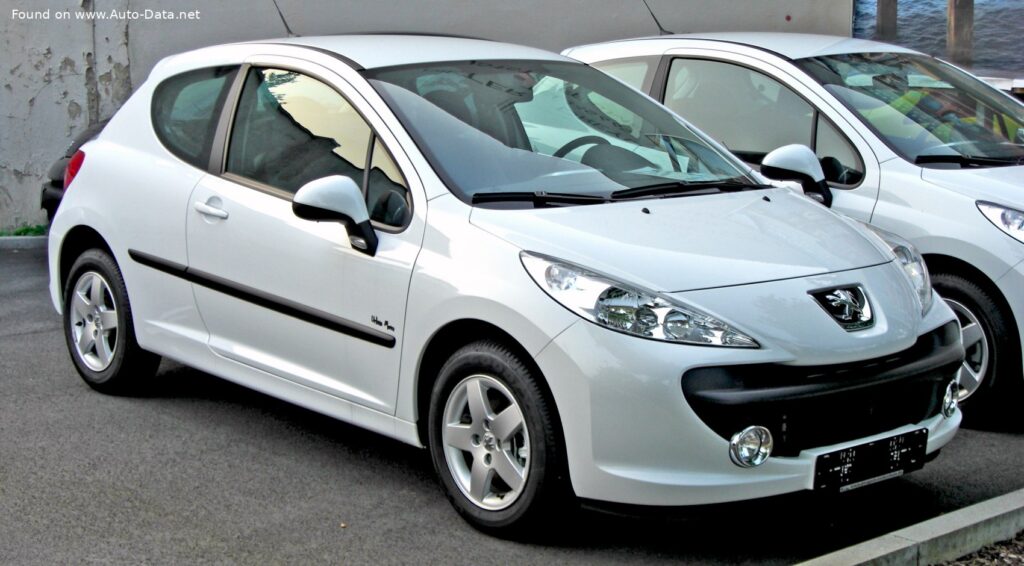
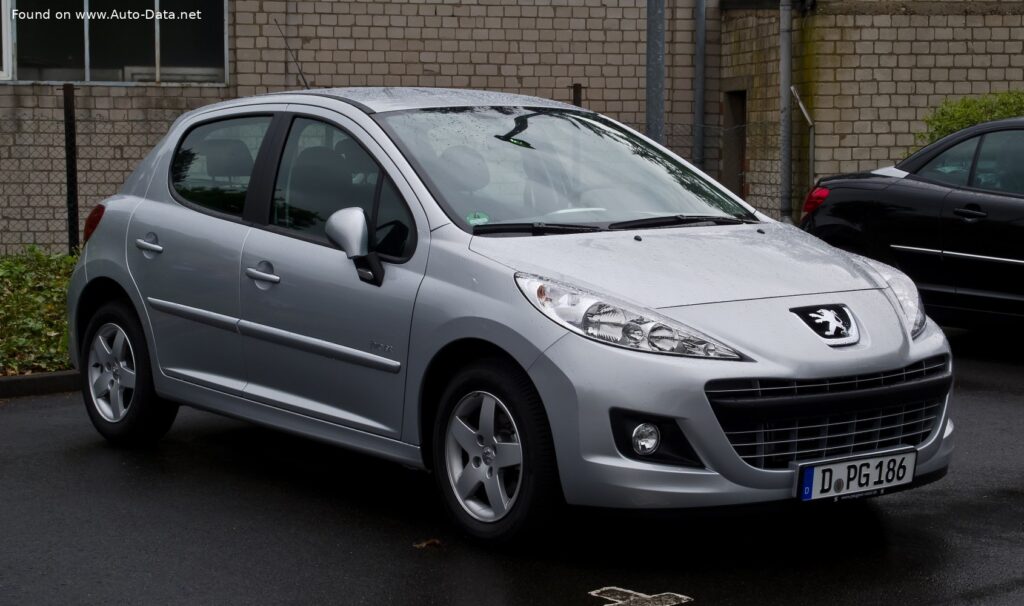
The Peugeot 207 (facelift 2009) retained the appealing hatchback body style that was central to its predecessor’s success, offering a blend of compact dimensions and practical interior space. Available in both 3-door and 5-door configurations, it seated five passengers, making it a versatile choice for individuals and small families alike. The 2009 facelift brought subtle but effective updates to the exterior, typically including revised front bumpers, new grille designs, and updated lighting clusters, giving it a fresher, more contemporary look without straying far from the original 207’s distinctive styling. Its overall length measured 159.25 inches, with a width of 68.82 inches and a height of 57.95 inches, making it nimble for city driving and parking. The wheelbase of 100 inches contributed to a stable ride quality for its segment.
Inside, the 207’s cabin was designed with practicality and comfort in mind. The facelift often brought improvements to material quality and trim options, aiming for a more premium feel. While not a luxury vehicle, it offered a user-friendly layout and adequate ergonomics. For cargo, the trunk space ranged from a minimum of 9.53 cu. ft. with all seats in place, expanding significantly to 32.6 cu. ft. with the rear seats folded down, demonstrating its hatchback versatility.
Safety and driving dynamics were also key considerations. The Peugeot 207 (facelift 2009) was equipped with essential assisting systems like ABS (Anti-lock Braking System) as standard, enhancing braking control. The braking system itself comprised ventilated discs at the front and solid discs at the rear, providing confident stopping power. Its suspension setup featured an independent McPherson strut system with coil springs and an anti-roll bar at the front, paired with a semi-independent setup featuring coil springs and an elastic beam at the rear. This combination delivered a comfortable ride quality balanced with competent handling for its class. The steering was a rack and pinion type, offering direct feedback. Standard tire size was 195/55 R16 on 16-inch wheel rims, contributing to both grip and ride comfort. The vehicle also boasted a relatively low drag coefficient (Cd) of 0.30, aiding both fuel efficiency and reducing wind noise.
Technical Specifications
| Category | Specification |
|---|---|
| General Information | |
| Brand | Peugeot |
| Model | 207 |
| Generation | 207 (facelift 2009) |
| Type (Engine) | 1.6 HDi (112 Hp) |
| Start of Production | 2009 year |
| End of Production | 2012 year |
| Powertrain Architecture | Internal Combustion engine |
| Body type | Hatchback |
| Seats | 5 |
| Doors | 3-5 |
| Performance Specs | |
| Fuel consumption (economy) – urban | 5.7 l/100 km (41.3 US mpg) |
| Fuel consumption (economy) – extra urban | 4 l/100 km (58.8 US mpg) |
| Fuel consumption (economy) – combined | 4.6 l/100 km (51.1 US mpg) |
| CO2 emissions | 119 g/km |
| Fuel Type | Diesel |
| Acceleration 0 – 60 mph | 10.1 sec |
| Maximum speed | 193 km/h (119.92 mph) |
| Emission standard | Euro 5 |
| Weight-to-power ratio | 10.6 kg/Hp (94.1 Hp/tonne) |
| Weight-to-torque ratio | 4.4 kg/Nm (226.9 Nm/tonne) |
| Engine Specs | |
| Power | 112 Hp @ 3600 rpm |
| Power per liter | 71.8 Hp/l |
| Torque | 270 Nm @ 1750 rpm (199.14 lb.-ft.) |
| Engine layout | Front, Transverse |
| Engine Model/Code | 9HR DV6C |
| Engine displacement | 1560 cm3 (95.2 cu. in.) |
| Number of cylinders | 4 |
| Engine configuration | Inline |
| Cylinder Bore | 75 mm (2.95 in.) |
| Piston Stroke | 88.3 mm (3.48 in.) |
| Compression ratio | 17.6:1 |
| Number of valves per cylinder | 2 |
| Fuel injection system | Diesel Commonrail |
| Engine aspiration | Turbocharger, Intercooler |
| Valvetrain | SOHC |
| Engine oil capacity | 3.75 l (3.96 US qt) |
| Coolant | 5.6 l (5.92 US qt) |
| Engine systems | Particulate filter |
| Space, Volume and Weights | |
| Kerb Weight | 1190 kg (2623.5 lbs.) |
| Max. weight | 1726 kg (3805.18 lbs.) |
| Max load | 536 kg (1181.68 lbs.) |
| Trunk (boot) space – minimum | 270 l (9.53 cu. ft.) |
| Trunk (boot) space – maximum | 923 l (32.6 cu. ft.) |
| Fuel tank capacity | 50 l (13.21 US gal) |
| Permitted trailer load with brakes (12%) | 1150 kg (2535.32 lbs.) |
| Permitted trailer load without brakes | 600 kg (1322.77 lbs.) |
| Dimensions | |
| Length | 4045 mm (159.25 in.) |
| Width | 1748 mm (68.82 in.) |
| Width with mirrors folded | 1818 mm (71.57 in.) |
| Width including mirrors | 1972 mm (77.64 in.) |
| Height | 1472 mm (57.95 in.) |
| Wheelbase | 2540 mm (100 in.) |
| Front track | 1475 mm (58.07 in.) |
| Rear (Back) track | 1468 mm (57.8 in.) |
| Drag coefficient (Cd) | 0.30 |
| Minimum turning circle (turning diameter) | 11.0 m (36.09 ft.) |
| Drivetrain, Brakes and Suspension Specs | |
| Drivetrain Architecture | Front wheel drive |
| Drive wheel | Front wheel drive |
| Number of gears and type of gearbox | 6 gears, manual transmission |
| Front suspension | Independent, type McPherson with coil spring and anti-roll bar |
| Rear suspension | Semi-independent, coil spring, Elastic beam |
| Front brakes | Ventilated discs |
| Rear brakes | Disc |
| Assisting systems | ABS (Anti-lock braking system) |
| Steering type | Steering rack and pinion |
| Tires size | 195/55 R16 |
| Wheel rims size | 16 |
Legacy & Market Impact of the Peugeot 207
The Peugeot 207, and specifically the facelifted 2009 model with its efficient 1.6 HDi (112 Hp) engine, played a significant role in the fiercely competitive European supermini segment. This class of vehicles, known for its compact size, fuel efficiency, and affordability, is arguably the most important in many European markets. The 207 faced stiff competition from established rivals such as the Renault Clio, Ford Fiesta, Volkswagen Polo, Opel Corsa, and Fiat Punto. In this crowded field, the 207 carved out its niche by offering a distinctive French design flair, a comfortable ride, and a strong emphasis on diesel powertrain efficiency.
While it didn’t achieve the same iconic status or sales volumes as its predecessor, the 206, the 207 was a consistent performer for Peugeot. The 1.6 HDi (112 Hp) variant was particularly well-regarded for its blend of usable power and exceptional fuel economy, making it a popular choice for both private buyers and fleet operators. Its Euro 5 compliance and particulate filter also showcased Peugeot’s commitment to cleaner diesel technology during a period when environmental concerns were increasingly influencing automotive purchasing decisions in Europe.
The Peugeot 207 (facelift 2009) 1.6 HDi (112 Hp) cemented Peugeot’s reputation as a leader in small, efficient diesel engines, a segment where French manufacturers traditionally excelled. It offered a compelling package of modern technology, practical design, and low running costs, which were highly valued by European consumers. Its legacy is that of a solid, reliable, and economical supermini that successfully navigated the demands of a challenging market, contributing to Peugeot’s continued presence and influence in the global automotive landscape, even if its direct impact was primarily felt outside of North America. The 207 paved the way for its successor, the 208, and underscored the importance of continuous innovation in design, efficiency, and technology for compact vehicles worldwide.