The Peugeot 207 (facelift 2009) 1.6 THP (156 Hp): A European Hot Hatch Contender
The Peugeot 207 (facelift 2009) 1.6 THP (156 Hp) represents a significant iteration of the French automaker’s popular B-segment supermini, a class of vehicles particularly dominant in the European market. Launched in 2009 as a mid-cycle refresh for the 207 generation, this particular variant stood out for its potent turbocharged engine, offering a compelling blend of performance and everyday usability. While the Peugeot 207 was never officially sold in the United States, it played a crucial role in Peugeot’s global strategy, especially in Europe, where it competed fiercely against established rivals like the Ford Fiesta, Renault Clio, and Volkswagen Polo. This model, produced from 2009 to 2012, showcased Peugeot’s commitment to dynamic driving characteristics and sophisticated powertrain technology in a compact package.
Evolution and Market Positioning
The Peugeot 207 itself was introduced in 2006 as the successor to the highly successful 206. The 2009 facelift aimed to refresh its exterior styling, update interior materials, and refine its engine lineup to meet evolving emission standards and consumer expectations. The 1.6 THP (Turbo High Pressure) engine, a collaborative effort with BMW, was a key highlight, offering a level of performance typically associated with larger, more expensive cars, but within the economical footprint of a small hatchback. This positioned the Peugeot 207 (facelift 2009) 1.6 THP (156 Hp) as a “warm hatch” – a step below full-blown performance models but significantly more spirited than standard variants, appealing to drivers seeking excitement without sacrificing practicality or fuel efficiency.
Engine and Performance: The Heart of the Peugeot 207 (facelift 2009) 1.6 THP (156 Hp)
At the core of this particular 207 variant is the acclaimed 1.6-liter THP (Turbo High Pressure) gasoline engine, identified by its 5FR EP6DT code. This inline four-cylinder powerplant, featuring a DOHC-VVT (Dual Overhead Camshaft with Variable Valve Timing) valvetrain, direct fuel injection, and a turbocharger with an intercooler, was engineered for both efficiency and robust power delivery. It produced a healthy 156 horsepower at 6000 rpm, translating to an impressive 97.6 horsepower per liter, a testament to its advanced design for its era. More significantly, the engine generated a substantial 177.01 lb.-ft. of torque, available across a broad rev range from 1400 to 4000 rpm. This wide torque band ensured excellent responsiveness and flexibility in various driving conditions, making it enjoyable both in urban environments and on the open road.
Mated to a precise 6-speed manual transmission, the 1.6 THP engine propelled the 207 from 0 to 60 mph in a swift 7.6 seconds, with 0 to 62 mph (100 km/h) achieved in 8 seconds. Its top speed was rated at 134.22 mph (216 km/h), making it one of the quicker cars in its segment. Despite its performance credentials, Peugeot engineered the engine for reasonable fuel economy. The combined fuel consumption was an estimated 34.6 US mpg (6.8 l/100 km), with extra-urban figures reaching an impressive 46.1 US mpg (5.1 l/100 km). Urban driving yielded around 24.2 US mpg (9.7 l/100 km). Emissions were rated at 159 g/km of CO2, meeting the Euro 5 emission standard, reflecting a balance between performance and environmental considerations.
Design and Features
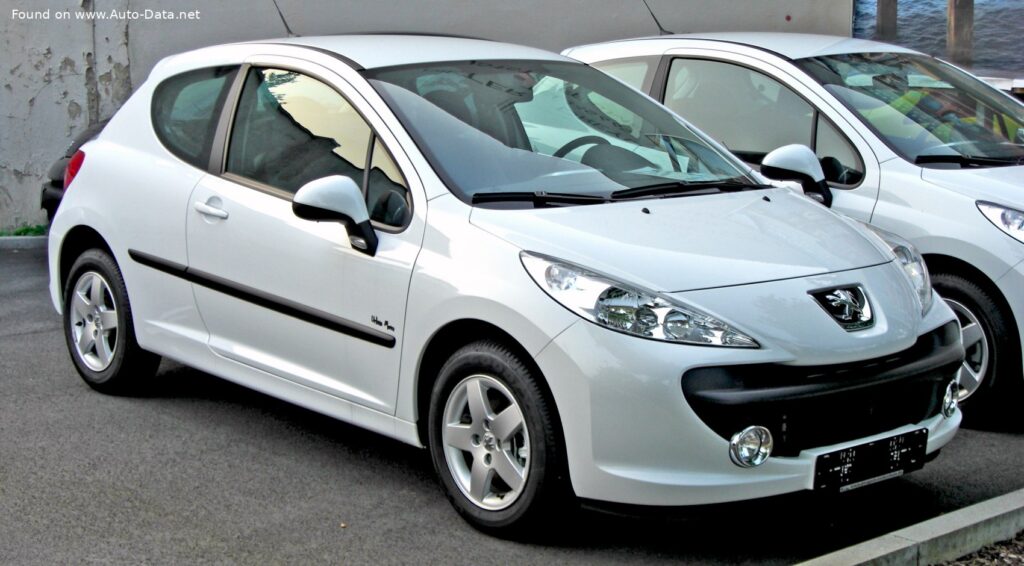
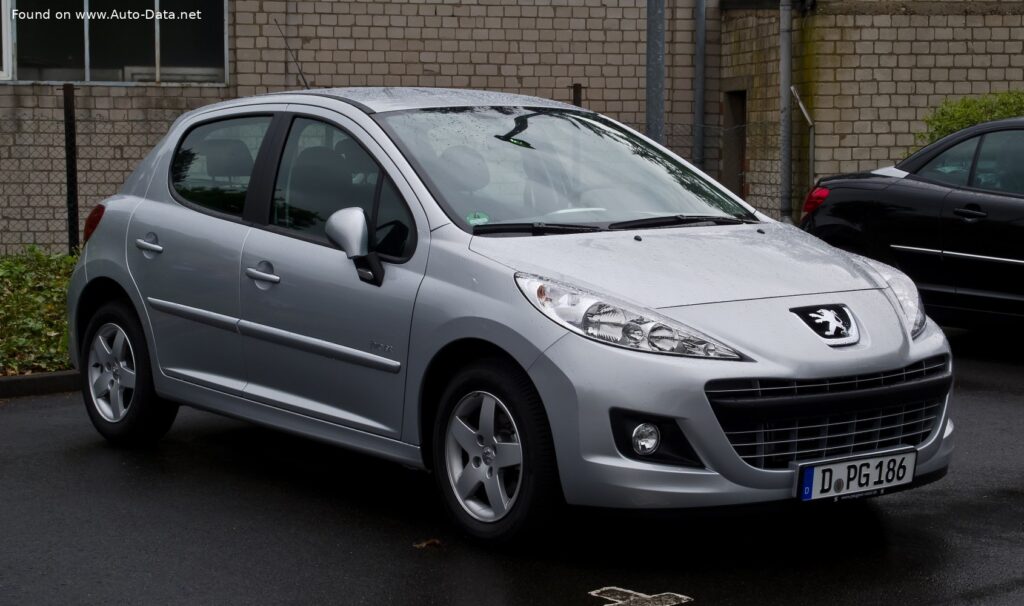
The Peugeot 207 (facelift 2009) maintained the general design language of the pre-facelift model but incorporated subtle refinements. As a hatchback, it was offered in both 3-door and 5-door configurations, providing versatility for different buyer needs. The facelift introduced minor updates to the front grille, headlights, and taillights, giving it a slightly fresher and more modern appearance. Its compact dimensions – a length of 159.25 inches, a width of 68.82 inches, and a height of 57.95 inches – made it agile and easy to maneuver in congested European cities, while a wheelbase of 100 inches contributed to a stable ride.
Inside, the 207 offered seating for five occupants, typical for its segment. While not a luxury vehicle, the interior was designed for practicality and comfort, with improvements in material quality and trim details following the facelift. Cargo capacity was respectable for a supermini, with a minimum trunk space of 9.53 cubic feet (270 liters), expandable to 32.6 cubic feet (923 liters) with the rear seats folded down. This flexibility further enhanced its appeal as a versatile daily driver. The vehicle’s aerodynamic profile, indicated by a drag coefficient (Cd) of 0.30, contributed to both fuel efficiency and reduced wind noise at higher speeds.
Safety features for the 207 included a comprehensive suite of passive and active systems. The standard anti-lock braking system (ABS) with ventilated discs at the front and disc brakes at the rear ensured confident stopping power. The suspension setup, featuring independent McPherson struts with coil springs and an anti-roll bar at the front and a semi-independent elastic beam with coil springs at the rear, provided a good balance between ride comfort and handling prowess. The car rode on 205/45 R17 tires, mounted on 17-inch wheel rims, which further contributed to its sporty stance and grip.
Technical Specifications
| Category | Specification |
|---|---|
| Brand | Peugeot |
| Model | 207 |
| Generation | 207 (facelift 2009) |
| Type (Engine) | 1.6 THP (156 Hp) |
| Production Start | 2009 year |
| Production End | 2012 year |
| Powertrain Architecture | Internal Combustion engine |
| Body type | Hatchback |
| Seats | 5 |
| Doors | 3-5 |
| Performance Specs | |
| Fuel consumption (economy) – urban | 9.7 l/100 km (24.2 US mpg) |
| Fuel consumption (economy) – extra urban | 5.1 l/100 km (46.1 US mpg) |
| Fuel consumption (economy) – combined | 6.8 l/100 km (34.6 US mpg) |
| CO2 emissions | 159 g/km |
| Fuel Type | Petrol (Gasoline) |
| Acceleration 0 – 60 mph | 7.6 sec |
| Acceleration 0 – 62 mph (0 – 100 km/h) | 8 sec |
| Maximum speed | 134.22 mph (216 km/h) |
| Emission standard | Euro 5 |
| Weight-to-power ratio | 7.9 kg/Hp (126.4 Hp/tonne) |
| Weight-to-torque ratio | 5.1 kg/Nm (194.5 Nm/tonne) |
| Engine Specs | |
| Power | 156 Hp @ 6000 rpm |
| Power per liter | 97.6 Hp/l |
| Torque | 177.01 lb.-ft. (240 Nm) @ 1400-4000 rpm |
| Engine layout | Front, Transverse |
| Engine Model/Code | 5FR EP6DT |
| Engine displacement | 1598 cm3 (97.52 cu. in.) |
| Number of cylinders | 4 |
| Engine configuration | Inline |
| Cylinder Bore | 3.03 in. (77 mm) |
| Piston Stroke | 3.38 in. (85.8 mm) |
| Compression ratio | 10.5:1 |
| Number of valves per cylinder | 4 |
| Fuel injection system | Direct injection |
| Engine aspiration | Turbocharger, Intercooler |
| Valvetrain | DOHC-VVT |
| Engine oil capacity | 4.25 l (4.49 US qt) |
| Engine oil specification | Not provided |
| Coolant capacity | 5.5 l (5.81 US qt) |
| Space, Volume and Weights | |
| Kerb Weight | 2720.5 lbs. (1234 kg) |
| Max. weight (GVWR) | 3745.65 lbs. (1699 kg) |
| Max load | 1025.15 lbs. (465 kg) |
| Trunk (boot) space – minimum | 9.53 cu. ft. (270 l) |
| Trunk (boot) space – maximum | 32.6 cu. ft. (923 l) |
| Fuel tank capacity | 13.21 US gal (50 l) |
| Permitted trailer load with brakes (12%) | 2535.32 lbs. (1150 kg) |
| Permitted trailer load without brakes | 1322.77 lbs. (600 kg) |
| Dimensions | |
| Length | 159.25 in. (4045 mm) |
| Width | 68.82 in. (1748 mm) |
| Width with mirrors folded | 71.57 in. (1818 mm) |
| Width including mirrors | 77.64 in. (1972 mm) |
| Height | 57.95 in. (1472 mm) |
| Wheelbase | 100 in. (2540 mm) |
| Front track | 58.07 in. (1475 mm) |
| Rear (Back) track | 57.8 in. (1468 mm) |
| Drag coefficient (Cd) | 0.30 |
| Minimum turning circle (turning diameter) | 36.09 ft. (11.0 m) |
| Drivetrain, Brakes and Suspension Specs | |
| Drivetrain Architecture | Front-wheel drive, Internal Combustion engine |
| Drive wheel | Front wheel drive |
| Number of gears and type of gearbox | 6 gears, manual transmission |
| Front suspension | Independent, McPherson with coil spring and anti-roll bar |
| Rear suspension | Semi-independent, coil spring, Elastic beam |
| Front brakes | Ventilated discs |
| Rear brakes | Disc |
| Assisting systems | ABS (Anti-lock braking system) |
| Steering type | Steering rack and pinion |
| Tires size | 205/45 R17 |
| Wheel rims size | 17 inches |
Legacy and Market Impact
The Peugeot 207, particularly its 1.6 THP variants, left a notable mark on the European supermini segment. It was a direct competitor to other popular B-segment hatchbacks such as the Volkswagen Polo, Ford Fiesta, Opel Corsa (Vauxhall Corsa in the UK), and the Renault Clio. While the 207 aimed for a more premium feel than its predecessor, the 206, it faced stiff competition from rivals that often excelled in specific areas, whether it be driving dynamics (Fiesta) or perceived quality (Polo).
The 1.6 THP engine, developed in collaboration with BMW (and also used in models like the Mini Cooper S), was a significant asset for the Peugeot 207 (facelift 2009) 1.6 THP (156 Hp). It provided a level of sophistication and performance that elevated the 207 above many of its naturally aspirated competitors. This engine helped Peugeot maintain its reputation for producing engaging and spirited small cars, a heritage stretching back to models like the iconic 205 GTi. The THP engine, however, also gained a reputation for certain reliability issues in some early iterations, particularly related to timing chain tensioners and carbon buildup, which somewhat affected its long-term perception, though later revisions improved these aspects.
In terms of market impact, the 207 was a strong seller for Peugeot across Europe, reinforcing the brand’s presence in a critical volume segment. Its combination of stylish French design, comfortable ride, and the potent THP engine in this specific trim offered a compelling package for those seeking a practical yet fun-to-drive compact car. Its absence from the North American market is typical for many European B-segment vehicles, as the segment generally struggles to gain traction against larger, more affordable sedans and SUVs preferred by American consumers. Importing and adapting such a vehicle for US regulations and market preferences would have also significantly increased its cost, making it uncompetitive. Ultimately, the Peugeot 207 (facelift 2009) 1.6 THP (156 Hp) is remembered as a capable and spirited European hatchback that successfully blended performance with the practicality demanded by its target audience.