Introduction to the Peugeot 207 SW 1.4 VTi (95 Hp)
The Peugeot 207 SW 1.4 VTi (95 Hp) represents a compelling entry in the European B-segment, or supermini class, specifically tailored for practicality and versatility. Launched in 2007 as part of the broader 207 generation, the SW (Station Wagon) variant offered a more spacious and family-friendly alternative to its popular hatchback sibling. Produced until 2009 with this particular powertrain, the 207 SW was a significant player in markets where compact station wagons were highly valued for their blend of maneuverability, fuel efficiency, and expanded cargo capacity. While not officially imported to the United States, this model exemplifies the European automotive philosophy of maximizing utility within a compact footprint, catering to urban families and individuals requiring more space than a standard hatchback without the bulk of a larger vehicle. Its internal combustion engine architecture, coupled with a front-wheel-drive layout, underscored its conventional yet reliable engineering for everyday driving.
The Peugeot 207 SW: A Practical Evolution
Succeeding the immensely successful 206, the Peugeot 207 series, including the SW, aimed to elevate standards in terms of design, safety, and driving dynamics within its segment. The SW variant, in particular, carved out a niche by offering a considerably larger trunk and more flexible interior space, addressing a key consumer need in its primary European markets. The 1.4 VTi engine, a product of the PSA Group’s collaboration with BMW (known as the ‘Prince’ engine family), provided a modern, efficient, and adequately powered option for the segment, balancing performance with economical operation and adherence to contemporary emission standards. This particular iteration of the 207 SW was designed to be a pragmatic daily driver, capable of handling a variety of tasks from city commuting to weekend trips, all while maintaining the characteristic French flair for design and ride comfort.
Engine and Performance: The 1.4 VTi Powerplant for the Peugeot 207 SW
At the heart of the Peugeot 207 SW 1.4 VTi (95 Hp) lies a sophisticated naturally aspirated inline-four gasoline engine, designated by the code 8FS EP3. This powerplant, featuring a displacement of 1397 cm3 (approximately 1.4 liters or 85.25 cubic inches), was engineered for a balance of efficiency and responsive performance. It generated a peak output of 95 horsepower at 6000 revolutions per minute (rpm), making it a competitive offering in its class. Torque was rated at 136 Nm (100.31 lb.-ft.) at a respectable 4000 rpm, providing sufficient pulling power for urban driving and highway cruising.
A key technological highlight of this engine was its Dual Overhead Camshaft (DOHC) valvetrain with Variable Valve Timing (VVT). This system allowed for precise control over valve lift and timing, optimizing engine breathing across the rev range. The result was improved fuel efficiency, reduced emissions, and a broader torque curve compared to engines without such advanced valvetrain technology. Fuel delivery was handled by a multi-port manifold injection system, a reliable and well-proven method for gasoline engines of this era.
Power was transmitted to the front wheels via a smooth-shifting 5-speed manual transmission, offering direct driver engagement and control over the power delivery. This drivetrain architecture, combined with the engine’s characteristics, allowed the 207 SW 1.4 VTi to achieve a 0 to 60 mph acceleration time of approximately 11.2 seconds, with a top speed of 114.95 mph (185 km/h). While not a performance leader, these figures were entirely adequate for its intended purpose as a practical family wagon.
Fuel economy was a strong point for the 207 SW 1.4 VTi, reflecting its efficient engine design and the manual gearbox. The combined fuel consumption was rated at 6.3 liters per 100 kilometers, which translates to an impressive 37.3 US miles per gallon. Urban driving yielded 28.7 US mpg (8.2 l/100 km), while extra-urban conditions saw consumption drop to 45.2 US mpg (5.2 l/100 km). With CO2 emissions of 150 g/km, the vehicle met the Euro 4 emission standard, demonstrating its commitment to environmental responsibility for its time. The car’s weight-to-power ratio stood at 12.8 kg/Hp (78.2 Hp/tonne), further underscoring its efficient use of the available power.
Design and Features of the Peugeot 207 SW
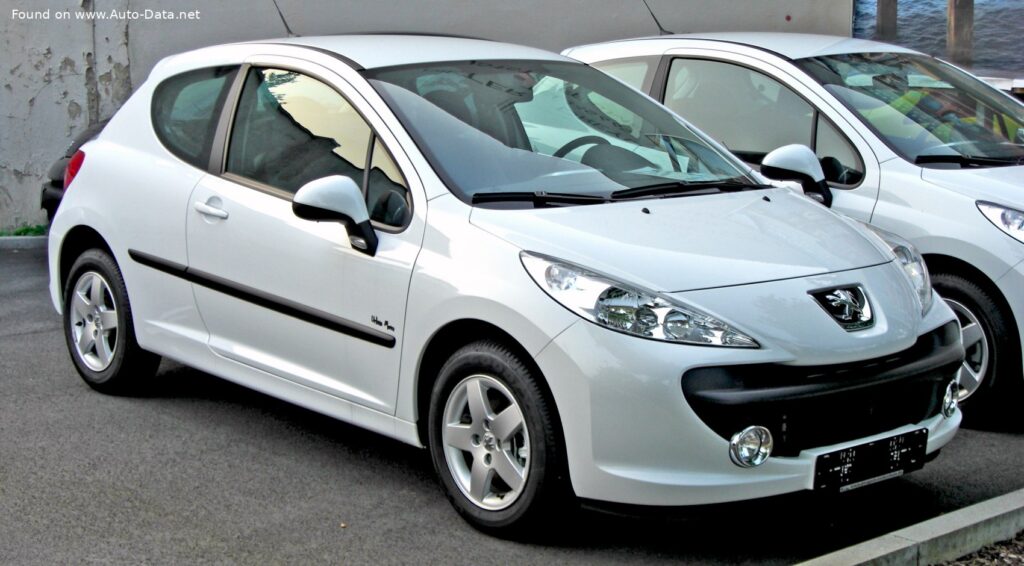
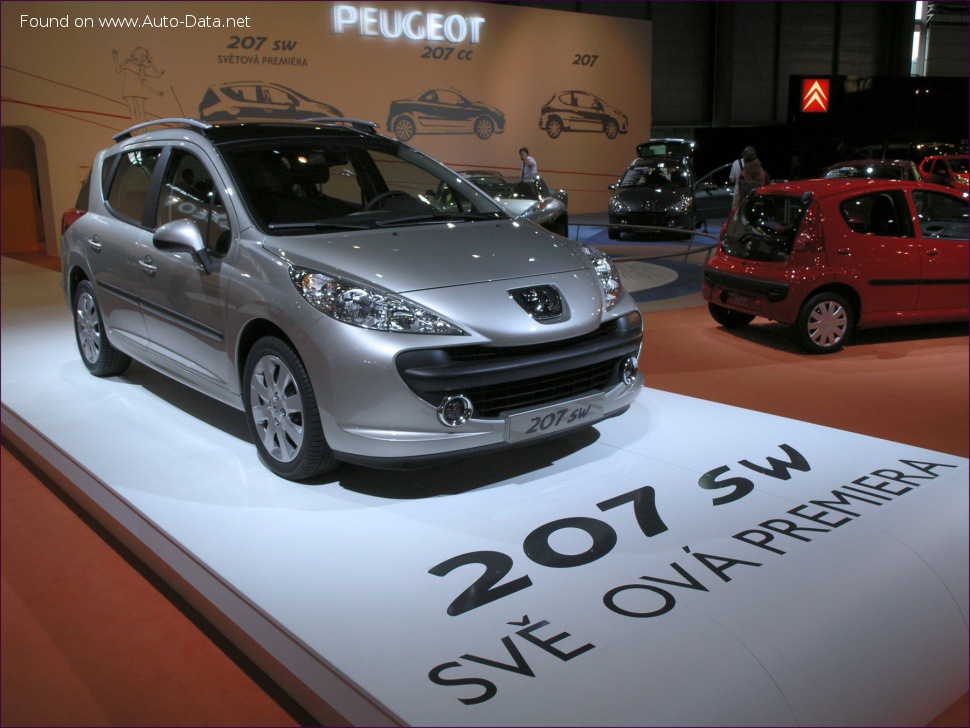
The Peugeot 207 SW adopted a distinctive and appealing design that blended the contemporary styling of the 207 hatchback with the added utility of a station wagon body. Its exterior dimensions, measuring 163.62 inches (4156 mm) in length, 68.82 inches (1748 mm) in width (77.64 inches or 1972 mm including mirrors), and 60.12 inches (1527 mm) in height, positioned it as a compact yet surprisingly capacious vehicle. The extended roofline and redesigned rear section seamlessly integrated the larger cargo area, while retaining a cohesive and dynamic aesthetic. The drag coefficient (Cd) of 0.3 was commendable for a vehicle of its type, contributing to both fuel efficiency and reduced wind noise.
Inside, the 207 SW was designed to be a highly functional 5-door, 5-seater vehicle. The primary advantage of the SW variant was its flexible cargo space. With the rear seats in place, it offered a minimum trunk volume of 11.9 cubic feet (337 liters), which was significantly more practical than its hatchback counterpart. When the rear seats were folded down, this capacity expanded dramatically to a maximum of 44.43 cubic feet (1258 liters), transforming the car into a highly capable hauler for its size. This adaptability made it an ideal choice for families and individuals needing to transport varying amounts of luggage, groceries, or sports equipment.
Standard features for the 207 SW in its European markets typically included power-assisted steering (rack and pinion type), central locking, and a range of comfort and convenience options, though specific trims varied. Safety was also a key consideration for Peugeot, and the 207 SW came equipped with an Anti-lock Braking System (ABS) as standard, enhancing control during emergency braking maneuvers. The braking system comprised ventilated discs at the front for effective stopping power and reliable drum brakes at the rear. The suspension setup featured an independent McPherson strut system at the front and a semi-independent coil spring arrangement at the rear, providing a comfortable ride quality characteristic of French vehicles, while maintaining predictable handling. The vehicle rode on 185/65 R15 tires, mounted on 15-inch wheel rims, offering a good balance of grip, comfort, and rolling resistance. The 100-inch (2540 mm) wheelbase contributed to a stable ride, and a minimum turning circle of 35.43 feet (10.8 m) ensured easy maneuverability in urban environments.
Technical Specifications
| Category | Specification |
|---|---|
| Brand | Peugeot |
| Model | 207 SW |
| Engine Type | 1.4 VTi (95 Hp) |
| Production Start | 2007 |
| Production End | 2009 |
| Body Type | Station Wagon (Estate) |
| Seats | 5 |
| Doors | 5 |
| Fuel Type | Petrol (Gasoline) |
| Engine Layout | Front, Transverse |
| Engine Model/Code | 8FS EP3 |
| Engine Displacement | 1397 cm3 (85.25 cu. in.) |
| Number of Cylinders | 4, Inline |
| Cylinder Bore | 77 mm (3.03 in.) |
| Piston Stroke | 75 mm (2.95 in.) |
| Compression Ratio | 11:1 |
| Valves per Cylinder | 4 |
| Valvetrain | DOHC-VVT |
| Fuel Injection System | Multi-port manifold injection |
| Engine Aspiration | Naturally aspirated |
| Power | 95 Hp @ 6000 rpm |
| Power per Liter | 68 Hp/l |
| Torque | 136 Nm @ 4000 rpm (100.31 lb.-ft. @ 4000 rpm) |
| Acceleration 0-60 mph | 11.2 sec |
| Acceleration 0-100 km/h | 11.8 sec |
| Maximum Speed | 185 km/h (114.95 mph) |
| Fuel Consumption (Urban) | 8.2 l/100 km (28.7 US mpg) |
| Fuel Consumption (Extra Urban) | 5.2 l/100 km (45.2 US mpg) |
| Fuel Consumption (Combined) | 6.3 l/100 km (37.3 US mpg) |
| CO2 Emissions | 150 g/km |
| Emission Standard | Euro 4 |
| Engine Oil Capacity | 4.25 l (4.49 US qt) |
| Coolant Capacity | 6 l (6.34 US qt) |
| Drivetrain Architecture | Front-wheel drive |
| Gearbox Type | 5-speed manual |
| Front Suspension | Independent type McPherson |
| Rear Suspension | Semi-independent, coil spring |
| Front Brakes | Ventilated discs |
| Rear Brakes | Drum |
| Assisting Systems | ABS (Anti-lock braking system) |
| Steering Type | Steering rack and pinion |
| Tires Size | 185/65 R15 |
| Wheel Rims Size | 15 inches |
| Kerb Weight | 1215 kg (2678.62 lbs) |
| Max. Weight | 1691 kg (3728.02 lbs) |
| Max Load | 476 kg (1049.4 lbs) |
| Trunk Space (Min) | 337 l (11.9 cu. ft.) |
| Trunk Space (Max) | 1258 l (44.43 cu. ft.) |
| Fuel Tank Capacity | 50 l (13.21 US gal) |
| Permitted Trailer Load (with brakes) | 1150 kg (2535.32 lbs) |
| Permitted Trailer Load (without brakes) | 600 kg (1322.77 lbs) |
| Length | 4156 mm (163.62 in.) |
| Width | 1748 mm (68.82 in.) |
| Width with mirrors folded | 1818 mm (71.57 in.) |
| Width including mirrors | 1972 mm (77.64 in.) |
| Height | 1527 mm (60.12 in.) |
| Wheelbase | 2540 mm (100 in.) |
| Front Track | 1467 mm (57.76 in.) |
| Rear Track | 1461 mm (57.52 in.) |
| Drag Coefficient (Cd) | 0.3 |
| Minimum Turning Circle | 10.8 m (35.43 ft.) |
Legacy and Market Impact of the Peugeot 207 SW
The Peugeot 207 SW 1.4 VTi (95 Hp), though a specific variant within the broader 207 range, played an important role in shaping Peugeot’s reputation as a manufacturer of practical, stylish, and efficient compact cars in Europe. Its primary market was undoubtedly the European continent, where compact station wagons have historically enjoyed significant popularity due to their blend of city-friendly dimensions and family-oriented utility. The 207 SW was a direct competitor to other popular B-segment wagons of its time, such as the Renault Clio Grandtour, the Skoda Fabia Combi, and even some smaller variants of the Volkswagen Polo Variant, though the Polo was less focused on a dedicated wagon body style in this segment during the 207 SW’s production run.
Peugeot’s legacy with the 207 SW was built upon its ability to offer a distinctive French take on the compact family car. Its design, while sharing cues with the 207 hatchback, offered a more mature and purposeful aesthetic. The car was generally well-regarded for its comfortable ride, a hallmark of Peugeot engineering, and its responsive handling, which made it enjoyable to drive on various European road conditions. The 1.4 VTi engine, with its modern DOHC-VVT technology, contributed significantly to the model’s market appeal by offering a compelling balance of adequate power for daily use and commendable fuel efficiency, crucial factors for European consumers facing higher fuel prices and stricter emission regulations.
The 207 SW’s impact was largely felt in its contribution to Peugeot’s overall sales volume in the B-segment, maintaining the brand’s strong presence in a highly competitive category. It demonstrated Peugeot’s commitment to offering diverse body styles to meet varied consumer needs, moving beyond the traditional hatchback to provide more specialized solutions. While it might not have been a groundbreaking technological marvel, its solid engineering, practical design, and adherence to evolving environmental standards ensured its relevance and desirability during its production years. For many European families, the 207 SW provided an accessible and sensible option, embodying the spirit of a compact, versatile vehicle that could adapt to a range of lifestyle requirements, making it a quietly influential model in its segment. Its success paved the way for future Peugeot models to continue offering practical and efficient solutions in the compact car market.