The Peugeot 207 SW (facelift 2009): A European Compact Wagon Defined by Practicality
The Peugeot 207 SW (facelift 2009) represents a key offering in the highly competitive European B-segment, or supermini class, specifically tailored for those requiring enhanced practicality and cargo capacity over the standard hatchback. Produced by the French automaker Peugeot from 2009 to 2013, this station wagon variant received a mid-cycle refresh, aiming to keep it competitive with updated styling cues, interior refinements, and powertrain optimizations. As a model primarily designed for and sold in European and other international markets, the Peugeot 207 SW (facelift 2009) was never officially imported into the United States, yet its design philosophy and technical specifications provide a fascinating insight into the diverse automotive landscape outside of North America. It epitomized the European preference for compact, fuel-efficient vehicles that could navigate narrow city streets while still offering enough space for a small family or weekend excursions.
Engine and Performance: The 1.4 VTi Powerplant
At the heart of the Peugeot 207 SW (facelift 2009) discussed here is the 1.4-liter VTi (Variable Valve Lift and Timing) gasoline engine, an example of the advanced “Prince” engine family developed in collaboration between PSA Peugeot Citroën and BMW. This naturally aspirated, inline four-cylinder unit, designated as engine code 8FR EP3, was engineered for a balance of efficiency and adequate performance for its class. It delivers a respectable 95 horsepower at 6000 rpm, paired with 100.31 lb.-ft. of torque peaking at a lower 4000 rpm, making it tractable in city driving conditions. The engine’s DOHC-VVT valvetrain and multi-port manifold injection system contributed to its Euro 5 emission standard compliance, a significant factor in European markets.
Power is transmitted to the front wheels via a standard 5-speed manual transmission, a common and efficient choice for vehicles in this segment. This powertrain configuration allows the 207 SW 1.4 VTi to achieve a 0-60 mph acceleration time of 11.8 seconds, with a top speed of 114.95 mph. While not a performance-oriented vehicle, these figures were perfectly adequate for daily commuting and light highway travel. Fuel economy was a strong selling point, with a combined rating of 39.9 US mpg (5.9 liters per 100 km), showcasing its efficiency for cost-conscious European buyers. The engine’s compact 1397 cm3 (85.25 cu. in.) displacement and 11:1 compression ratio further underscore its design for optimal fuel utilization without resorting to forced induction, a common strategy for compact engines of the era.
Design and Features: Practicality Meets European Style
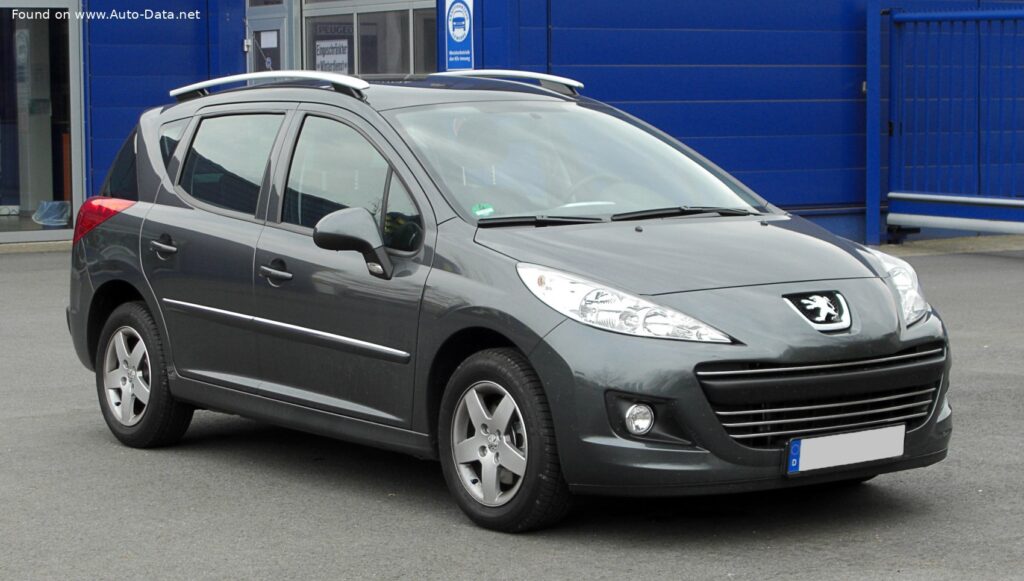
The Peugeot 207 SW (facelift 2009) adopted the station wagon (or “estate” in European parlance) body type, distinguishing it from its hatchback sibling by offering a significantly larger and more versatile cargo area. With five doors and seating for five occupants, it was designed as a practical family vehicle. The facelift introduced subtle refinements to its exterior styling, typically involving updated front fascias, revised lighting signatures, and new wheel designs, all aimed at giving it a fresher, more contemporary look. Its dimensions – 163.94 inches in length, 68.82 inches in width (excluding mirrors), and 60.12 inches in height – underscore its compact footprint, ideal for navigating crowded European urban environments.
Inside, the 207 SW emphasized functionality and comfort. The standard trunk space of 11.9 cubic feet (337 liters) could expand to a generous 44.43 cubic feet (1258 liters) with the rear seats folded down, transforming it into a capable hauler for its size. This flexibility was a major draw for buyers needing more utility than a conventional hatchback. Key features for the era included an electric power steering system, offering light and precise control, and an Anti-lock Braking System (ABS) for enhanced safety. The suspension setup, featuring an independent MacPherson strut design at the front and a semi-independent coil spring arrangement at the rear, provided a comfortable ride quality well-suited to varying road conditions. Braking duties were handled by ventilated discs at the front and drum brakes at the rear, a common and effective combination for vehicles of this weight and performance class. The car rode on 185/65 R15 tires, balancing grip, ride comfort, and fuel efficiency.
Technical Specifications for the Peugeot 207 SW (facelift 2009) 1.4 VTi (95 Hp)
The following table details the technical specifications of the Peugeot 207 SW (facelift 2009) 1.4 VTi (95 Hp):
| Category | Specification |
|---|---|
| General Information | |
| Brand | Peugeot |
| Model | 207 SW (facelift 2009) |
| Type (Engine) | 1.4 VTi (95 Hp) |
| Production Start | 2009 year |
| Production End | 2013 year |
| Powertrain Architecture | Internal Combustion engine |
| Body Type | Station wagon (estate) |
| Seats | 5 |
| Doors | 5 |
| Performance Specifications | |
| Fuel Consumption (Urban) | 7.9 l/100 km (29.8 US mpg) |
| Fuel Consumption (Extra Urban) | 4.9 l/100 km (48 US mpg) |
| Fuel Consumption (Combined) | 5.9 l/100 km (39.9 US mpg) |
| CO2 Emissions | 140 g/km |
| Fuel Type | Petrol (Gasoline) |
| Acceleration 0 – 60 mph | 11.8 sec |
| Acceleration 0 – 100 km/h | 12.4 sec |
| Maximum Speed | 185 km/h (114.95 mph) |
| Emission Standard | Euro 5 |
| Weight-to-Power Ratio | 12.7 kg/Hp, 78.9 Hp/tonne |
| Weight-to-Torque Ratio | 8.9 kg/Nm, 113 Nm/tonne |
| Engine Specifications | |
| Power | 95 Hp @ 6000 rpm |
| Power per Liter | 68 Hp/l |
| Torque | 136 Nm @ 4000 rpm (100.31 lb.-ft. @ 4000 rpm) |
| Engine Layout | Front, Transverse |
| Engine Model/Code | 8FR EP3 |
| Engine Displacement | 1397 cm3 (85.25 cu. in.) |
| Number of Cylinders | 4 |
| Engine Configuration | Inline |
| Cylinder Bore | 77 mm (3.03 in.) |
| Piston Stroke | 75 mm (2.95 in.) |
| Compression Ratio | 11:1 |
| Valves per Cylinder | 4 |
| Fuel Injection System | Multi-port manifold injection |
| Engine Aspiration | Naturally aspirated engine |
| Valvetrain | DOHC-VVT |
| Engine Oil Capacity | 4.25 l (4.49 US qt) |
| Coolant Capacity | 6 l (6.34 US qt) |
| Space, Volume and Weights | |
| Kerb Weight | 1204 kg (2654.37 lbs.) |
| Maximum Weight | 1691 kg (3728.02 lbs.) |
| Maximum Load | 487 kg (1073.65 lbs.) |
| Trunk (Boot) Space – Minimum | 337 l (11.9 cu. ft.) |
| Trunk (Boot) Space – Maximum | 1258 l (44.43 cu. ft.) |
| Fuel Tank Capacity | 50 l (13.21 US gal) |
| Permitted Trailer Load with Brakes (12%) | 1150 kg (2535.32 lbs.) |
| Permitted Trailer Load without Brakes | 600 kg (1322.77 lbs.) |
| Dimensions | |
| Length | 4164 mm (163.94 in.) |
| Width | 1748 mm (68.82 in.) |
| Width with Mirrors Folded | 1818 mm (71.57 in.) |
| Width Including Mirrors | 1972 mm (77.64 in.) |
| Height | 1527 mm (60.12 in.) |
| Wheelbase | 2540 mm (100 in.) |
| Front Track | 1467 mm (57.76 in.) |
| Rear (Back) Track | 1461 mm (57.52 in.) |
| Minimum Turning Circle | 10.4 m (34.12 ft.) |
| Drivetrain, Brakes and Suspension | |
| Drivetrain Architecture | Front-wheel drive, Internal Combustion engine |
| Drive Wheel | Front wheel drive |
| Number of Gears and Gearbox Type | 5 gears, manual transmission |
| Front Suspension | Independent type McPherson |
| Rear Suspension | Semi-independent, coil spring |
| Front Brakes | Ventilated discs |
| Rear Brakes | Drum |
| Assisting Systems | ABS (Anti-lock braking system) |
| Steering Type | Steering rack and pinion |
| Power Steering | Electric Steering |
| Tire Size | 185/65 R15 |
| Wheel Rims Size | 15 inches |
Legacy and Market Impact
The Peugeot 207 SW (facelift 2009) played a vital role in Peugeot’s lineup during its production run, particularly in markets where compact station wagons held significant appeal. In Europe, where space efficiency and fuel economy are paramount, the 207 SW offered a compelling alternative to larger, less agile vehicles. Its competitors included other B-segment wagons like the Renault Clio Estate, Skoda Fabia Combi, and specific variants of the Ford Fiesta, all vying for the attention of budget-conscious families and individuals seeking versatility.
The 207 series, including the SW variant, continued Peugeot’s long-standing tradition of producing popular and successful “2-series” models, following in the footsteps of the iconic 205 and the highly successful 206. While the 207 SW may not have achieved the cult status of some of its predecessors, it solidified Peugeot’s reputation for producing well-engineered, practical, and stylish compact cars. The adoption of the “Prince” engine, co-developed with BMW, also highlighted Peugeot’s commitment to modern engine technology, offering a blend of performance and efficiency that was competitive for its time. This engine family was known for its advanced features like variable valve timing and lift, contributing to the car’s relatively low CO2 emissions and good fuel economy.
In a market that was increasingly shifting towards SUVs and crossovers, the 207 SW represented a segment that, while shrinking, still served a dedicated customer base. Its legacy lies in its practical design, fuel-efficient powertrains, and its ability to offer genuine utility within a compact and maneuverable package. For many European families, it was an accessible and sensible choice, providing enough space for daily life without the increased running costs or larger footprint of an SUV. The 207 SW, particularly the facelifted model, remained a relevant and respected option until its discontinuation in 2013, paving the way for its successor, the 208, which would eventually see a return to a more focused hatchback strategy as the demand for supermini wagons waned.