The Peugeot 207 SW (facelift 2009): A Practical European Compact
The Peugeot 207 SW (facelift 2009) represents a significant iteration of Peugeot’s popular B-segment offering, specifically tailored for the European market. As a station wagon (known as an estate in Europe), this variant of the 207 generation, produced from 2009 to 2013, emphasized practicality, fuel efficiency, and a compact footprint suitable for dense urban environments and varied road conditions across the continent. While never officially sold in the United States, the Peugeot 207 SW (facelift 2009) played a crucial role in Peugeot’s lineup, providing a versatile alternative to the standard hatchback, competing in a fiercely contested segment that valued both economy and utility.
The 207 series itself was a successor to the highly successful 206, carrying forward Peugeot’s design language and commitment to driving dynamics, albeit with a slightly larger and more mature presence. The 2009 facelift brought subtle but important updates, refining its aesthetics and often incorporating minor mechanical or technological enhancements to keep it competitive. This particular model, equipped with the 1.6 HDi (High-pressure Direct Injection) engine producing 109 horsepower, was a prime example of the European preference for efficient diesel powertrains, offering a compelling blend of performance and exceptional fuel economy for daily commuting and longer journeys.
Engine & Performance: The Efficient 1.6 HDi in the Peugeot 207 SW (facelift 2009)
Under the hood of the Peugeot 207 SW (facelift 2009) lay a refined 1.6-liter (1560 cm3 or 95.2 cu. in.) HDi diesel engine, a powerplant synonymous with efficiency and robust performance within the PSA Group (Peugeot S.A. and Citroën). This inline four-cylinder engine, designated by the code 9HZ DV6TED4, delivered 109 horsepower at a modest 4000 rpm, translating to a respectable power-per-liter figure of 69.9 HP/l. More critically for a diesel, it produced a substantial 177.01 lb.-ft. (240 Nm) of torque arriving early at just 1750 rpm. This low-end torque was a key characteristic, providing strong acceleration from a standstill and excellent in-gear flexibility, making it well-suited for both city driving and highway cruising.
The engine’s architecture featured a DOHC (Double Overhead Camshaft) valvetrain with four valves per cylinder, ensuring efficient breathing. Its advanced Diesel Commonrail fuel injection system, combined with a turbocharger and intercooler, was instrumental in achieving both its power output and its impressive fuel economy. The compression ratio of 17.6:1 further optimized the diesel combustion process. Paired exclusively with a smooth-shifting 5-speed manual transmission, the 207 SW 1.6 HDi was designed for driver engagement and maximum efficiency.
Performance figures reflected this balance: the vehicle could accelerate from 0 to 60 mph in a swift 9.8 seconds (0-100 km/h in 10.3 seconds) and reach a top speed of 119.92 mph (193 km/h). However, its true strength lay in its fuel consumption. The combined fuel economy was an outstanding 52.3 US mpg (4.5 l/100 km), with extra-urban driving pushing that figure to an astonishing 61.9 US mpg (3.8 l/100 km). Urban consumption remained very competitive at 40.6 US mpg (5.8 l/100 km). These figures, coupled with CO2 emissions of 120 g/km, meant the 207 SW 1.6 HDi met the Euro 4 emission standard, making it an environmentally conscious choice for its time and a cost-effective vehicle to operate in European markets, where fuel prices and emissions regulations are significant factors for consumers.
Design & Features of the Peugeot 207 SW (facelift 2009)
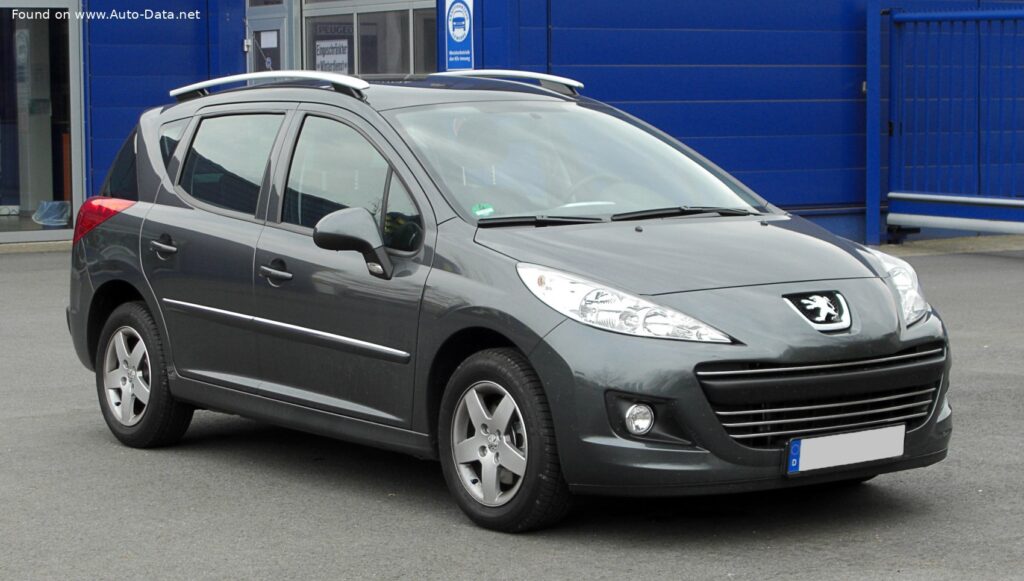
The Peugeot 207 SW (facelift 2009) adopted a contemporary and appealing design, characteristic of Peugeot’s aesthetic language of the late 2000s. As a 5-door station wagon, it offered enhanced practicality over its hatchback sibling without sacrificing too much of the car’s inherent agility. The facelift introduced subtle refinements to the front fascia, often including updated headlights, grille, and bumper designs, giving it a fresher and more modern appearance. Its overall length of 163.94 inches (4164 mm) and width of 68.82 inches (1748 mm) made it a compact and maneuverable vehicle, ideal for navigating narrow European streets and parking in tight spaces.
Despite its compact exterior, the SW variant was designed to maximize interior space and versatility. It comfortably seated five occupants, and its primary advantage was the expanded cargo area. The trunk space offered a minimum of 11.9 cu. ft. (337 liters) with the rear seats up, which could be dramatically expanded to a generous 44.43 cu. ft. (1258 liters) when the rear seats were folded down. This flexibility made it a popular choice for families, small businesses, and individuals requiring more utility than a standard hatchback could provide, whether for groceries, luggage, or hobby equipment.
The interior design of the 207 SW was functional and ergonomic, featuring a well-laid-out dashboard with clear instrumentation. Standard features for the era typically included air conditioning, power windows, and a decent audio system. Safety was also a consideration, with ABS (Anti-lock Braking System) as a standard assisting system, and a robust body structure contributing to occupant protection. The car rode on 195/55 R16 tires with 16-inch wheel rims, providing a balance of comfort and handling. The front suspension utilized an independent McPherson type, while the rear featured a semi-independent, coil spring setup, contributing to a compliant ride and stable handling characteristic of French cars. Power steering was electric, offering light and precise control, particularly beneficial for urban driving.
Technical Specifications: Peugeot 207 SW (facelift 2009) 1.6 HDi (109 Hp)
| Category | Specification |
|---|---|
| Brand | Peugeot |
| Model | 207 SW (facelift 2009) |
| Type (Engine) | 1.6 HDi (109 Hp) |
| Start of Production | 2009 |
| End of Production | 2013 |
| Powertrain Architecture | Internal Combustion Engine, Front Wheel Drive |
| Body type | Station wagon (estate) |
| Seats | 5 |
| Doors | 5 |
| Performance Specs | |
| Fuel consumption (economy) – urban | 5.8 l/100 km (40.6 US mpg) |
| Fuel consumption (economy) – extra urban | 3.8 l/100 km (61.9 US mpg) |
| Fuel consumption (economy) – combined | 4.5 l/100 km (52.3 US mpg) |
| CO2 emissions | 120 g/km |
| Fuel Type | Diesel |
| Acceleration 0 – 60 mph | 9.8 sec |
| Acceleration 0 – 100 km/h | 10.3 sec |
| Maximum speed | 119.92 mph (193 km/h) |
| Emission standard | Euro 4 |
| Weight-to-power ratio | 11.6 kg/Hp (86 Hp/tonne) |
| Weight-to-torque ratio | 5.3 kg/Nm (189.3 Nm/tonne) |
| Engine Specs | |
| Power | 109 Hp @ 4000 rpm |
| Power per liter | 69.9 Hp/l |
| Torque | 177.01 lb.-ft. (240 Nm) @ 1750 rpm |
| Engine layout | Front, Transverse |
| Engine Model/Code | 9HZ DV6TED4 |
| Engine displacement | 1560 cm3 (95.2 cu. in.) |
| Number of cylinders | 4 |
| Engine configuration | Inline |
| Cylinder Bore | 2.95 in. (75 mm) |
| Piston Stroke | 3.48 in. (88.3 mm) |
| Compression ratio | 17.6:1 |
| Number of valves per cylinder | 4 |
| Fuel injection system | Diesel Commonrail |
| Engine aspiration | Turbocharger, Intercooler |
| Valvetrain | DOHC |
| Engine oil capacity | 3.96 US qt (3.75 l) |
| Coolant capacity | 5.92 US qt (5.6 l) |
| Space, Volume and Weights | |
| Kerb Weight | 2795.46 lbs. (1268 kg) |
| Max. weight | 3875.73 lbs. (1758 kg) |
| Max load | 1080.27 lbs. (490 kg) |
| Trunk (boot) space – minimum | 11.9 cu. ft. (337 l) |
| Trunk (boot) space – maximum | 44.43 cu. ft. (1258 l) |
| Fuel tank capacity | 13.21 US gal (50 l) |
| Permitted trailer load with brakes (12%) | 2535.32 lbs. (1150 kg) |
| Permitted trailer load without brakes | 1322.77 lbs. (600 kg) |
| Dimensions | |
| Length | 163.94 in. (4164 mm) |
| Width | 68.82 in. (1748 mm) |
| Width with mirrors folded | 71.57 in. (1818 mm) |
| Width including mirrors | 77.64 in. (1972 mm) |
| Height | 60.12 in. (1527 mm) |
| Wheelbase | 100 in. (2540 mm) |
| Front track | 57.76 in. (1467 mm) |
| Rear (Back) track | 57.52 in. (1461 mm) |
| Drag coefficient (Cd) | 0.3 |
| Minimum turning circle (turning diameter) | 34.78 ft. (10.6 m) |
| Drivetrain, Brakes and Suspension Specs | |
| Drivetrain Architecture | Front wheel drive, Internal Combustion engine |
| Drive wheel | Front wheel drive |
| Number of gears and type of gearbox | 5 gears, manual transmission |
| Front suspension | Independent type McPherson |
| Rear suspension | Semi-independent, coil spring |
| Front brakes | Ventilated discs |
| Rear brakes | Disc |
| Assisting systems | ABS (Anti-lock braking system) |
| Steering type | Steering rack and pinion |
| Power steering | Electric Steering |
| Tires size | 195/55 R16 |
| Wheel rims size | 16 |
Legacy & Market Impact of the Peugeot 207 SW (facelift 2009)
The Peugeot 207 SW (facelift 2009) carved out a distinct niche within the highly competitive European B-segment. Its legacy is primarily defined by its blend of practical utility, commendable fuel efficiency, and a driving experience that was comfortable yet engaging. In markets like France, Germany, Italy, and the UK, where compact station wagons held significant appeal for their versatility and lower running costs compared to larger vehicles, the 207 SW was a strong contender.
Its primary competitors included other European compact estates such as the Renault Clio Estate (Grandtour), Skoda Fabia Combi, Seat Ibiza ST, and the Volkswagen Polo Variant. What set the 207 SW apart was Peugeot’s characteristic emphasis on a comfortable ride quality, a stylish design that felt more upscale than some rivals, and the proven reliability and efficiency of its HDi diesel engines. The 1.6 HDi variant, in particular, was a favorite among those who covered significant mileage, thanks to its exceptional fuel economy and strong torque delivery, which made highway cruising effortless.
The facelift in 2009 helped to extend the model’s appeal, keeping its design fresh and its features competitive against newer entrants. While the 207 SW might not have been a groundbreaking car in terms of revolutionary technology, it represented a mature and well-executed product in a segment that prioritized practicality and value. It reinforced Peugeot’s reputation as a manufacturer capable of producing competent and desirable small cars that catered specifically to European consumer needs and preferences.
Its impact was felt in its consistent sales performance in its target markets, contributing to Peugeot’s overall market share in the B-segment. The model also played a role in the broader trend of downsized, efficient diesel engines becoming mainstream in Europe before the shift towards electrification gained significant momentum. The 207 SW, especially in its 1.6 HDi guise, exemplified a period when diesel power was seen as the most effective solution for balancing performance with stringent fuel economy and CO2 emissions targets. Although it has since been succeeded by newer generations (like the 208 and its derivatives), the Peugeot 207 SW (facelift 2009) remains a testament to Peugeot’s engineering prowess in crafting practical, efficient, and well-rounded compact vehicles for the discerning European consumer.