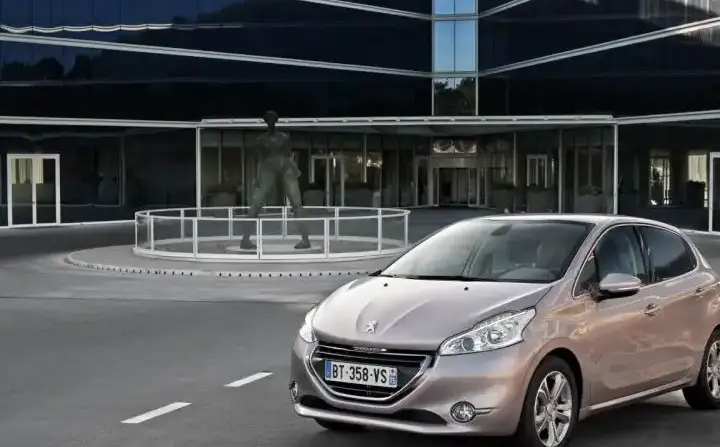
The Peugeot 208 I (Phase II), specifically the 1.2 PureTech 82 horsepower automatic variant, was a key offering in Peugeot’s subcompact hatchback lineup from 2015 to 2019. This version represented an entry-level powertrain option within the broader 208 range, positioned below the more powerful PureTech 110 and diesel variants. Introduced as part of the Phase II refresh of the first-generation 208 (T1 series), this model aimed to provide an affordable and fuel-efficient option for buyers prioritizing ease of use and lower running costs. It was primarily marketed in Europe, where subcompact hatchbacks are a dominant market segment.
Technical Specifications
| Brand | Peugeot |
| Model | 208 |
| Generation | 208 I (Phase II, 2015) |
| Type (Engine) | 1.2 PureTech (82 Hp) Automatic |
| Start of production | 2015 |
| End of production | 2019 |
| Powertrain Architecture | Internal Combustion engine |
| Body type | Hatchback |
| Seats | 5 |
| Doors | 3-5 |
| Fuel consumption (urban) | 4.6 l/100 km (51.1 US mpg, 61.4 UK mpg, 21.7 km/l) |
| Fuel consumption (extra urban) | 3.9 l/100 km (60.3 US mpg, 72.4 UK mpg, 25.6 km/l) |
| Fuel consumption (combined) | 4.2 l/100 km (56 US mpg, 67.3 UK mpg, 23.8 km/l) |
| CO2 emissions | 97 g/km |
| Fuel Type | Petrol (Gasoline) |
| Acceleration 0 – 100 km/h | 14.5 sec |
| Acceleration 0 – 62 mph | 14.5 sec |
| Acceleration 0 – 60 mph | 13.8 sec |
| Maximum speed | 178 km/h (110.6 mph) |
| Emission standard | Euro 6 |
| Weight-to-power ratio | 12 kg/Hp, 83.7 Hp/tonne |
| Weight-to-torque ratio | 8.3 kg/Nm, 120.4 Nm/tonne |
| Power | 82 Hp @ 5750 rpm |
| Power per litre | 68.4 Hp/l |
| Torque | 118 Nm @ 2750 rpm (87.03 lb.-ft. @ 2750 rpm) |
| Engine layout | Front, Transverse |
| Engine Model/Code | HMZ EB2F |
| Engine displacement | 1199 cm3 (73.17 cu. in.) |
| Number of cylinders | 3 |
| Engine configuration | Inline |
| Number of valves per cylinder | 4 |
| Fuel injection system | Multi-port manifold injection |
| Engine aspiration | Naturally aspirated engine |
| Engine oil capacity | 3.25 l (3.43 US qt, 2.86 UK qt) |
| Coolant capacity | 6 l (6.34 US qt, 5.28 UK qt) |
| Kerb Weight | 980 kg (2160.53 lbs.) |
| Max. weight | 1553 kg (3423.78 lbs.) |
| Max load | 573 kg (1263.25 lbs.) |
| Trunk (boot) space – minimum | 285 l (10.06 cu. ft.) |
| Trunk (boot) space – maximum | 1076 l (38 cu. ft.) |
| Fuel tank capacity | 50 l (13.21 US gal, 11 UK gal) |
| Permitted trailer load with brakes (12%) | 500 kg (1102.31 lbs.) |
| Length | 3973 mm (156.42 in.) |
| Width | 1829 mm (72.01 in.) |
| Width including mirrors | 2004 mm (78.9 in.) |
| Height | 1460 mm (57.48 in.) |
| Wheelbase | 2538 mm (99.92 in.) |
| Front track | 1475-1470 mm (58.07 – 57.87 in.) |
| Rear (Back) track | 1471-1467 mm (57.91 – 57.76 in.) |
| Ride height (ground clearance) | 123-129 mm (4.84 – 5.08 in.) |
| Minimum turning circle | 10.4 m (34.12 ft.) |
| Drivetrain Architecture | Front wheel drive |
| Number of gears and type of gearbox | 5 gears, automatic transmission |
| Front suspension | Independent type McPherson |
| Rear suspension | Elastic beam |
| Front brakes | Ventilated discs |
| Rear brakes | Drum |
| Assisting systems | ABS (Anti-lock braking system) |
| Steering type | Steering rack and pinion |
Powertrain & Engine Architecture
The heart of this 208 variant is the Peugeot-Citroën (PSA) HMZ EB2F 1.2-liter three-cylinder petrol engine. This engine is part of the “PureTech” family, known for its focus on efficiency and reduced friction. The 82 horsepower output is achieved through a naturally aspirated configuration, utilizing multi-point fuel injection and four valves per cylinder. The engine’s compact size and lightweight construction contribute to the 208’s overall agility. The engine code ‘HMZ’ designates a specific calibration for this power output and emission standard. The engine is transversely mounted at the front of the vehicle. Paired with this engine is a five-speed automatic transmission, which, while providing convenience, was not known for particularly rapid shifts or sporty performance. It was a conventional torque-converter automatic, prioritizing smooth operation over outright speed.
Driving Characteristics
The 1.2 PureTech 82 hp automatic 208 delivers modest performance. Acceleration from 0-60 mph takes around 13.8 seconds, and top speed is approximately 110 mph. The automatic transmission’s gear ratios are tuned for fuel economy rather than spirited driving. Power delivery is relatively linear, but the engine feels strained when pushed hard, particularly during overtaking maneuvers. Compared to the 110 hp PureTech or the diesel variants, this version feels noticeably slower. The automatic transmission, while convenient, doesn’t offer manual shift modes or particularly quick responses. The focus is on providing a comfortable and undemanding driving experience, ideal for urban commutes and shorter journeys.
Equipment & Trim Levels
The 1.2 PureTech 82 hp automatic typically came in lower to mid-range trim levels, such as ‘Access’, ‘Active’, or ‘Allure’ depending on the market. Standard equipment generally included air conditioning, power steering, electric front windows, a basic audio system with USB connectivity, and ABS brakes. Higher trim levels added features like alloy wheels, a touchscreen infotainment system, cruise control, and rear parking sensors. Interior upholstery was typically cloth, with a functional and durable design. Optional extras included a panoramic sunroof, navigation system, and upgraded audio systems.
Chassis & Braking
The 208 I utilizes a McPherson strut front suspension and an elastic beam rear suspension. This setup provides a reasonable balance between comfort and handling. The front brakes are ventilated discs, while the rear brakes are drums, a cost-saving measure common in this segment. ABS (Anti-lock Braking System) is standard. The steering is a rack and pinion system, offering decent precision but lacking significant feedback. Stabilizer bars are present, but are relatively thin compared to those found on higher-performance 208 models.
Market Reception & Comparison
The 1.2 PureTech 82 hp automatic 208 was generally well-received as an affordable and economical option. Critics praised its fuel efficiency and comfortable ride, but noted its lack of outright performance. Compared to the 110 hp PureTech, the 82 hp version offered significantly less power, but at a lower price point. The diesel variants provided better fuel economy but came with a higher initial cost and potential concerns about diesel emissions. The automatic transmission was seen as a convenient feature, but some reviewers found it to be sluggish and unresponsive.
Legacy
The 1.2 PureTech engine proved to be a reliable unit, although some early examples experienced issues with the timing chain. The automatic transmission, while not particularly sophisticated, generally proved durable. In the used car market, the 1.2 PureTech 82 hp automatic 208 represents a budget-friendly option for buyers seeking a small, economical hatchback. Its simplicity and relatively low running costs make it an attractive choice for first-time drivers or those primarily using the car for urban commuting. However, potential buyers should be aware of the engine’s limited power output and the transmission’s somewhat dated technology.