The Peugeot 3008 I (Phase I, 2009) 1.6 VTI (120 Hp): A Pioneer in the European Crossover Segment
The Peugeot 3008 I (Phase I, 2009) represents a pivotal moment for the French automaker, marking its entry into the rapidly expanding compact crossover segment. Unveiled in 2008 and launched in 2009, this first-generation 3008 was designed to blend the practicality of a multi-purpose vehicle (MPV) with the elevated driving position and rugged aesthetics of a sport utility vehicle (SUV). While never officially sold in the United States, the 3008 quickly established itself as a significant player in its primary European and Asian markets, offering a compelling package of versatility, comfort, and distinctive styling. The specific variant under examination, the 1.6 VTI with 120 horsepower, was a popular choice, embodying the model’s focus on efficient performance suitable for both urban commuting and longer family journeys.
Engine & Performance: The 1.6 VTI Powertrain
At the heart of this particular Peugeot 3008 I (Phase I, 2009) model lies the 1.6-liter VTI (Variable Valve Lift and Timing Injection) gasoline engine, a naturally aspirated inline-four cylinder unit known by its internal code 5FW EP6C. This engine was part of the “Prince” engine family, a collaborative development between PSA Peugeot Citroën and BMW, which gained a reputation for its advanced technology and efficiency in compact applications. With a displacement of 1598 cm3 (97.52 cubic inches), the engine generates a respectable 120 horsepower at 6000 rpm, delivering its power smoothly across the rev range.
Torque output stands at 160 Nm (118.01 lb.-ft.) at 4250 rpm, providing adequate pulling power for everyday driving scenarios. The engine’s DOHC (Double Overhead Camshaft) valvetrain with four valves per cylinder and multi-port manifold injection system contribute to its responsiveness and efficiency. Mated to a 5-speed manual transmission, the powertrain architecture is front-wheel drive, a common configuration for European crossovers prioritizing fuel economy and road-biased performance over off-road capability.
In terms of acceleration, the Peugeot 3008 I (Phase I, 2009) 1.6 VTI can accelerate from 0 to 60 mph in a calculated 11.2 seconds, with a top speed reaching 114.95 mph. While not a performance powerhouse, these figures are entirely competitive for a family-oriented crossover of its era. Fuel economy was a strong suit for this variant, with a combined rating of 33.1 US mpg (7.1 l/100 km). Urban driving yielded approximately 24 US mpg (9.8 l/100 km), while extra-urban conditions saw impressive figures of 42 US mpg (5.6 l/100 km). This efficiency, coupled with its Euro 5 emission standard compliance, made it an environmentally conscious choice for European consumers. The 60-liter (15.85 US gallon) fuel tank provided a commendable cruising range.
Design & Features: Blending Form and Function
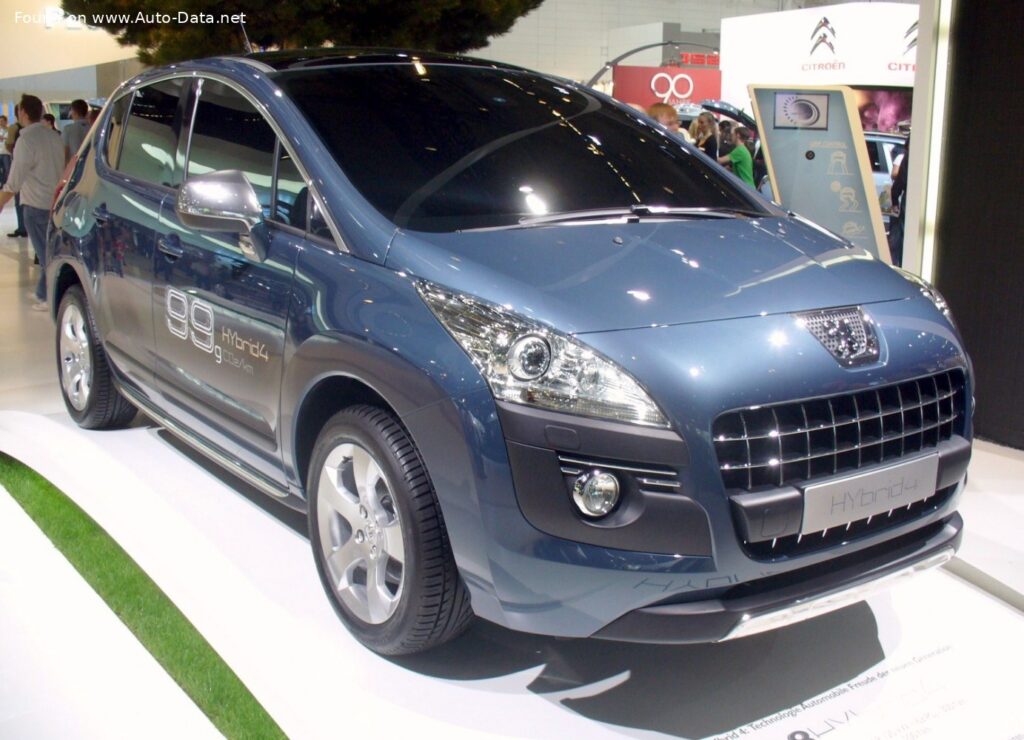
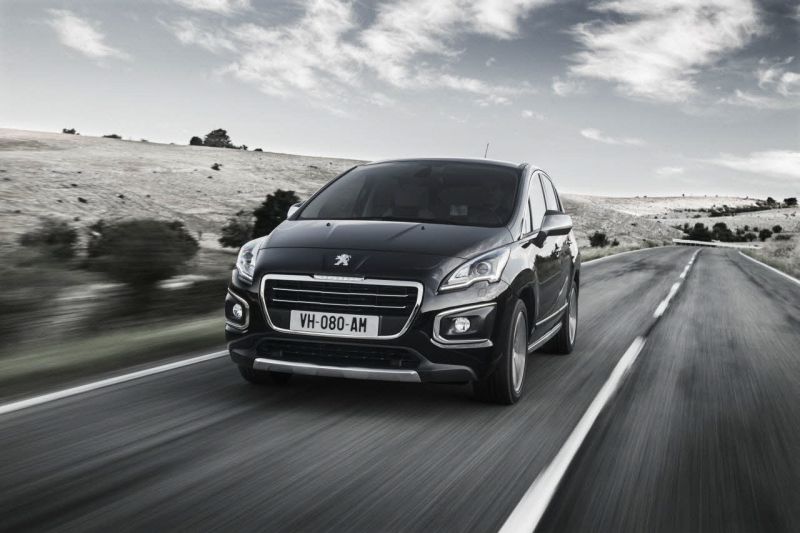
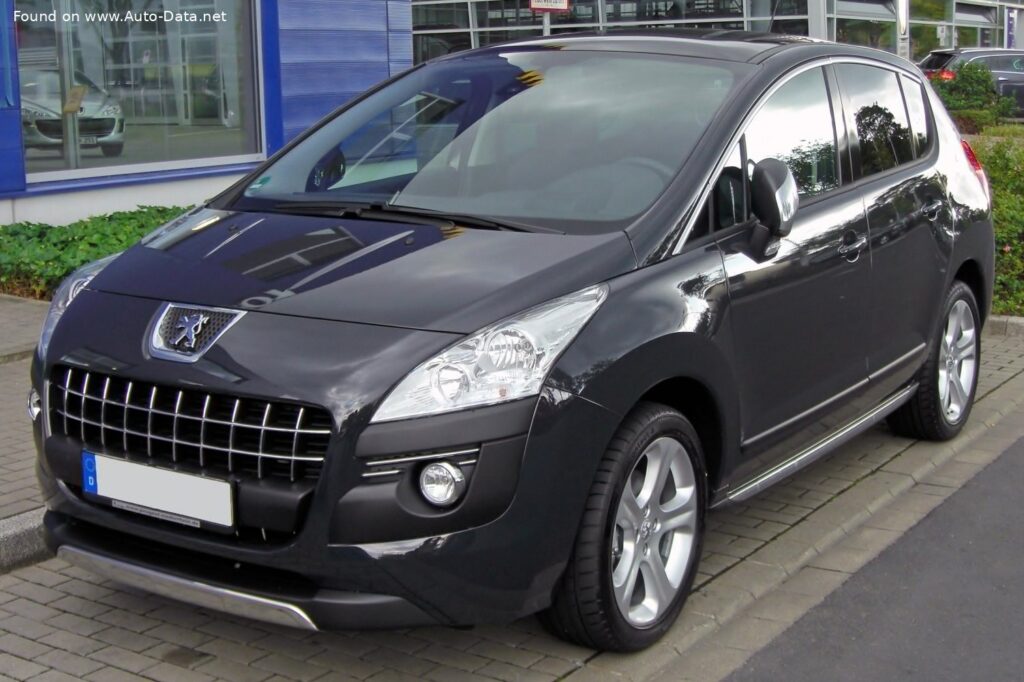
The Peugeot 3008 I (Phase I, 2009) broke new ground for Peugeot in terms of design, adopting a distinctive silhouette that straddled the line between an SUV and an MPV. Classified as an SUV, its body type featured 5 doors and seating for 5 occupants, emphasizing practicality and passenger comfort. Its dimensions—171.85 inches in length, 72.32 inches in width, and 64.53 inches in height—gave it a commanding road presence without being overly cumbersome for city driving. The wheelbase of 102.87 inches contributed to a stable ride and generous interior space.
A key design element was its elevated driving position, a hallmark of SUVs and a popular feature for drivers seeking better visibility. The exterior design, characterized by a prominent grille, sculpted lines, and robust wheel arches, aimed to convey a sense of adventure and modernity. Standard tire size was 225/50R17, mounted on 17.5J x 17-inch wheel rims, providing a good balance of grip and ride comfort.
Inside, the 3008 was designed with versatility in mind. The cargo area, or trunk space, offered a flexible capacity ranging from 15.26 cubic feet (432 liters) with all seats up, expanding significantly to 43.83 cubic feet (1241 liters) when the rear seats were folded down. This adaptability made it highly suitable for families and those needing ample cargo room. The interior styling was modern for its time, with a cockpit-like dashboard design that angled controls towards the driver.
Underneath, the 3008 featured an independent McPherson strut front suspension with coil springs and an anti-roll bar, paired with a semi-independent rear suspension also utilizing coil springs. This setup was engineered to provide a comfortable ride quality typical of French automobiles, while maintaining composed handling. Braking was handled by ventilated discs at the front and solid discs at the rear, supported by an Anti-lock Braking System (ABS) for enhanced safety. The electric power steering system, a rack and pinion type, offered light and precise control, aiding maneuverability in tight urban environments. With a minimum turning circle of 36.09 feet (11 meters), it was surprisingly agile for its size.
Technical Specifications for the Peugeot 3008 I (Phase I, 2009)
| Category | Specification |
|---|---|
| Brand | Peugeot |
| Model | 3008 |
| Generation | 3008 I (Phase I, 2009) |
| Type (Engine) | 1.6 VTI (120 Hp) |
| Production Start | 2009 |
| Production End | 2013 |
| Powertrain Architecture | Internal Combustion Engine, Front-Wheel Drive |
| Body Type | SUV |
| Seats | 5 |
| Doors | 5 |
| Performance Specs | |
| Fuel Consumption (Urban) | 9.8 l/100 km (24 US mpg) |
| Fuel Consumption (Extra Urban) | 5.6 l/100 km (42 US mpg) |
| Fuel Consumption (Combined) | 7.1 l/100 km (33.1 US mpg) |
| Fuel Type | Petrol (Gasoline) |
| Acceleration 0-60 mph | 11.2 seconds |
| Acceleration 0-100 km/h | 11.8 seconds |
| Maximum Speed | 185 km/h (114.95 mph) |
| Emission Standard | Euro 5 |
| Weight-to-Power Ratio | 12.3 kg/Hp (81.4 Hp/tonne) |
| Weight-to-Torque Ratio | 9.2 kg/Nm (108.5 Nm/tonne) |
| Engine Specs | |
| Power | 120 Hp @ 6000 rpm |
| Power per Litre | 75.1 Hp/l |
| Torque | 160 Nm (118.01 lb.-ft.) @ 4250 rpm |
| Engine Layout | Front, Transverse |
| Engine Model/Code | 5FW EP6C |
| Engine Displacement | 1598 cm3 (1.6 Liters, 97.52 cu. in.) |
| Number of Cylinders | 4 |
| Engine Configuration | Inline |
| Cylinder Bore | 77 mm (3.03 in.) |
| Piston Stroke | 85.8 mm (3.38 in.) |
| Compression Ratio | 11:1 |
| Valves per Cylinder | 4 |
| Fuel Injection System | Multi-port manifold injection |
| Engine Aspiration | Naturally aspirated |
| Valvetrain | DOHC |
| Engine Oil Capacity | 4.25 l (4.49 US qt) |
| Coolant Capacity | 6 l (6.34 US qt) |
| Space, Volume, and Weights | |
| Kerb Weight | 1474 kg (3249.61 lbs.) |
| Maximum Weight | 2020 kg (4453.34 lbs.) |
| Maximum Load | 546 kg (1203.72 lbs.) |
| Trunk (Boot) Space – Minimum | 432 l (15.26 cu. ft.) |
| Trunk (Boot) Space – Maximum | 1241 l (43.83 cu. ft.) |
| Fuel Tank Capacity | 60 l (15.85 US gal) |
| Dimensions | |
| Length | 4365 mm (171.85 in.) |
| Width | 1837 mm (72.32 in.) |
| Height | 1639 mm (64.53 in.) |
| Wheelbase | 2613 mm (102.87 in.) |
| Front Track | 1532 mm (60.31 in.) |
| Rear Track | 1527 mm (60.12 in.) |
| Minimum Turning Circle | 11 m (36.09 ft.) |
| Drivetrain, Brakes, and Suspension Specs | |
| Drivetrain Architecture | Internal Combustion engine drives the front wheels |
| Drive Wheel | Front-wheel drive |
| Gearbox | 5 gears, manual transmission |
| Front Suspension | Independent, McPherson with coil spring and anti-roll bar |
| Rear Suspension | Semi-independent, coil spring |
| Front Brakes | Ventilated discs |
| Rear Brakes | Disc |
| Assisting Systems | ABS (Anti-lock braking system) |
| Steering Type | Steering rack and pinion |
| Power Steering | Electric Steering |
| Tires Size | 225/50R17 |
| Wheel Rims Size | 17.5J x 17 |
Legacy & Market Impact in Europe and Beyond
The Peugeot 3008 I (Phase I, 2009) arrived at a time when the automotive landscape in Europe was shifting dramatically. Consumers were increasingly looking for vehicles that combined the practicality of traditional hatchbacks and MPVs with the aspirational styling and perceived robustness of SUVs. The 3008 was Peugeot’s answer to this demand, positioning itself as a “crossover” that aimed to offer the best of both worlds. It quickly established a strong reputation for its comfortable ride, refined interior, and intelligent packaging.
In its primary European market, the 3008 faced stiff competition from a growing array of rivals. Key competitors included the trailblazing Nissan Qashqai, which largely defined the compact crossover segment, as well as models like the Volkswagen Tiguan, Renault Koleos, Hyundai ix35 (Tucson), and Skoda Yeti. Despite this crowded field, the 3008 managed to carve out a significant niche thanks to its distinctive French design philosophy, an emphasis on driving comfort, and a focus on interior versatility.
The 1.6 VTI (120 Hp) variant, in particular, was a popular choice due to its balance of adequate performance and commendable fuel efficiency, making it an economical and practical option for families and individuals alike. Its compliance with Euro 5 emission standards also underscored Peugeot’s commitment to environmental responsibility, a growing concern for European buyers.
Historically, the first-generation 3008 was a crucial model for Peugeot. It demonstrated the brand’s ability to innovate and adapt to changing market trends, moving beyond its traditional strengths in hatchbacks and sedans. While its initial styling might have been polarizing to some, its functional benefits and comfortable driving experience ensured its success. The groundwork laid by the 3008 I ultimately paved the way for its highly successful second-generation model, which evolved into a more pronounced SUV design and garnered numerous international awards, including European Car of the Year. The 2009 Phase I 3008 1.6 VTI stands as a testament to Peugeot’s foresight and engineering prowess in establishing a strong foothold in the dynamic and competitive global crossover market.