The Peugeot 3008 I (Phase I, 2009): A European Crossover Pioneer
The Peugeot 3008 I (Phase I, 2009) represents a significant entry by the French automaker Peugeot into the burgeoning compact crossover SUV segment. Launched in 2009, this first-generation model, specifically the Phase I variant, aimed to blend the practicality of a multi-purpose vehicle (MPV) with the elevated driving position and rugged aesthetics of an SUV. Designed primarily for the European market, where it quickly gained traction, the 3008 offered a compelling package for families seeking versatility, comfort, and fuel efficiency. This article delves into the specifics of the 2.0 HDi (163 Hp) FAP variant, a popular diesel-powered option that exemplified Peugeot’s commitment to performance and environmental responsibility during its production run from 2009 to 2013. Its architecture, featuring an internal combustion engine driving the front wheels, provided a balanced and accessible driving experience, appealing to a wide demographic across the continent.
Powertrain and Dynamic Performance
At the heart of the Peugeot 3008 I (Phase I, 2009) 2.0 HDi (163 Hp) FAP lies a sophisticated 2.0-liter (1997 cm³ or 121.86 cu. in.) inline four-cylinder diesel engine, bearing the internal code RHH DW10CTED4. This powerplant is a testament to Peugeot’s expertise in diesel technology, featuring a common-rail fuel injection system and boosted by a turbocharger with an intercooler. These technologies work in concert to deliver a robust 163 horsepower at 3750 rpm, providing ample power for both urban commuting and longer highway journeys. More impressively, the engine generates a substantial 250.77 lb.-ft. of torque at a low 2000 rpm, ensuring strong acceleration and flexible in-gear performance, particularly beneficial for a vehicle of its size.
Power is channeled to the front wheels through a smooth-shifting 6-speed automatic transmission, optimized for both efficiency and driver comfort. This drivetrain architecture contributes to the vehicle’s respectable performance figures: the Peugeot 3008 I (Phase I, 2009) can accelerate from 0 to 60 mph in an estimated 9.7 seconds, with a top speed reaching 118.06 mph (190 km/h).
Beyond raw performance, fuel economy was a major selling point for this diesel variant. The 2.0 HDi FAP achieved a combined fuel consumption rating of 35.6 US mpg (6.6 l/100 km), with even more impressive figures on the extra-urban cycle at 42.8 US mpg (5.5 l/100 km). This efficiency, combined with a generous 15.85 US gallon (60 l) fuel tank, afforded a substantial cruising range. Furthermore, the “FAP” designation signifies the inclusion of a Diesel Particulate Filter, a crucial component for meeting the stringent Euro 5 emission standards of its time, demonstrating Peugeot’s commitment to reducing environmental impact. The vehicle’s weight-to-power ratio stands at 9.4 kg/Hp, or 105.9 Hp/tonne, indicating a well-balanced power delivery for its segment.
Exterior and Interior Design Philosophy
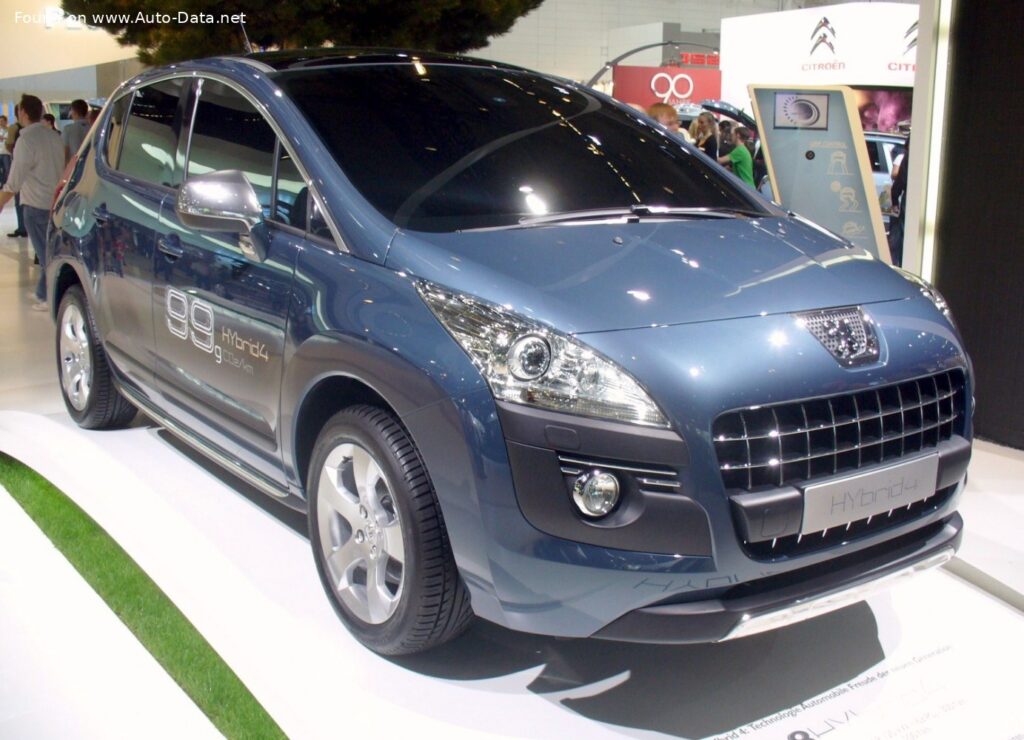
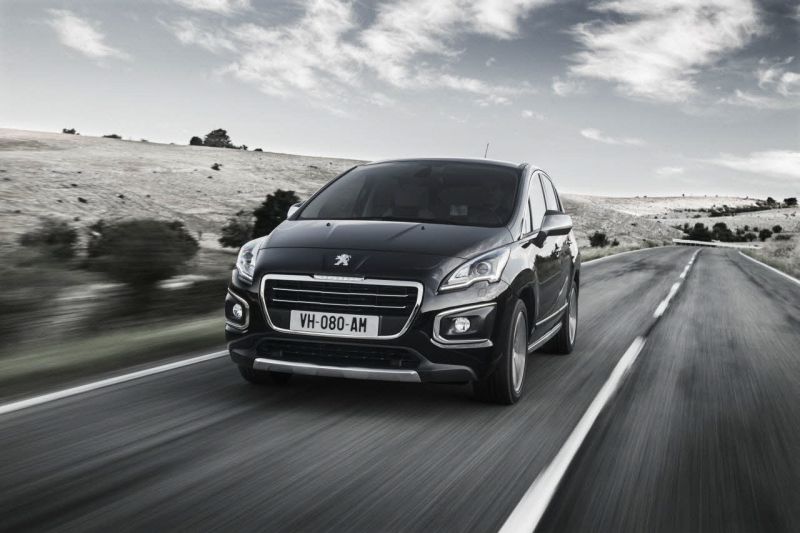
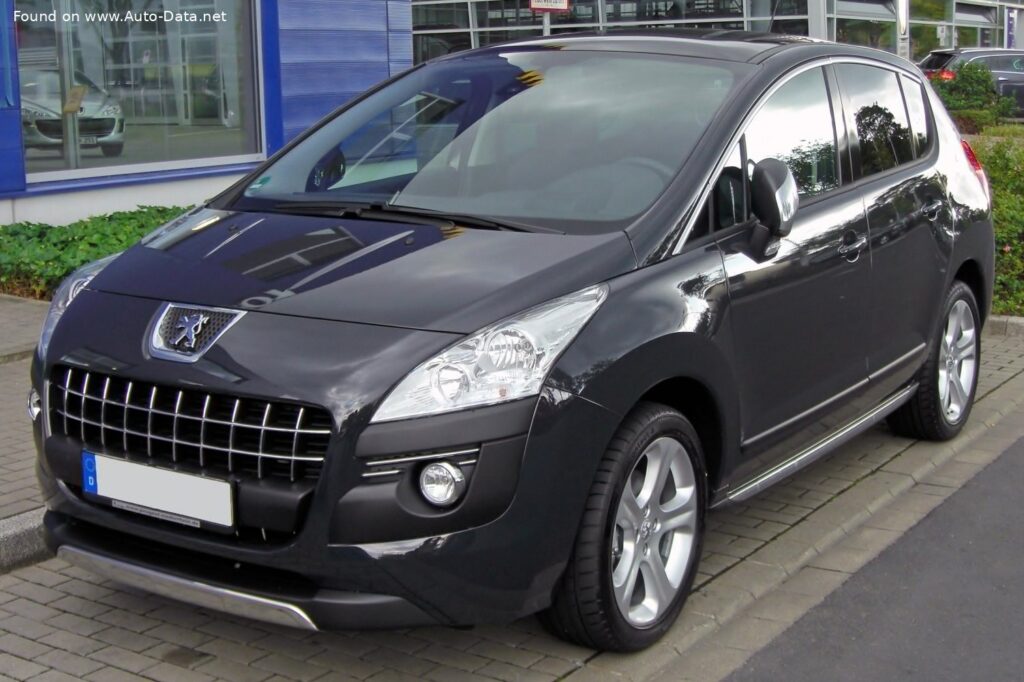
The Peugeot 3008 I (Phase I, 2009) adopted a distinctive body type that Peugeot termed a “crossover,” blurring the lines between an SUV, an MPV, and even a large hatchback. Its exterior design was characterized by a robust stance, featuring a prominent front grille, sculpted lines, and an elevated ride height. With a length of 171.85 inches (4365 mm), a width of 72.32 inches (1837 mm), and a height of 64.37 inches (1635 mm), the 3008 presented a substantial yet manageable footprint, ideal for navigating both urban environments and open roads. The wheelbase of 102.87 inches (2613 mm) contributed to a stable ride and a spacious cabin.
Inside, the Peugeot 3008 I (Phase I, 2009) was designed with practicality and comfort in mind, offering seating for five occupants across five doors. The cabin benefited from an elevated driving position, providing excellent visibility, a characteristic often appreciated in SUVs. The interior layout was versatile, with a minimum trunk (boot) space of 15.26 cu. ft. (432 liters), which could expand significantly to 43.83 cu. ft. (1241 liters) with the rear seats folded, catering to various cargo needs. This flexibility made it a highly practical choice for families and individuals requiring ample storage.
Key features for its era included an independent McPherson strut front suspension with a coil spring and anti-roll bar, paired with a semi-independent rear suspension, providing a comfortable and composed ride. Braking duties were handled by ventilated discs at the front and solid discs at the rear, augmented by an Anti-lock Braking System (ABS) for enhanced safety. The vehicle was equipped with electric power steering, offering light and precise control, and rode on tire sizes such as 225/50 R17 or 235/45 R18, depending on the trim level, mounted on corresponding 17-inch or 18-inch wheel rims.
Detailed Technical Specifications
| General Information | |
| Brand | Peugeot |
| Model | 3008 |
| Generation | 3008 I (Phase I, 2009) |
| Type (Engine) | 2.0 HDi (163 Hp) FAP |
| Start of Production | 2009 year |
| End of Production | 2013 year |
| Powertrain Architecture | Internal Combustion Engine |
| Body Type | SUV |
| Seats | 5 |
| Doors | 5 |
| Performance Specifications | |
| Fuel Type | Diesel |
| Fuel Consumption (Urban) | 8.6 l/100 km (27.4 US mpg) |
| Fuel Consumption (Extra Urban) | 5.5 l/100 km (42.8 US mpg) |
| Fuel Consumption (Combined) | 6.6 l/100 km (35.6 US mpg) |
| Acceleration 0 – 60 mph | 9.7 sec |
| Acceleration 0 – 100 km/h | 10.2 sec |
| Maximum Speed | 190 km/h (118.06 mph) |
| Emission Standard | Euro 5 |
| Weight-to-Power Ratio | 9.4 kg/Hp (105.9 Hp/tonne) |
| Weight-to-Torque Ratio | 4.5 kg/Nm (220.9 Nm/tonne) |
| Engine Specifications | |
| Power | 163 Hp @ 3750 rpm |
| Power per Liter | 81.6 Hp/l |
| Torque | 340 Nm @ 2000 rpm (250.77 lb.-ft. @ 2000 rpm) |
| Engine Layout | Front, Transverse |
| Engine Model/Code | RHH DW10CTED4 |
| Engine Displacement | 1997 cm³ (121.86 cu. in.) |
| Number of Cylinders | 4 |
| Engine Configuration | Inline |
| Number of Valves per Cylinder | 4 |
| Fuel Injection System | Diesel Commonrail |
| Engine Aspiration | Turbocharger, Intercooler |
| Engine Oil Capacity | 5 l (5.28 US qt) |
| Engine Systems | Particulate Filter |
| Space, Volume, and Weights | |
| Kerb Weight | 1539 kg (3392.91 lbs) |
| Max. Weight | 2100 kg (4629.71 lbs) |
| Max Load | 561 kg (1236.79 lbs) |
| Trunk (boot) Space – Minimum | 432 l (15.26 cu. ft.) |
| Trunk (boot) Space – Maximum | 1241 l (43.83 cu. ft.) |
| Fuel Tank Capacity | 60 l (15.85 US gal) |
| Dimensions | |
| Length | 4365 mm (171.85 in.) |
| Width | 1837 mm (72.32 in.) |
| Height | 1635 mm (64.37 in.) |
| Wheelbase | 2613 mm (102.87 in.) |
| Minimum Turning Circle | 11.7 m (38.39 ft.) |
| Drivetrain, Brakes, and Suspension | |
| Drivetrain Architecture | Front-wheel drive (ICE drives front wheels) |
| Drive Wheel | Front-wheel drive |
| Number of Gears and Gearbox Type | 6 gears, Automatic Transmission |
| Front Suspension | Independent, McPherson with coil spring and anti-roll bar |
| Rear Suspension | Semi-independent, coil spring |
| Front Brakes | Ventilated discs |
| Rear Brakes | Disc |
| Assisting Systems | ABS (Anti-lock Braking System) |
| Steering Type | Steering rack and pinion |
| Power Steering | Electric Steering |
| Tires Size | 225/50 R17; 235/45 R18 |
| Wheel Rims Size | 17; 18 |
Legacy and Market Impact
The Peugeot 3008 I (Phase I, 2009) played a crucial role in Peugeot’s strategy to capture a share of the rapidly expanding compact crossover market in Europe. While not sold in the United States, its impact across the Atlantic was significant. It quickly established a reputation for its comfortable ride, refined diesel powertrains, practical interior, and distinctive styling. It offered a compelling alternative to traditional hatchbacks and sedans for families and individuals who valued a higher driving position, increased versatility, and a sense of adventure, even if it was primarily a front-wheel-drive vehicle.
In its primary European market, the 3008 competed against a growing list of rivals, including the Nissan Qashqai, Volkswagen Tiguan, Ford Kuga, and Renault Koleos. What set the 3008 apart was its unique blend of MPV practicality with SUV aesthetics, coupled with Peugeot’s strong reputation for diesel engine refinement and efficiency. The 2.0 HDi (163 Hp) FAP variant, in particular, was lauded for offering a strong balance of performance and excellent fuel economy, making it an economical choice for long-distance driving in an era of rising fuel costs. Its adherence to Euro 5 emission standards also positioned it as an environmentally conscious option for consumers at the time.
The first-generation 3008 laid the groundwork for future success, demonstrating Peugeot’s ability to innovate and adapt to changing consumer preferences. Its initial success paved the way for the critically acclaimed second-generation model, which further cemented Peugeot’s position as a leader in the crossover segment. The Peugeot 3008 I (Phase I, 2009), therefore, holds an important place in the brand’s history, representing a bold step into a new market segment and showcasing Peugeot’s engineering prowess, particularly in diesel technology and practical vehicle design. It remains a testament to the brand’s enduring appeal in markets where efficient, versatile, and well-designed vehicles are highly valued.