The Peugeot 3008 I (Phase I, 2009) 2.0 HDi (200 Hp) HYbrid4 4×4 Automatic: A Pioneer in Diesel-Electric Hybrid Technology
The Peugeot 3008, introduced in 2008, marked a significant entry for the French automaker into the burgeoning compact crossover SUV segment. The first generation, specifically the Phase I launched in 2009, quickly garnered attention for its blend of practicality, distinctive styling, and innovative engineering. Among its various powertrain options, the Peugeot 3008 I (Phase I, 2009) 2.0 HDi (200 Hp) HYbrid4 4×4 Automatic variant stands out as a true technological trailblazer. Produced between 2011 and 2013, this model was a pioneering full hybrid electric vehicle (FHEV) that combined a diesel engine with an electric motor, offering both impressive fuel efficiency and all-wheel-drive capability. While not officially sold in the United States, this particular 3008 played a crucial role in showcasing Peugeot’s commitment to advanced powertrain solutions in its primary European and Asian markets, setting new benchmarks for efficiency in its class. It represented a bold step by Peugeot to offer a practical, family-oriented SUV that didn’t compromise on environmental responsibility or driving dynamics.
Engine and Performance of the Peugeot 3008 I (Phase I, 2009) 2.0 HDi (200 Hp) HYbrid4 4×4 Automatic
At the heart of the Peugeot 3008 I (Phase I, 2009) 2.0 HDi (200 Hp) HYbrid4 4×4 Automatic lies its innovative FHEV powertrain architecture, a system that uniquely combined a diesel internal combustion engine (ICE) with an electric motor to deliver both power and exceptional fuel economy. The front wheels were primarily driven by a robust 2.0-liter HDi (High-Pressure Direct Injection) turbodiesel engine, specifically the RHC DW10CTED4 model. This four-cylinder, inline engine featured a DOHC valvetrain, turbocharger, and intercooler, producing a healthy 163 horsepower at 3750 rpm and a substantial 221.27 lb.-ft. of torque at a low 1580 rpm. Its common-rail fuel injection system and particulate filter ensured compliance with Euro 5 emission standards, a critical factor in the European market.
Complementing the diesel engine was a synchronous electric motor positioned on the rear axle, which provided additional power and enabled the HYbrid4’s unique all-wheel-drive functionality. This electric motor contributed 37 horsepower at 2500 rpm and an impressive 147.51 lb.-ft. of torque from just 1250 rpm. The combined system output reached a compelling 200 horsepower, managed by a smooth 6-speed automatic transmission. This sophisticated drivetrain allowed the 3008 HYbrid4 to accelerate from 0 to 60 mph in a brisk 8.1 seconds, with a top speed of 118.68 mph, making it surprisingly agile for an SUV of its size.
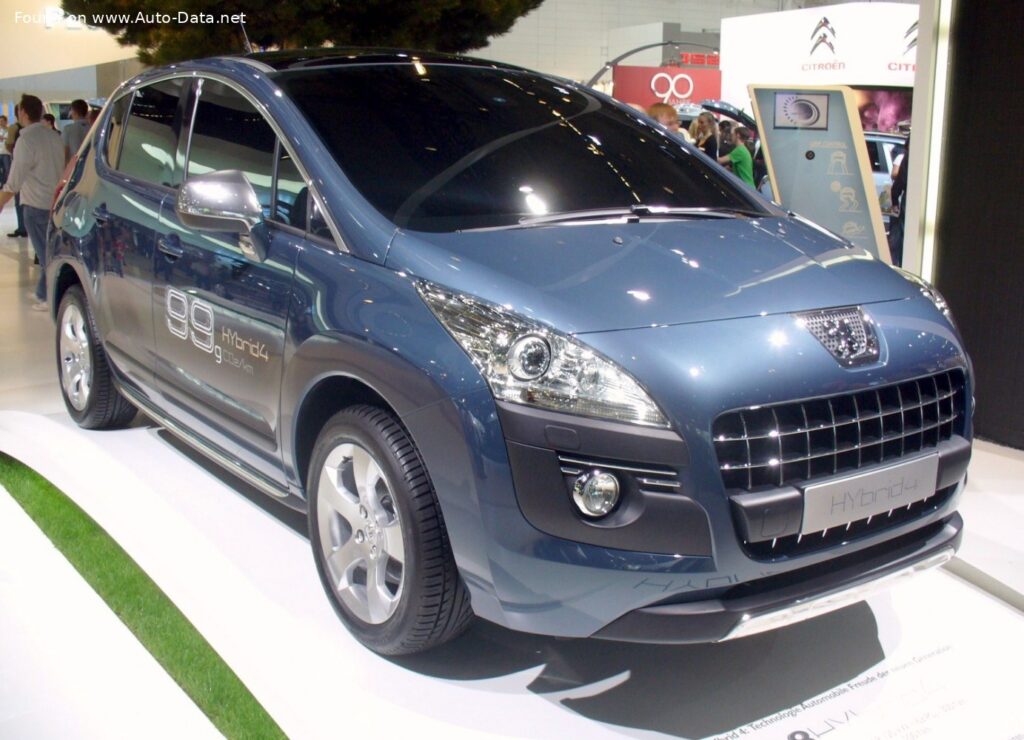
The HYbrid4 system was powered by a 1.1 kWh Nickel-metal hydride (NiMH) battery, strategically located under the trunk. While its all-electric range was limited to approximately 1.24 miles at speeds up to 37.28 mph, its primary function was to assist the diesel engine, recover braking energy, and provide electric-only propulsion at low speeds or for short distances. This intelligent integration resulted in truly remarkable fuel efficiency for an all-wheel-drive SUV, achieving an NEDC combined rating of 3.8 liters per 100 kilometers, which translates to an outstanding 61.9 US miles per gallon. With CO2 emissions of just 99 g/km, the 3008 HYbrid4 was a class leader in environmental performance, demonstrating that power and efficiency could coexist.
Design and Features
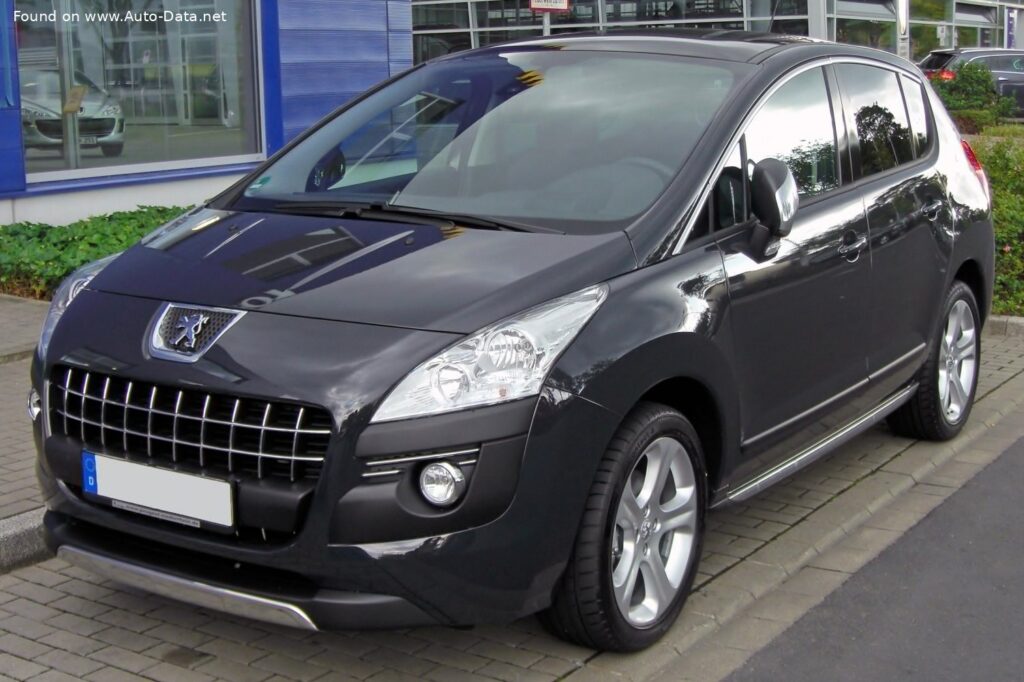
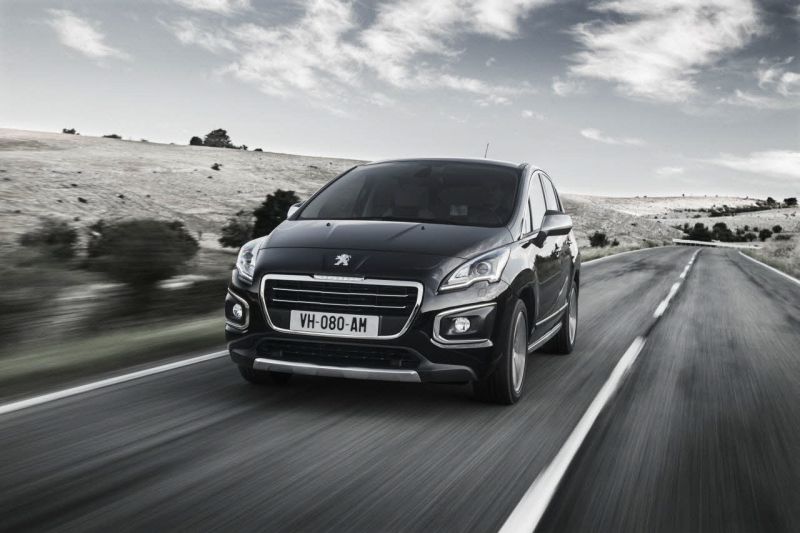
The Peugeot 3008 I (Phase I, 2009) adopted a distinctive design that blended elements of an SUV, an MPV (Multi-Purpose Vehicle), and a hatchback, creating a unique crossover aesthetic. With its five doors and seating for five occupants, it offered a practical and versatile package. The exterior dimensions were compact yet substantial, measuring 171.85 inches in length, 72.32 inches in width (83.19 inches including mirrors), and 64.53 inches in height, with a wheelbase of 102.87 inches. These proportions contributed to a commanding road presence while maintaining maneuverability in urban environments.
Inside, the 3008 was designed with versatility and comfort in mind. The cabin offered ample space for passengers and a flexible cargo area. The trunk space ranged from 13.31 cubic feet with all seats in place, expanding to a generous 47.36 cubic feet with the rear seats folded down, making it suitable for families and active lifestyles. The interior reflected Peugeot’s focus on quality materials and ergonomic design, typical of European vehicles of its class.
From a technical standpoint, the 3008 HYbrid4 incorporated several advanced features for its time. The all-wheel-drive system, with the ICE driving the front and the electric motor driving the rear, allowed for intelligent power distribution, enhancing traction and stability in various driving conditions. The vehicle featured an independent McPherson strut front suspension with a coil spring and anti-roll bar, while the rear utilized a semi-independent setup with coil springs, providing a comfortable yet composed ride. Braking was handled by 302 mm ventilated discs at the front and 290 mm solid discs at the rear, supported by an Anti-lock Braking System (ABS) for enhanced safety. Electric power steering offered precise control and ease of maneuvering, complemented by a minimum turning circle of 36.09 feet. Standard equipment included a Start & Stop system to further reduce fuel consumption and emissions in city driving, along with a particulate filter for the diesel engine. The 225/50 R17 tires mounted on 7.5J x 17 wheel rims provided a good balance of grip and ride comfort.
Technical Specifications
| Category | Specification |
|---|---|
| General Information | |
| Brand | Peugeot |
| Model | 3008 |
| Generation | 3008 I (Phase I, 2009) |
| Type (Engine) | 2.0 HDi (200 Hp) HYbrid4 4×4 Automatic |
| Start of Production | 2011 year |
| End of Production | 2013 year |
| Powertrain Architecture | FHEV (Full Hybrid Electric Vehicle) |
| Body type | SUV |
| Seats | 5 |
| Doors | 5 |
| Performance Specs | |
| Fuel consumption – urban (NEDC) | 3.7 l/100 km (63.6 US mpg) |
| Fuel consumption – extra urban (NEDC) | 3.9 l/100 km (60.3 US mpg) |
| Fuel consumption – combined (NEDC) | 3.8 l/100 km (61.9 US mpg) |
| CO2 emissions (NEDC) | 99 g/km |
| Fuel Type | Diesel |
| Acceleration 0 – 60 mph | 8.1 sec |
| Maximum speed | 118.68 mph (191 km/h) |
| Emission standard | Euro 5 |
| Weight-to-power ratio | 8.3 kg/Hp, 120.5 Hp/tonne |
| Weight-to-torque ratio | 5.5 kg/Nm, 180.7 Nm/tonne |
| Electric Cars and Hybrids Specs | |
| Gross battery capacity | 1.1 kWh |
| Battery voltage | 200 V |
| Battery technology | Nickel-metal hydride (NiMH) |
| Battery location | Under the trunk |
| All-electric range (NEDC) | 1.24 mi (2 km) |
| Max speed (electric) | 37.28 mph (60 km/h) |
| Electric motor 1 power | 37 Hp @ 2500 rpm |
| Electric motor 1 torque | 147.51 lb.-ft. @ 1250 rpm (200 Nm) |
| Electric motor location | Rear axle, Transverse |
| Electric motor type | Synchronous |
| System power | 200 Hp |
| Internal Combustion Engine Specs | |
| Power | 163 Hp @ 3750 rpm |
| Power per liter | 81.6 Hp/l |
| Torque | 221.27 lb.-ft. @ 1580 rpm (300 Nm) |
| Engine layout | Front, Transverse |
| Engine Model/Code | RHC DW10CTED4 |
| Engine displacement | 2.0 Liters (1997 cm3, 121.86 cu. in.) |
| Number of cylinders | 4 |
| Engine configuration | Inline |
| Cylinder Bore | 3.35 in. (85 mm) |
| Piston Stroke | 3.46 in. (88 mm) |
| Compression ratio | 16:1 |
| Number of valves per cylinder | 4 |
| Fuel injection system | Diesel Commonrail |
| Engine aspiration | Turbocharger, Intercooler |
| Valvetrain | DOHC |
| Engine oil capacity | 5.28 US qt (5 l) |
| Engine systems | Start & Stop System, Particulate filter |
| Space, Volume and Weights | |
| Kerb Weight | 3659.67 lbs. (1660 kg) |
| Max. weight | 4949.38 lbs. (2245 kg) |
| Max load | 1289.7 lbs. (585 kg) |
| Trunk (boot) space – minimum | 13.31 cu. ft. (377 l) |
| Trunk (boot) space – maximum | 47.36 cu. ft. (1341 l) |
| Fuel tank capacity | 14.93 US gal (56.5 l) |
| Permitted trailer load with brakes (12%) | 1697.56 lbs. (770 kg) |
| Permitted trailer load without brakes | 1102.31 lbs. (500 kg) |
| Permitted towbar download | 154.32 lbs. (70 kg) |
| Dimensions | |
| Length | 171.85 in. (4365 mm) |
| Width | 72.32 in. (1837 mm) |
| Width including mirrors | 83.19 in. (2113 mm) |
| Height | 64.53 in. (1639 mm) |
| Wheelbase | 102.87 in. (2613 mm) |
| Front track | 60.31 in. (1532 mm) |
| Rear (Back) track | 60.12 in. (1527 mm) |
| Front overhang | 36.06 in. (916 mm) |
| Rear overhang | 32.91 in. (836 mm) |
| Minimum turning circle (turning diameter) | 36.09 ft. (11 m) |
| Drivetrain, Brakes and Suspension Specs | |
| Drivetrain Architecture | ICE drives front wheels; Electric motor drives rear wheels. |
| Drive wheel | All-wheel drive (4×4) |
| Number of gears and type of gearbox | 6 gears, automatic transmission |
| Front suspension | Independent, McPherson with coil spring and anti-roll bar |
| Rear suspension | Semi-independent, coil spring |
| Front brakes | Ventilated discs, 302 mm |
| Rear brakes | Disc, 290 mm |
| Assisting systems | ABS (Anti-lock braking system) |
| Steering type | Steering rack and pinion |
| Power steering | Electric Steering |
| Tires size | 225/50 R17 |
| Wheel rims size | 7.5J x 17 |
Legacy and Market Impact
The Peugeot 3008 I (Phase I, 2009) 2.0 HDi (200 Hp) HYbrid4 4×4 Automatic holds a significant place in automotive history, particularly within the European market. It was a true pioneer, being one of the world’s first mass-produced diesel-electric hybrid vehicles and the very first to offer an all-wheel-drive system achieved through a diesel engine powering the front and an electric motor powering the rear. This innovative HYbrid4 system was a testament to Peugeot’s engineering prowess and its forward-thinking approach to efficiency and environmental responsibility.
In its primary European market, the 3008 HYbrid4 competed against a growing segment of compact SUVs and crossovers, including popular models like the Nissan Qashqai, Volkswagen Tiguan, and Ford Kuga. However, its unique diesel-hybrid powertrain gave it a distinct advantage, especially in countries where diesel fuel was prevalent and fuel efficiency was a top priority. While other manufacturers were exploring gasoline-electric hybrids, Peugeot carved out a niche with its diesel-electric solution, offering a compelling blend of torque, range, and low emissions that few competitors could match at the time. Its CO2 emissions of 99 g/km were particularly impressive, helping owners benefit from tax incentives in various European nations and enhancing its appeal to environmentally conscious buyers.
The reputation of the 3008 HYbrid4 was largely positive, praised for its sophisticated drivetrain, comfortable ride, and practical interior. It demonstrated that hybrid technology didn’t have to sacrifice performance or utility. Although the specific production run for this variant was relatively short (2011-2013), its impact was far-reaching. It paved the way for subsequent HYbrid4 models across Peugeot and Citroën lineups and validated the concept of a diesel-electric powertrain as a viable and highly efficient option. The lessons learned from the first-generation 3008 HYbrid4 undoubtedly influenced Peugeot’s later hybrid and electric vehicle strategies, contributing to the broader industry shift towards diverse electrified powertrains. Today, it stands as an important milestone, showcasing an early and ingenious approach to combining robust diesel performance with the environmental benefits of hybrid technology in a practical SUV package.