The Peugeot 3008 I (Phase II, 2013): A European Crossover’s Refined Mid-Life
The Peugeot 3008 I, particularly in its Phase II iteration launched in 2013, represented a significant player in the burgeoning compact crossover SUV segment within the European and other international markets. While never officially sold in the United States, this French-engineered vehicle carved out a niche for itself as a practical, versatile, and fuel-efficient family car. The Peugeot 3008 I (Phase II, 2013) was a refreshed version of the original 3008, which debuted in 2009, bringing updated styling, enhanced features, and a continued focus on its unique blend of hatchback practicality, MPV spaciousness, and SUV-like ground clearance and styling cues. This article focuses on the 1.6 HDi (115 Hp) FAP BMP variant, a popular diesel powertrain option known for its economy and moderate performance.
Evolution and Market Positioning of the Peugeot 3008 I (Phase II, 2013)
The first generation Peugeot 3008 was introduced at a time when traditional multi-purpose vehicles (MPVs) were beginning to cede market share to more stylish and rugged-looking crossovers. Peugeot’s response was a vehicle that defied easy categorization, often described as a “crossover” or “compact SUV” but with strong undertones of a family-friendly MPV. The Phase II refresh, which began production in 2013 and continued until 2015, aimed to keep the 3008 competitive against a rapidly expanding field of rivals. This facelift primarily focused on exterior aesthetic enhancements, bringing the 3008’s design more in line with Peugeot’s then-current corporate identity, characterized by a more prominent grille and updated lighting signatures. Internally, refinements were made to materials and infotainment options, though the core practical layout remained. For European consumers, the 3008 offered a compelling package of comfort, elevated driving position, and a flexible interior, making it a strong contender in its class.
Engine and Performance: The 1.6 HDi (115 Hp) FAP BMP Powertrain
Under the hood of this particular Peugeot 3008 I (Phase II, 2013) model lay a 1.6-liter HDi (High-pressure Direct injection) diesel engine, a staple of Peugeot’s powertrain lineup for its balance of efficiency and usable torque. This inline four-cylinder unit, designated with the engine code BHX DV6FC, featured a common rail fuel injection system and was equipped with a turbocharger and intercooler, enhancing both power delivery and fuel economy. It produced a respectable 115 horsepower at 3,600 rpm and a robust 199.14 lb.-ft. of torque available from a low 1,750 rpm. This low-end torque was particularly beneficial for daily driving, providing ample pulling power for city traffic and highway cruising, especially when the vehicle was loaded with passengers and cargo.
A key characteristic of this variant was its transmission: a 6-speed Automated Manual Transmission (AMT), referred to here as BMP (Boîte Manuelle Pilotée, or piloted manual gearbox). Unlike a conventional torque-converter automatic or a continuously variable transmission (CVT), the BMP system essentially uses a standard manual gearbox with an electronically controlled clutch and gear selection system. While highly efficient, this type of transmission is known for its distinct shift characteristics, which can sometimes be perceived as less smooth than a traditional automatic, especially during spirited driving. However, its design contributed significantly to the vehicle’s excellent fuel economy ratings.
Performance figures for the 1.6 HDi (115 Hp) FAP BMP model were geared towards practicality rather than outright speed. It could accelerate from 0 to 60 mph in a reasonable 12 seconds, reaching a maximum speed of 113.71 mph. More importantly for its target audience, the vehicle boasted impressive fuel efficiency, with combined consumption figures ranging from 54.7 to 56 US mpg. Coupled with its low CO2 emissions of 110-112 g/km, the 3008 met the stringent Euro 5 emission standard, making it an environmentally conscious choice for European buyers at the time. The inclusion of a Diesel Particulate Filter (FAP) was crucial for reducing harmful emissions, a standard feature on modern diesel engines in Europe.
Design and Features of the Peugeot 3008 I (Phase II, 2013)
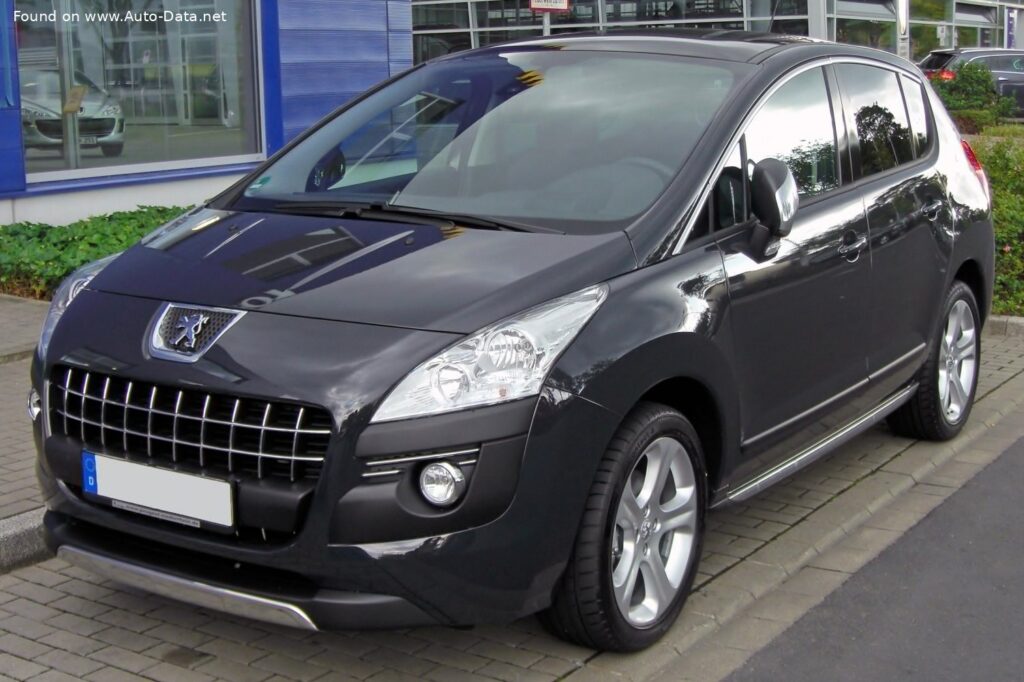
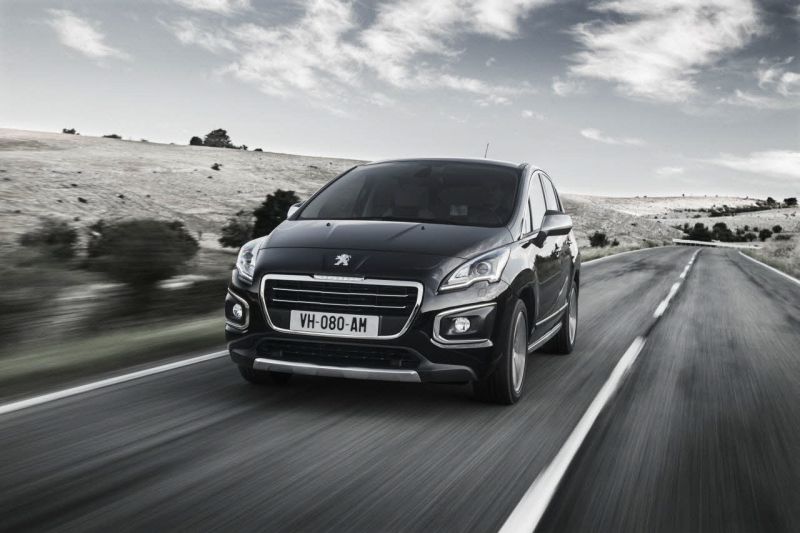
The exterior design of the Phase II 3008 saw a more refined front fascia, incorporating Peugeot’s updated grille design, revised headlights, and new LED daytime running lights on some trims, giving it a more contemporary and sophisticated look. The overall silhouette remained, blending the practicality of an MPV with the rugged appeal of an SUV. As a compact SUV, it featured 5 doors and seating for 5 occupants. Its dimensions were well-suited for European urban environments, with a length of 171.85 inches, a width of 72.32 inches (83.19 inches including mirrors), and a height of 64.37 inches. The 102.87-inch wheelbase contributed to a comfortable ride and stable handling.
Inside, the 3008 was renowned for its thoughtful and flexible cabin. The elevated driving position offered excellent visibility, a common draw for SUV and crossover buyers. The interior emphasized practicality, featuring a versatile cargo area with a minimum trunk space of 18.08 cubic feet, which could expand significantly to 56.64 cubic feet with the rear seats folded down. This modularity was a key selling point, allowing owners to easily adapt the vehicle for various cargo and passenger needs. Standard features for the era included power steering with a rack and pinion system, front-wheel drive architecture, and a comprehensive safety suite including ABS (Anti-lock Braking System). The suspension setup, with an independent McPherson strut front and independent coil spring rear, was tuned for a comfortable ride, absorbing road imperfections typical of European roads. The vehicle came with tire sizes such as 225/50 R17 or 235/45 R18, mounted on 17-inch or 18-inch wheel rims, respectively, contributing to both aesthetics and handling.
Technical Specifications
| Category | Specification | US Equivalent (where applicable) |
|---|---|---|
| Brand | Peugeot | |
| Model | 3008 | |
| Generation | 3008 I (Phase II, 2013) | |
| Type (Engine) | 1.6 HDi (115 Hp) FAP BMP | |
| Production Years | 2013 – 2015 | |
| Body type | SUV | |
| Seats | 5 | |
| Doors | 5 | |
| Performance Specifications | ||
| Fuel consumption (urban) | 4.5-4.7 l/100 km | 50-52.3 US mpg |
| Fuel consumption (extra urban) | 4.0-4.1 l/100 km | 57.4-58.8 US mpg |
| Fuel consumption (combined) | 4.2-4.3 l/100 km | 54.7-56 US mpg |
| CO2 emissions | 110-112 g/km | |
| Fuel Type | Diesel | |
| Acceleration 0-60 mph | 12 sec | |
| Maximum speed | 183 km/h | 113.71 mph |
| Emission standard | Euro 5 | |
| Weight-to-power ratio | 12.4 kg/Hp | 27.34 lbs/Hp |
| Weight-to-torque ratio | 5.3 kg/Nm | 11.68 lbs/lb.-ft. |
| Engine Specifications | ||
| Power | 115 Hp @ 3600 rpm | |
| Power per liter | 73.7 Hp/l | |
| Torque | 270 Nm @ 1750 rpm | 199.14 lb.-ft. @ 1750 rpm |
| Engine layout | Front, Transverse | |
| Engine Model/Code | BHX DV6FC | |
| Engine displacement | 1560 cm3 | 1.6 liters / 95.2 cu. in. |
| Number of cylinders | 4 | |
| Engine configuration | Inline | |
| Number of valves per cylinder | 2 | |
| Fuel injection system | Diesel Commonrail | |
| Engine aspiration | Turbocharger, Intercooler | |
| Engine oil capacity | 3.75 l | 3.96 US qt |
| Engine oil specification | Not specified | |
| Engine systems | Particulate filter (FAP) | |
| Space, Volume and Weights | ||
| Kerb Weight | 1423 kg | 3137.18 lbs. |
| Max. weight | 2030 kg | 4475.38 lbs. |
| Max load | 607 kg | 1338.21 lbs. |
| Trunk (boot) space – minimum | 512 l | 18.08 cu. ft. |
| Trunk (boot) space – maximum | 1604 l | 56.64 cu. ft. |
| Fuel tank capacity | 60 l | 15.85 US gal |
| Dimensions | ||
| Length | 4365 mm | 171.85 in. |
| Width | 1837 mm | 72.32 in. |
| Width with mirrors folded | 1910 mm | 75.2 in. |
| Width including mirrors | 2113 mm | 83.19 in. |
| Height | 1635 mm | 64.37 in. |
| Wheelbase | 2613 mm | 102.87 in. |
| Front overhang | 916 mm | 36.06 in. |
| Rear overhang | 836 mm | 32.91 in. |
| Minimum turning circle | 10.9 m | 35.76 ft. |
| Drivetrain, Brakes and Suspension | ||
| Drivetrain Architecture | Internal Combustion engine drives front wheels | |
| Drive wheel | Front wheel drive | |
| Number of gears and type of gearbox | 6 gears, automatic transmission BMP | |
| Front suspension | Independent, McPherson with coil spring and anti-roll bar | |
| Rear suspension | Independent coil spring | |
| Front brakes | Ventilated discs | |
| Rear brakes | Disc | |
| Assisting systems | ABS (Anti-lock braking system) | |
| Steering type | Steering rack and pinion | |
| Tires size | 225/50 R17; 235/45 R18 | |
| Wheel rims size | 17; 18 | |
Legacy and Market Impact
The Peugeot 3008 I (Phase II, 2013) played a vital role in Peugeot’s strategy to capture a share of the burgeoning crossover market in Europe. Despite its somewhat unconventional styling that blended MPV and SUV cues, it gained a reputation for its comfortable ride, practical interior, and impressive fuel efficiency, particularly with the HDi diesel powertrains. The 1.6 HDi (115 Hp) FAP BMP variant, in particular, was a popular choice among European families and fleet operators due to its low running costs and compliant Euro 5 emissions.
In its primary market, the 3008 competed against a growing list of rivals, including well-established players like the Nissan Qashqai, Volkswagen Tiguan, Ford Kuga (known as the Escape in the US), Renault Kadjar, and Korean contenders such as the Kia Sportage and Hyundai ix35 (Tucson). What set the 3008 apart was its distinct French flair, its focus on interior versatility, and its relatively high levels of comfort. While it might not have been the sportiest option, it excelled as a refined and practical family vehicle.
The first generation 3008, and specifically its Phase II refresh, laid crucial groundwork for Peugeot. It demonstrated the brand’s ability to innovate in a highly competitive segment and adapt to changing consumer preferences away from traditional sedans and MPVs. The lessons learned from the 3008 I, both in terms of design and engineering, directly informed the development of its successor. The second-generation Peugeot 3008, launched in 2016, dramatically shifted towards a more conventional and assertive SUV design, achieving widespread critical acclaim and significantly boosting Peugeot’s fortunes globally. Thus, while the Peugeot 3008 I (Phase II, 2013) may not be familiar to American audiences, it remains a significant chapter in Peugeot’s modern history, representing a thoughtful and efficient European crossover that successfully navigated the transitional period of automotive design and consumer demand.