Introduction to the Peugeot 3008 I (Phase II, 2013) 2.0 BlueHDi (150 Hp)
The Peugeot 3008, a prominent nameplate in the European compact crossover SUV segment, first made its debut in 2008. The vehicle under scrutiny here represents the Peugeot 3008 I (Phase II, 2013) 2.0 BlueHDi (150 Hp), a significant update to the first generation that was introduced in 2013 and remained in production until 2016. Positioned as a versatile family vehicle, the 3008 I aimed to blend the practicality of an SUV with the driving dynamics and comfort of a conventional hatchback, catering primarily to the discerning European market. While never officially sold in the United States, its design and engineering philosophies reflect global automotive trends, emphasizing efficiency, utility, and a refined driving experience. This particular variant, equipped with the 2.0-liter BlueHDi diesel engine, stood out for its impressive balance of performance and fuel economy, making it a highly competitive offering in its class across Europe.
Engine and Performance Characteristics of the Peugeot 3008 I (Phase II, 2013) 2.0 BlueHDi (150 Hp)
At the heart of the Peugeot 3008 I (Phase II, 2013) 2.0 BlueHDi (150 Hp) lies a sophisticated 2.0-liter (1997 cm3 or 121.86 cubic inches) inline four-cylinder BlueHDi diesel engine, internally designated as AHX DW10FD. This powertrain was a testament to Peugeot’s commitment to advanced diesel technology, designed to deliver robust performance while adhering to stringent European emission standards. The engine produces a respectable 150 horsepower at 4000 rpm, translating to a power output of approximately 75.1 horsepower per liter of displacement. More notably for a diesel, it generates a substantial 370 Newton-meters (272.9 lb.-ft.) of torque, available at a low 2000 rpm. This ample torque at low engine speeds ensures strong pulling power and effortless acceleration, characteristic of modern diesel powertrains.
The engine’s architecture features a front, transverse layout, driving the front wheels through a precise 6-speed manual transmission. This setup provides an engaging driving experience, allowing the driver full control over the power delivery. Key to its efficiency and performance is the advanced fuel injection system, utilizing common rail direct diesel injection, coupled with a turbocharger and intercooler. This combination optimizes combustion, enhancing both power output and fuel economy. Furthermore, the BlueHDi technology incorporates a particulate filter, crucial for meeting the Euro 6 emission standard, which was a significant environmental benchmark at the time.
In terms of raw performance, the 3008 I 2.0 BlueHDi is capable of accelerating from 0 to 60 mph in an estimated 9.2 seconds (0 to 100 km/h in 9.7 seconds), reaching a maximum speed of 121.17 mph (195 km/h). These figures underscore its capability for both urban commuting and highway cruising. Fuel economy was a major selling point, with combined consumption rated at an impressive 4.2 liters per 100 kilometers, which translates to approximately 56 US mpg. Urban driving yielded 4.9 l/100 km (48 US mpg), while extra-urban conditions saw consumption drop to 3.8 l/100 km (61.9 US mpg). With CO2 emissions of just 109 g/km, the 3008 I 2.0 BlueHDi was a leader in its segment for environmental efficiency.
Design and Features
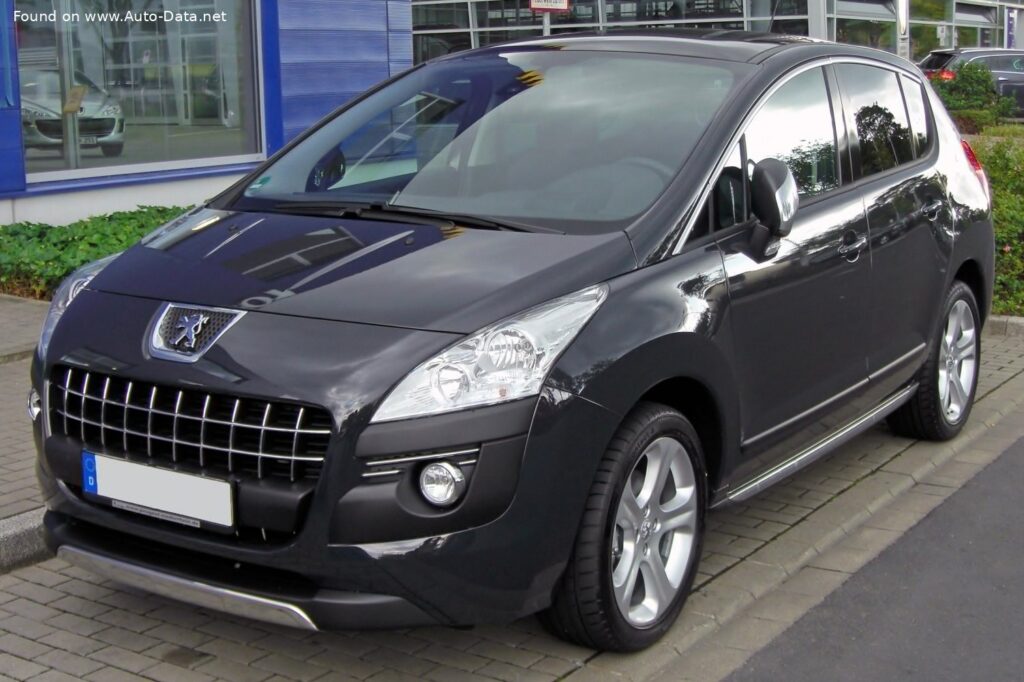
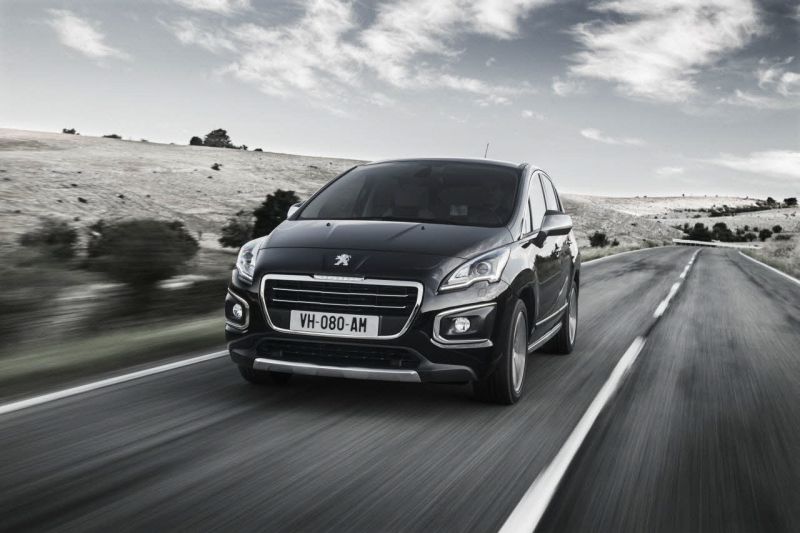
The Peugeot 3008 I (Phase II) retained the distinctive crossover styling of its predecessor, characterized by a blend of SUV ruggedness and MPV practicality. It featured a 5-door SUV body type, offering seating for five occupants. The Phase II facelift, introduced in 2013, brought subtle yet impactful aesthetic revisions, primarily to the front fascia, giving it a more contemporary and assertive look in line with Peugeot’s evolving design language. This included a redesigned grille, updated headlights, and revised bumper elements, aiming for a more sophisticated and less polarizing appearance than the original model.
Inside, the 3008 I prioritized comfort, versatility, and a commanding driving position. The cabin design was driver-focused, with intuitive controls and quality materials for its segment. Practicality was a strong suit, exemplified by its generous trunk space, which ranged from a minimum of 512 liters (18.08 cu. ft.) with all seats in place to a cavernous 1604 liters (56.64 cu. ft.) with the rear seats folded down. This flexible cargo capacity made it ideal for families and those requiring ample storage.
Standard features included a robust drivetrain architecture with front-wheel drive, ensuring predictable handling and efficiency. The suspension system comprised an independent McPherson strut setup with coil springs and an anti-roll bar at the front, complemented by a semi-independent coil spring rear suspension. This configuration provided a comfortable ride quality while maintaining good body control. Braking duties were handled by ventilated discs at the front and solid discs at the rear, supported by an Anti-lock Braking System (ABS) for enhanced safety. Steering was managed by a rack and pinion system, offering responsive feedback. The vehicle rode on 225/50 R17 tires mounted on 17-inch wheel rims, contributing to its stable stance and comfortable ride. A 60-liter (15.85 US gallon) fuel tank provided an excellent cruising range, especially given its impressive fuel economy.
Technical Specifications
| Category | Specification |
|---|---|
| General Information | |
| Brand | Peugeot |
| Model | 3008 |
| Generation | 3008 I (Phase II, 2013) |
| Engine Type | 2.0 BlueHDi (150 Hp) |
| Production Start | 2013 |
| Production End | 2016 |
| Powertrain Architecture | Internal Combustion Engine |
| Body Type | SUV |
| Seats | 5 |
| Doors | 5 |
| Performance Specs | |
| Fuel Consumption (Urban) | 4.9 l/100 km (48 US mpg) |
| Fuel Consumption (Extra Urban) | 3.8 l/100 km (61.9 US mpg) |
| Fuel Consumption (Combined) | 4.2 l/100 km (56 US mpg) |
| CO2 Emissions | 109 g/km |
| Fuel Type | Diesel |
| Acceleration 0-60 mph | 9.2 sec |
| Acceleration 0-100 km/h | 9.7 sec |
| Maximum Speed | 195 km/h (121.17 mph) |
| Emission Standard | Euro 6 |
| Weight-to-Power Ratio | 10.2 kg/Hp (98 Hp/tonne) |
| Weight-to-Torque Ratio | 4.1 kg/Nm (241.8 Nm/tonne) |
| Engine Specs | |
| Power | 150 Hp @ 4000 rpm |
| Power per Liter | 75.1 Hp/l |
| Torque | 370 Nm (272.9 lb.-ft.) @ 2000 rpm |
| Engine Layout | Front, Transverse |
| Engine Model/Code | AHX DW10FD |
| Engine Displacement | 1997 cm3 (121.86 cu. in.) |
| Number of Cylinders | 4 |
| Engine Configuration | Inline |
| Valves per Cylinder | 4 |
| Fuel Injection System | Diesel Commonrail |
| Engine Aspiration | Turbocharger, Intercooler |
| Engine Oil Capacity | 5 l (5.28 US qt) |
| Engine Systems | Particulate filter |
| Space, Volume and Weights | |
| Kerb Weight | 1530 kg (3373.07 lbs) |
| Max. Weight | 2080 kg (4585.62 lbs) |
| Max Load | 550 kg (1212.54 lbs) |
| Trunk Space (Min) | 512 l (18.08 cu. ft.) |
| Trunk Space (Max) | 1604 l (56.64 cu. ft.) |
| Fuel Tank Capacity | 60 l (15.85 US gal) |
| Dimensions | |
| Length | 4365 mm (171.85 in.) |
| Width | 1837 mm (72.32 in.) |
| Width with mirrors folded | 1910 mm (75.2 in.) |
| Width including mirrors | 2113 mm (83.19 in.) |
| Height | 1635 mm (64.37 in.) |
| Wheelbase | 2613 mm (102.87 in.) |
| Front Track | 1532 mm (60.31 in.) |
| Rear Track | 1527 mm (60.12 in.) |
| Front Overhang | 916 mm (36.06 in.) |
| Rear Overhang | 836 mm (32.91 in.) |
| Minimum Turning Circle | 11.7 m (38.39 ft.) |
| Drivetrain, Brakes and Suspension Specs | |
| Drivetrain Architecture | Internal Combustion Engine drives front wheels |
| Drive Wheel | Front-wheel drive |
| Gearbox Type | 6 gears, manual transmission |
| Front Suspension | Independent, McPherson with coil spring and anti-roll bar |
| Rear Suspension | Semi-independent, coil spring |
| Front Brakes | Ventilated discs |
| Rear Brakes | Disc |
| Assisting Systems | ABS (Anti-lock braking system) |
| Steering Type | Steering rack and pinion |
| Tires Size | 225/50 R17 |
| Wheel Rims Size | 17 inches |
Legacy and Market Impact of the Peugeot 3008 I
The Peugeot 3008 I, particularly in its Phase II iteration with the efficient 2.0 BlueHDi engine, carved out a significant niche in the highly competitive European compact SUV segment. Despite its unique blend of SUV and MPV characteristics, which initially polarized some critics, the 3008 I ultimately proved to be a strong seller for Peugeot, especially after its facelift addressed some of the earlier design concerns. Its reputation was built on a foundation of practicality, comfort, and, crucially, exceptional fuel efficiency—a paramount consideration for European consumers.
In its primary markets, the 3008 I faced stiff competition from well-established rivals such as the Nissan Qashqai (often credited with popularizing the compact crossover), Volkswagen Tiguan, Ford Kuga, and Renault Kadjar. Peugeot distinguished the 3008 through its distinctive styling, a focus on interior versatility, and its advanced diesel powertrains. The 2.0 BlueHDi (150 Hp) variant, in particular, was lauded for its strong torque delivery and impressive economy, making it an attractive option for both private buyers and fleet operators. Its Euro 6 compliance also ensured its relevance in an increasingly environmentally conscious market.
The 3008 I played a vital role in showcasing Peugeot’s engineering prowess and its ability to adapt to evolving market demands. It helped solidify Peugeot’s position in the burgeoning crossover segment and laid critical groundwork for the second-generation 3008, which went on to win numerous awards and achieve even greater commercial success with a more conventional, yet still distinctively styled, SUV approach. The first-generation 3008, therefore, stands as an important transitional model for Peugeot, demonstrating the brand’s commitment to innovation and its steady ascent in the global automotive landscape, even if its direct presence was limited to markets outside of North America. Its legacy is one of a practical, efficient, and well-engineered vehicle that successfully navigated the complexities of its segment and contributed significantly to Peugeot’s brand image and market share.