As an international automotive expert, I present a detailed analysis of the Peugeot 3008 II (Phase II, 2020) 1.2 (136 Hp) Hybrid e-DCS6, a vehicle that exemplifies modern European automotive design, engineering, and the ongoing shift towards electrification. While Peugeot is a brand with a rich history and significant presence globally, it is not currently sold in the United States market. Therefore, this article will focus on its role and impact within its primary European markets, utilizing American English terminology for clarity and consistency.
The Peugeot 3008 II (Phase II, 2020) 1.2 (136 Hp) Hybrid e-DCS6: A Modern European Crossover
The Peugeot 3008 II represents the second generation of Peugeot’s popular compact crossover SUV, introduced in 2016. The “Phase II” designation refers to the significant facelift and technological update that occurred in 2020, bringing refreshed styling, enhanced features, and updated powertrains to maintain its competitive edge. This particular variant, the 1.2 (136 Hp) Hybrid e-DCS6, is a notable addition, specifically launched in April 2023, showcasing Peugeot’s commitment to mild-hybrid technology for improved efficiency and reduced emissions.
Positioned in the highly competitive C-segment SUV market in Europe, the 3008 stands out with its distinctive styling, premium interior, and engaging driving dynamics. This mild-hybrid electric vehicle (MHEV) powertrain variant, produced for a brief period in 2023, underscores the rapid evolution of automotive technology and the industry’s response to stringent environmental regulations, particularly the Euro 6d emissions standard.
Engine & Performance
At the heart of the Peugeot 3008 II (Phase II, 2020) 1.2 (136 Hp) Hybrid e-DCS6 lies a sophisticated powertrain architecture that combines a conventional gasoline engine with a mild-hybrid system. The internal combustion engine (ICE) is Peugeot’s acclaimed PureTech / HN09 1.2-liter (1199 cm³ or 73.17 cu. in.) three-cylinder inline engine. This powerplant is equipped with a turbocharger and intercooler, along with a direct injection fuel system, allowing it to produce a respectable 136 horsepower at 5500 rpm. Its maximum torque output is 230 Nm (169.64 lb.-ft.) delivered at a low 1750 rpm, ensuring responsive acceleration and flexible driving characteristics.
The mild-hybrid component integrates a 48-volt system with a compact lithium-ion battery and an electric motor. The electric motor, a synchronous type, is cleverly integrated into the e-DCS6 automatic transmission, contributing an additional 21 horsepower and 55 Nm (40.57 lb.-ft.) of torque. This MHEV system, classified as a power-assist or battery-assisted hybrid vehicle (BAHV), primarily functions to boost the gasoline engine during acceleration, allowing for smoother starts, and enabling the engine to switch off during coasting or low-speed driving, thereby significantly improving fuel efficiency and reducing emissions. The system also aids in energy recovery through regenerative braking.
Performance figures for this variant are quite competitive for its class. The 3008 Hybrid e-DCS6 can accelerate from 0 to 60 mph in an estimated 9.5 seconds, with a 0 to 100 km/h sprint taking 10 seconds. Its top speed is rated at 200 km/h (124.27 mph). Combined fuel consumption (WLTP) is an impressive 5.6-5.7 liters per 100 km, which translates to approximately 41.3 to 42 US miles per gallon. CO2 emissions are kept low at 126-129 g/km, adhering to the strict Euro 6d emission standard.
Design & Features
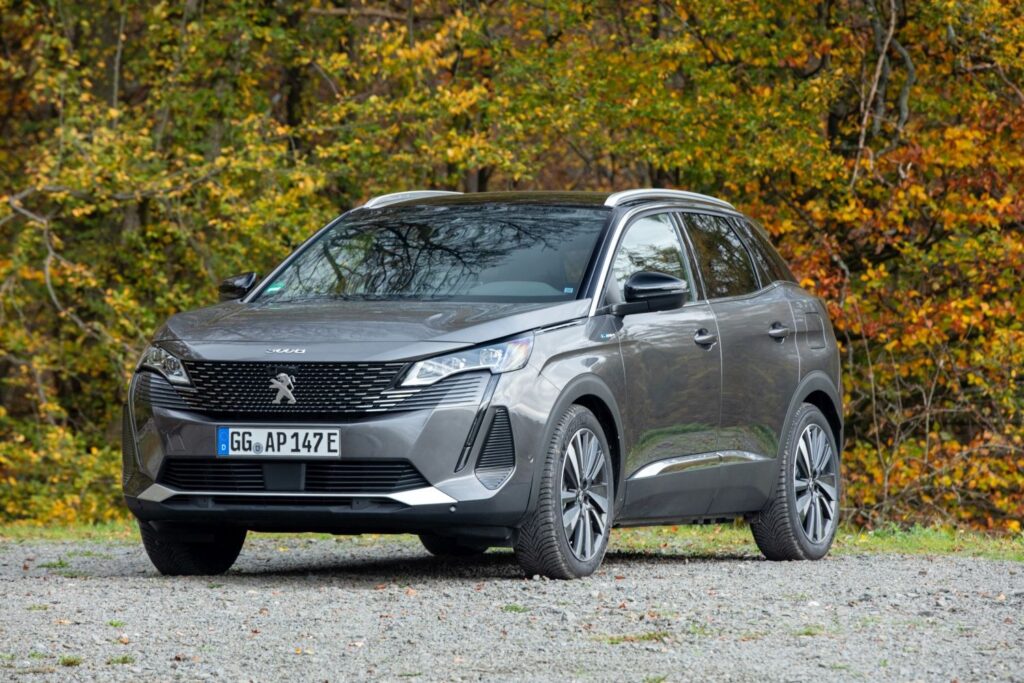
The Peugeot 3008 II (Phase II, 2020) maintains its distinctive and modern SUV styling that has garnered critical acclaim since its initial launch. The facelift in 2020 brought a more assertive front fascia, featuring a frameless grille, sharp LED headlights with “fang-like” daytime running lights, and updated taillights with Peugeot’s signature “three-claw” design. The overall aesthetic is bold, sophisticated, and unmistakably European, blending rugged SUV cues with elegant lines.
Inside, the 3008 continues to offer Peugeot’s innovative i-Cockpit, a defining feature of the brand’s modern vehicles. This ergonomic layout includes a compact steering wheel, a configurable 12.3-inch digital instrument cluster positioned above the steering wheel, and a central touchscreen infotainment system. The interior boasts high-quality materials, meticulous fit and finish, and a design that feels both futuristic and driver-focused. Seating for five occupants is comfortable, and the five-door SUV body type ensures practicality and ease of access.
In terms of features, the 3008 Hybrid e-DCS6 is equipped with a range of modern amenities and safety systems. Standard equipment typically includes a Start & Stop System, a particulate filter for the gasoline engine, and a comprehensive suite of safety features like ABS (Anti-lock Braking System). The vehicle’s dimensions, with a length of 175.08 inches, a width of 72.48 inches (82.6 inches including mirrors), and a height of 63.94 inches, provide a commanding road presence while remaining maneuverable in urban environments. The generous wheelbase of 105.31 inches contributes to a stable ride and ample interior space. With a ground clearance of 8.62 inches, it also offers a decent capability for light off-road excursions or navigating challenging urban terrain.
The trunk (boot) space is versatile, offering a minimum of 7.42 to 20.87 cubic feet (210-591 liters) with the rear seats up, expanding to a substantial 58.98 cubic feet (1670 liters) when the rear seats are folded down, making it highly practical for families and cargo.
Technical Specifications
| Category | Specification | US Equivalent / Notes |
|---|---|---|
| General Information | ||
| Brand | Peugeot | |
| Model | 3008 | |
| Generation | 3008 II (Phase II, 2020) | |
| Type (Engine) | 1.2 (136 Hp) Hybrid e-DCS6 | |
| Start of Production | April, 2023 year | |
| End of Production | September, 2023 year | |
| Powertrain Architecture | MHEV (Mild Hybrid Electric Vehicle) | Power-assist hybrid, battery-assisted hybrid vehicles (BAHV) |
| Body Type | SUV | |
| Seats | 5 | |
| Doors | 5 | |
| Performance Specs | ||
| Combined Fuel Consumption (WLTP) | 5.6-5.7 l/100 km | 41.3 – 42 US mpg |
| CO2 Emissions (WLTP) | 126-129 g/km | |
| Fuel Type | Petrol (Gasoline) | |
| Acceleration 0 – 60 mph (Calculated) | 9.5 sec | |
| Acceleration 0 – 100 km/h | 10 sec | |
| Maximum Speed | 200 km/h | 124.27 mph |
| Emission Standard | Euro 6d | |
| Weight-to-Power Ratio | 10.9 kg/Hp | 92 Hp/tonne |
| Weight-to-Torque Ratio | 6.4 kg/Nm | 155.6 Nm/tonne |
| Electric Cars and Hybrids Specs | ||
| Gross Battery Capacity | 0.89 kWh | |
| Net (Usable) Battery Capacity | 0.43 kWh | |
| Battery Voltage | 48 V | |
| Battery Technology | Lithium-ion (Li-Ion) | |
| Battery Location | Below the floor, under the front seats | |
| Electric Motor Power | 21 Hp | |
| Electric Motor Torque | 55 Nm | 40.57 lb.-ft. |
| Electric Motor Location | Integrated into the transmission | |
| Electric Motor Type | Synchronous | |
| Internal Combustion Engine Specs | ||
| Power | 136 Hp @ 5500 rpm | |
| Power per Liter | 113.4 Hp/l | |
| Torque | 230 Nm @ 1750 rpm | 169.64 lb.-ft. @ 1750 rpm |
| Engine Layout | Front, Transverse | |
| Engine Model/Code | PureTech / HN09 | |
| Engine Displacement | 1199 cm³ | 1.2 Liters / 73.17 cu. in. |
| Number of Cylinders | 3 | |
| Engine Configuration | Inline | |
| Number of Valves per Cylinder | 4 | |
| Fuel Injection System | Direct injection | |
| Engine Aspiration | Turbocharger, Intercooler | |
| Engine Oil Capacity | 3.5 l | 3.7 US qt |
| Engine Systems | Start & Stop System, Particulate filter | |
| Space, Volume and Weights | ||
| Kerb Weight | 1478 kg | 3258.43 lbs. |
| Max. Weight | 2050 kg | 4519.48 lbs. |
| Max Load | 572 kg | 1261.04 lbs. |
| Trunk (Boot) Space – Minimum | 210-591 l | 7.42 – 20.87 cu. ft. |
| Trunk (Boot) Space – Maximum | 1670 l | 58.98 cu. ft. |
| Fuel Tank Capacity | 53 l | 14 US gal |
| Permitted Trailer Load with Brakes (12%) | 1250 kg | 2755.78 lbs. |
| Dimensions | ||
| Length | 4447 mm | 175.08 in. |
| Width | 1841 mm | 72.48 in. |
| Width with Mirrors Folded | 1906 mm | 75.04 in. |
| Width Including Mirrors | 2098 mm | 82.6 in. |
| Height | 1624 mm | 63.94 in. |
| Wheelbase | 2675 mm | 105.31 in. |
| Front Track | 1579-1601 mm | 62.17 – 63.03 in. |
| Rear (Back) Track | 1587-1610 mm | 62.48 – 63.39 in. |
| Front Overhang | 923 mm | 36.34 in. |
| Rear Overhang | 849 mm | 33.43 in. |
| Ride Height (Ground Clearance) | 219 mm | 8.62 in. |
| Approach Angle | 20° | |
| Departure Angle | 29° | |
| Drivetrain, Brakes and Suspension Specs | ||
| Drivetrain Architecture | ICE and electric motor drive front wheels; mixed mode only | Front-wheel drive MHEV |
| Drive Wheel | Front wheel drive | |
| Number of Gears and Type of Gearbox | 6 gears, automatic transmission e-DCS | |
| Front Suspension | Independent type McPherson | |
| Rear Suspension | Semi-independent, coil spring | |
| Front Brakes | Ventilated discs | |
| Rear Brakes | Disc | |
| Assisting Systems | ABS (Anti-lock braking system) | |
| Steering Type | Steering rack and pinion | |
| Power Steering | Electric Steering | |
| Tires Size | 215/65 R17 103V; 225/55 R18 102V; 205/55 R19 97V | |
| Wheel Rims Size | 17; 18; 19 | |
Legacy & Market Impact
The Peugeot 3008, particularly its second generation, has carved out a significant niche in the highly competitive European compact SUV segment. Upon its initial launch, it was lauded for its striking design, premium interior, and dynamic driving experience, even earning the prestigious European Car of the Year award in 2017. The Phase II refresh in 2020 ensured its continued relevance, keeping pace with evolving design trends and technological advancements.
The introduction of mild-hybrid variants like the 1.2 (136 Hp) Hybrid e-DCS6 demonstrates Peugeot’s strategic response to increasingly strict emissions regulations and the growing consumer demand for more fuel-efficient and environmentally friendly vehicles. While its production run for this specific variant was relatively brief in 2023, it served as a crucial stepping stone in Peugeot’s broader electrification strategy, bridging the gap between conventional gasoline engines and full plug-in hybrids or battery electric vehicles. This MHEV system allowed the 3008 to offer improved urban fuel economy and reduced CO2 emissions without the added complexity or cost of a full hybrid system, making it an attractive option for a wide range of buyers.
In the European market, the Peugeot 3008 competes fiercely with established rivals such as the Volkswagen Tiguan, Nissan Qashqai, Hyundai Tucson, Kia Sportage, and its Stellantis stablemate, the Opel/Vauxhall Grandland. Its success lies in its ability to differentiate itself through bold styling, a distinctive user experience provided by the i-Cockpit, and a perceived upmarket feel that often punches above its weight class. The 3008’s reputation for comfort, practicality, and efficiency, especially with the mild-hybrid powertrain, solidifies its position as a strong contender for families and individuals seeking a versatile and modern compact SUV.
The short production window for this particular specification highlights the rapid pace of change in the automotive industry, where models and powertrains are constantly updated to reflect market demands and regulatory shifts. Nonetheless, the 3008 II (Phase II) 1.2 (136 Hp) Hybrid e-DCS6 stands as a testament to Peugeot’s engineering prowess and its commitment to offering innovative, efficient, and stylish vehicles in the global automotive landscape, even if its direct presence isn’t felt in the American market.