The Peugeot 3008 III e-3008 73 kWh (213 Hp): A New Era of Electric SUV
The Peugeot 3008 III represents a significant leap forward for the French automaker in the highly competitive compact SUV segment, particularly with its all-electric variant, the e-3008. Unveiled in September 2023, this third generation of the popular 3008 model marks a pivotal moment in Peugeot’s electrification strategy, introducing a bold new design language and advanced electric vehicle (EV) technology. While Peugeot models are not officially sold in the United States, the 3008 has consistently been a strong performer in its primary European market, recognized for its distinctive styling, practical interior, and engaging driving dynamics. The e-3008, specifically the 73 kWh (213 Hp) version, is positioned as a compelling option for European consumers seeking a stylish, efficient, and technologically advanced electric SUV, embodying Peugeot’s commitment to sustainable mobility. This model builds upon the success of its predecessors, evolving into a more sophisticated and environmentally conscious package designed to meet the demands of a rapidly electrifying automotive landscape.
Engine & Performance: Electrifying the {original_focus_keyword}
At the heart of the Peugeot e-3008 73 kWh (213 Hp) lies a robust and efficient all-electric powertrain. This BEV (Battery Electric Vehicle) architecture signifies Peugeot’s dedication to zero-emission driving. The vehicle is powered by a single electric motor strategically positioned on the front axle, driving the front wheels. This synchronous motor delivers a substantial 213 horsepower (Hp) across a broad rev range, from 4370 to 14000 rpm, ensuring responsive acceleration and sustained power delivery. Torque output is equally impressive, with 252.98 lb.-ft. (343 Nm) available from a low 250 rpm up to 4370 rpm. This immediate torque characteristic, inherent to electric powertrains, provides a feeling of effortless acceleration from a standstill.
Performance figures for the e-3008 are competitive within its segment. It accelerates from 0 to 60 mph in a brisk 8.3 seconds (0-100 km/h in 8.7 seconds), making it agile enough for both city driving and highway merging. The top speed is electronically limited to 105.63 mph (170 km/h), a common practice for electric vehicles to optimize range and battery longevity. The seamless power delivery is managed by a single-gear automatic transmission, characteristic of most electric cars, providing a smooth and uninterrupted driving experience.
The energy source for this impressive performance is a 73 kWh gross battery capacity, utilizing advanced Lithium nickel manganese cobalt oxides (Li-NMC) technology. This battery pack, weighing 1146.4 lbs. (520 kg), is intelligently located below the floor, contributing to a low center of gravity and enhanced vehicle stability. With a 400V battery voltage, the e-3008 is equipped for efficient charging. The official WLTP (Worldwide Harmonized Light Vehicles Test Procedure) all-electric range is a commendable 326.22 miles (525 km), making it suitable for long-distance travel without frequent recharging. Energy consumption is rated at an efficient 22.37 kWh/100 miles (13.9 kWh/100 km), translating to an impressive 151 MPGe, underscoring its efficiency in real-world driving scenarios.
Design & Features: A Vision of Modernity
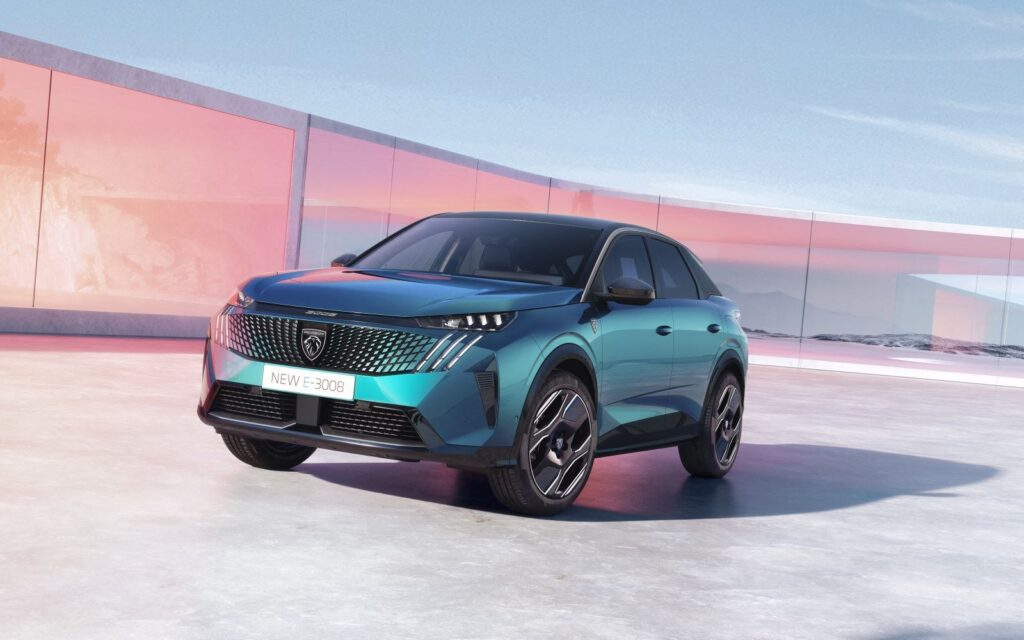
The Peugeot 3008 III, and specifically the e-3008, showcases a radical evolution in design, moving towards a more coupe-like SUV profile while retaining the practicality expected of the segment. The body type is a 5-door SUV, designed to comfortably accommodate five occupants. Its exterior dimensions are substantial yet well-proportioned: 178.82 inches (4542 mm) in length, 74.61 inches (1895 mm) in width, and 64.61 inches (1641 mm) in height. The wheelbase measures 107.83 inches (2739 mm), contributing to a spacious cabin and a stable ride. The ground clearance of 7.8 inches (198 mm) provides adequate capability for light off-road excursions or navigating challenging urban environments.
Inside, the 3008 III is expected to feature Peugeot’s signature i-Cockpit, an innovative cabin layout characterized by a small, flattened steering wheel, a high-mounted digital instrument cluster, and a large central touchscreen. This ergonomic design aims to enhance driver engagement and provide intuitive access to vehicle functions and infotainment. Given its modern EV status, the e-3008 likely incorporates advanced connectivity features, over-the-air updates, and a comprehensive suite of driver-assistance systems, including ABS (Anti-lock Braking System) as standard. The trunk space is generous for a compact SUV, offering a minimum of 18.36 cu. ft. (520 liters), suitable for family trips or substantial cargo. The vehicle’s kerb weight stands at 4660.57 lbs. (2114 kg), reflecting the substantial battery pack and robust construction. It also boasts a permitted trailer load with brakes of 2755.78 lbs. (1250 kg), adding to its versatility.
The chassis and suspension setup are engineered for a balanced ride, combining comfort with responsive handling. It features an independent McPherson strut front suspension and an independent multi-link rear suspension, a setup typically found in more premium vehicles, ensuring refined road manners. Braking is handled by ventilated discs both front (365×37 mm) and rear (356×26 mm), providing strong and consistent stopping power. The electric power steering system and a tight minimum turning circle of 34.78 ft. (10.6 m) enhance maneuverability in urban settings. The e-3008 comes equipped with tire sizes ranging from 235/55 R19 to 235/50 R20, mounted on 19 or 20-inch wheel rims, complementing its assertive stance.
Technical Specifications: Peugeot 3008 III e-3008 73 kWh (213 Hp)
| Category | Specification | Metric / US Equivalent |
|---|---|---|
| Brand | Peugeot | |
| Model | 3008 | |
| Generation | 3008 III (Phase I, 2023) | |
| Type (Engine) | e-3008 73 kWh (213 Hp) | |
| Start of Production | September, 2023 | |
| Powertrain Architecture | BEV (Electric Vehicle) | |
| Body Type | SUV | |
| Seats | 5 | |
| Doors | 5 | |
| Performance Specs | ||
| Fuel Type | Electricity | |
| Acceleration 0 – 60 mph | 8.3 sec | |
| Acceleration 0 – 100 km/h | 8.7 sec | |
| Maximum Speed | 170 km/h | 105.63 mph |
| Weight-to-power ratio | 9.9 kg/Hp | 100.8 Hp/tonne |
| Weight-to-torque ratio | 6.2 kg/Nm | 162.3 Nm/tonne |
| Electric Cars and Hybrids Specs | ||
| Gross Battery Capacity | 73 kWh | |
| Battery Voltage | 400 V | |
| Battery Technology | Lithium nickel manganese cobalt oxides (Li-NMC) | |
| Battery Weight | 520 kg | 1146.4 lbs. |
| Battery Location | Below the floor | |
| All-electric Range (WLTP) | 525 km | 326.22 mi |
| Average Energy Consumption (WLTP) | 13.9 kWh/100 km | 22.37 kWh/100 mi, 151 MPGe, 4.5 mi/kWh |
| Electric Motor Power | 213 Hp @ 4370-14000 rpm | |
| Electric Motor Torque | 343 Nm @ 250-4370 rpm | 252.98 lb.-ft. @ 250-4370 rpm |
| Electric Motor Location | Front axle, Transverse | |
| Electric Motor Type | Synchronous | |
| System Power | 213 Hp @ 4370-14000 rpm | |
| System Torque | 343 Nm @ 250-4370 rpm | 252.98 lb.-ft. @ 250-4370 rpm |
| Space, Volume and Weights | ||
| Kerb Weight | 2114 kg | 4660.57 lbs. |
| Trunk (boot) Space – minimum | 520 l | 18.36 cu. ft. |
| Permitted Trailer Load with Brakes (12%) | 1250 kg | 2755.78 lbs. |
| Dimensions | ||
| Length | 4542 mm | 178.82 in. |
| Width | 1895 mm | 74.61 in. |
| Height | 1641 mm | 64.61 in. |
| Wheelbase | 2739 mm | 107.83 in. |
| Front Track | 1630 mm | 64.17 in. |
| Rear (Back) Track | 1636 mm | 64.41 in. |
| Front Overhang | 940 mm | 37.01 in. |
| Rear Overhang | 863 mm | 33.98 in. |
| Ride Height (Ground Clearance) | 198 mm | 7.8 in. |
| Minimum Turning Circle (Turning Diameter) | 10.6 m | 34.78 ft. |
| Drivetrain, Brakes and Suspension Specs | ||
| Drivetrain Architecture | One electric motor drives the front wheels. | |
| Drive Wheel | Front wheel drive | |
| Number of Gears and Type of Gearbox | 1 gear, automatic transmission | |
| Front Suspension | Coil spring, Independent type McPherson | |
| Rear Suspension | Independent multi-link suspension | |
| Front Brakes | Ventilated discs, 365×37 mm | |
| Rear Brakes | Ventilated discs, 356×26 mm | |
| Assisting Systems | ABS (Anti-lock braking system) | |
| Steering Type | Steering rack and pinion | |
| Power Steering | Electric Steering | |
| Tires Size | 235/55 R19; 235/50 R20 | |
| Wheel Rims Size | 19; 20 | |
Legacy & Market Impact: The Peugeot 3008 III in Europe
The Peugeot 3008 has consistently been a cornerstone of Peugeot’s success in the European market since its inception. The arrival of the third generation, particularly with its dedicated electric variant, the e-3008, underscores Peugeot’s aggressive push towards electrification and its ambition to remain a dominant player in the compact SUV segment. In Europe, the Peugeot 3008 III e-3008 faces stiff competition from a growing number of electric SUVs, including established rivals like the Volkswagen ID.4, Skoda Enyaq, Hyundai Kona Electric, Kia Niro EV, and even premium offerings such as the Tesla Model Y. Despite this crowded landscape, the e-3008 is poised to carve out a significant niche thanks to its distinctive French design flair, sophisticated interior, and competitive range and performance figures.
Peugeot’s strategy with the e-3008 is to offer a compelling alternative that combines emotional design with practical EV benefits. Its bold, futuristic styling, characterized by sharp lines and an assertive front fascia, helps it stand out from more conventional competitors. The commitment to a dedicated EV platform for the e-3008 (the STLA Medium platform from Stellantis) allows for optimized packaging, a flat floor, and a maximized interior space, which are crucial advantages in the EV market. The substantial 326-mile (525 km) WLTP range addresses one of the primary concerns for EV adoption, making it a viable option for a wider range of customers, including those who frequently undertake longer journeys.
Historically, the 3008 has been praised for its comfortable ride, intuitive i-Cockpit, and overall value proposition in Europe. The e-3008 aims to build on this reputation by adding the benefits of electric propulsion: instant torque, quiet operation, and lower running costs. Its market impact will likely be measured by its ability to attract both existing 3008 owners transitioning to electric and new customers drawn by its design and EV capabilities. Peugeot is banking on the e-3008 to be a high-volume seller, contributing significantly to the brand’s overall electrification targets and solidifying its position as a leader in the European EV landscape. The vehicle’s blend of aesthetic appeal, advanced technology, and practical utility positions it as a strong contender to shape the future of electric mobility in its primary markets.