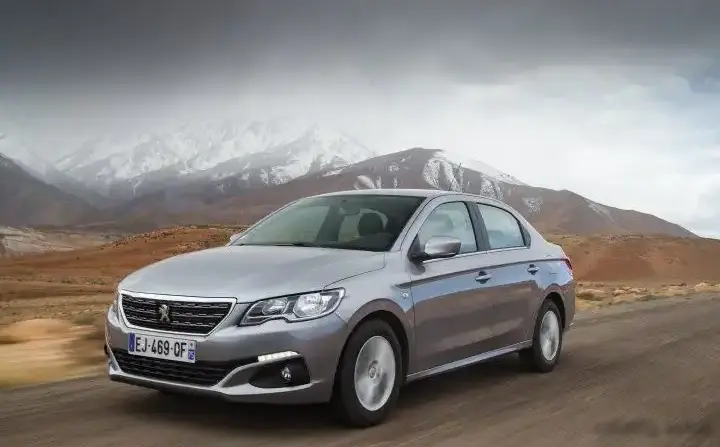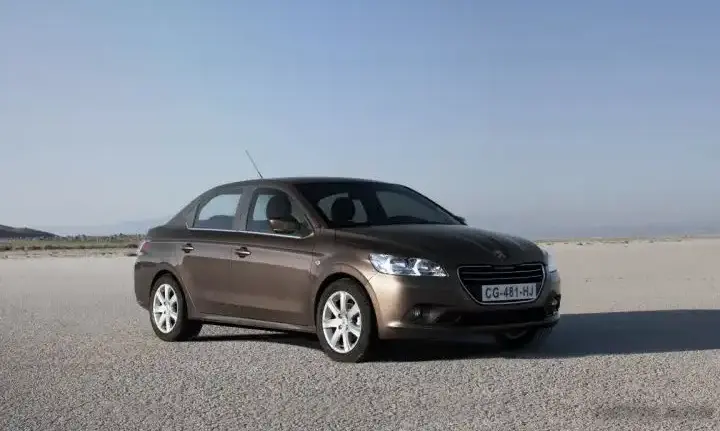
The Peugeot 301 1.6 VTi Automatic, produced between 2012 and 2017, was a significant variant within the first generation of the Peugeot 301 series (T9). Primarily designed for emerging markets – notably North Africa, the Middle East, and South America – the 301 served as Peugeot’s entry-level sedan offering. The 1.6 VTi Automatic trim aimed to strike a balance between affordability, comfort, and practicality, appealing to buyers who desired a conventional automatic transmission in a compact vehicle. It occupied a mid-range position in the 301 lineup, positioned above the base 1.2-liter engine options and below the diesel variants.
Technical Specifications
| Brand | Peugeot |
| Model | 301 |
| Generation | 301 |
| Type (Engine) | 1.6 VTi (115 Hp) Automatic |
| Start of production | 2012 |
| End of production | 2017 |
| Powertrain Architecture | Internal Combustion engine |
| Body type | Sedan |
| Seats | 5 |
| Doors | 4 |
| Fuel consumption (urban) | 10 l/100 km (23.5 US mpg) |
| Fuel consumption (extra urban) | 5.6 l/100 km (42 US mpg) |
| Fuel consumption (combined) | 7.3 l/100 km (32.2 US mpg) |
| Fuel Type | Petrol (Gasoline) |
| Acceleration 0 – 100 km/h | 11.8 sec |
| Acceleration 0 – 62 mph | 11.8 sec |
| Acceleration 0 – 60 mph | 11.2 sec |
| Maximum speed | 188 km/h (116.82 mph) |
| Emission standard | Euro 5 |
| Weight-to-power ratio | 9.5 kg/Hp |
| Weight-to-torque ratio | 7.3 kg/Nm |
| Power | 115 Hp @ 6050 rpm |
| Torque | 150 Nm @ 4000 rpm (110.63 lb.-ft. @ 4000 rpm) |
| Engine layout | Front, Transverse |
| Engine Model/Code | NFP EC5 |
| Engine displacement | 1587 cm3 (96.84 cu. in.) |
| Number of cylinders | 4 |
| Engine configuration | Inline |
| Number of valves per cylinder | 4 |
| Fuel injection system | Multi-port manifold injection |
| Engine aspiration | Naturally aspirated engine |
| Engine oil capacity | 3.25 l (3.43 US qt | 2.86 UK qt) |
| Kerb Weight | 1090 kg (2403.04 lbs.) |
| Max. weight | 1559 kg (3437.01 lbs.) |
| Max load | 469 kg (1033.97 lbs.) |
| Trunk (boot) space – minimum | 506 l (17.87 cu. ft.) |
| Trunk (boot) space – maximum | 1332 l (47.04 cu. ft.) |
| Fuel tank capacity | 50 l (13.21 US gal | 11 UK gal) |
| Length | 4442 mm (174.88 in.) |
| Width | 1748 mm (68.82 in.) |
| Height | 1466 mm (57.72 in.) |
| Wheelbase | 2652 mm (104.41 in.) |
| Drivetrain Architecture | The Internal combustion engine (ICE) drives the front wheels of the vehicle. |
| Drive wheel | Front wheel drive |
| Number of gears and type of gearbox | 4 gears, automatic transmission |
| Assisting systems | ABS (Anti-lock braking system) |
| Steering type | Steering rack and pinion |
Powertrain & Engine Architecture
The Peugeot 301 1.6 VTi Automatic is powered by the NFP EC5 engine, a 1.6-liter inline-four cylinder gasoline engine. This engine is naturally aspirated, meaning it doesn’t employ a turbocharger or supercharger. It utilizes multi-point fuel injection, delivering fuel directly into the intake ports. The engine generates 115 horsepower at 6050 rpm and 150 Nm (110.63 lb-ft) of torque at 4000 rpm. The engine’s valvetrain features four valves per cylinder, enhancing its breathing efficiency. The automatic transmission is a conventional four-speed unit. While not the most advanced transmission available, it was selected for its simplicity, reliability, and cost-effectiveness, aligning with the 301’s overall positioning as an affordable vehicle.
Driving Characteristics
The 1.6 VTi Automatic powertrain delivers adequate, though not particularly sporty, performance. The 0-60 mph acceleration time of approximately 11.2 seconds reflects this. The four-speed automatic transmission, while smooth in operation, lacks the responsiveness and efficiency of more modern transmissions with a greater number of gears. Gear ratios are optimized for fuel economy and comfortable cruising rather than rapid acceleration. Compared to the manual transmission versions of the 1.6 VTi, the automatic experiences a slight performance reduction due to the transmission’s inherent losses. It also feels less engaging to drive. In comparison to the diesel variants, the 1.6 VTi Automatic offers less torque, necessitating higher engine speeds to achieve comparable acceleration, particularly when the vehicle is fully loaded.
Equipment & Trim Levels
The 1.6 VTi Automatic trim typically included features such as air conditioning, power windows, central locking, and an audio system with USB connectivity. Safety equipment included ABS brakes and front airbags. Higher trim levels, often available as optional packages, could add features like alloy wheels, fog lights, a trip computer, and upgraded interior upholstery. Interior materials were generally durable and practical, reflecting the car’s budget-conscious design. The dashboard layout was functional and straightforward, prioritizing ease of use over stylistic flourishes.
Chassis & Braking
The Peugeot 301 utilizes a MacPherson strut front suspension and a torsion beam rear suspension. This configuration provides a reasonable compromise between ride comfort and handling. The front brakes are typically disc brakes, while the rear brakes are drum brakes on most variants, contributing to cost savings. The steering is a rack and pinion system, offering adequate precision and feel. Stabilizer bars were often incorporated to minimize body roll during cornering, though their thickness varied depending on the specific trim level.
Market Reception & Comparison
The Peugeot 301 1.6 VTi Automatic was generally well-received in its target markets as a practical and affordable sedan. Critics commended its comfortable ride and spacious interior, but noted that its performance was modest and its styling was conservative. Compared to competitors like the Renault Symbol and the Fiat Linea, the 301 offered a competitive level of equipment and fuel economy. The automatic transmission was considered a desirable feature for buyers prioritizing convenience, but it did impact fuel consumption compared to the manual versions. Reliability reports suggest that the NFP EC5 engine is generally robust, but consistent maintenance is essential to prevent potential issues.
Legacy
The Peugeot 301, and specifically the 1.6 VTi Automatic variant, has earned a reputation as a dependable and affordable used car. The NFP EC5 engine, while not renowned for its high performance, is relatively straightforward to maintain and repair. Parts availability is generally good in regions where the 301 was widely sold. The four-speed automatic transmission, though dated, has proven to be reasonably reliable with proper servicing. Today, the 301 1.6 VTi Automatic represents a viable option for buyers seeking a budget-friendly sedan with a comfortable ride and a conventional automatic transmission.