Technical Specifications
| Brand | Peugeot |
| Model | 301 |
| Generation | 301 (facelift 2017) |
| Type (Engine) | 1.6 HDi (100 Hp) |
| Start of production | 2017 |
| End of production | 2018 |
| Powertrain Architecture | Internal Combustion engine |
| Body type | Sedan |
| Seats | 5 |
| Doors | 4 |
| Fuel consumption (urban) | 4.6 l/100 km (51.1 US mpg, 61.4 UK mpg, 21.7 km/l) |
| Fuel consumption (extra urban) | 3.4 l/100 km (69.2 US mpg, 83.1 UK mpg, 29.4 km/l) |
| Fuel consumption (combined) | 3.9 l/100 km (60.3 US mpg, 72.4 UK mpg, 25.6 km/l) |
| CO2 emissions | 101 g/km |
| Fuel Type | Diesel |
| Acceleration 0 – 100 km/h | 11.9 sec |
| Acceleration 0 – 62 mph | 11.9 sec |
| Acceleration 0 – 60 mph | 11.3 sec |
| Maximum speed | 183 km/h (113.71 mph) |
| Emission standard | Euro 6 |
| Weight-to-power ratio | 10.9 kg/Hp, 91.7 Hp/tonne |
| Weight-to-torque ratio | 4.3 kg/Nm, 233 Nm/tonne |
| Power | 100 Hp @ 3750 rpm |
| Power per litre | 64.1 Hp/l |
| Torque | 254 Nm @ 1750 rpm (187.34 lb.-ft. @ 1750 rpm) |
| Engine layout | Front, Transverse |
| Engine Model/Code | BHY DV6FD |
| Engine displacement | 1560 cm3 (95.2 cu. in.) |
| Number of cylinders | 4 |
| Engine configuration | Inline |
| Number of valves per cylinder | 2 |
| Fuel injection system | Diesel Commonrail |
| Engine aspiration | Turbocharger, Intercooler |
| Engine oil capacity | 3.75 l (3.96 US qt | 3.3 UK qt) |
| Kerb Weight | 1090 kg (2403.04 lbs.) |
| Max. weight | 1585 kg (3494.33 lbs.) |
| Max load | 495 kg (1091.29 lbs.) |
| Trunk (boot) space – minimum | 506 l (17.87 cu. ft.) |
| Trunk (boot) space – maximum | 1332 l (47.04 cu. ft.) |
| Fuel tank capacity | 50 l (13.21 US gal | 11 UK gal) |
| Permitted trailer load with brakes (12%) | 750 kg (1653.47 lbs.) |
| Length | 4445 mm (175 in.) |
| Width | 1748 mm (68.82 in.) |
| Width including mirrors | 1953 mm (76.89 in.) |
| Height | 1466 mm (57.72 in.) |
| Wheelbase | 2652 mm (104.41 in.) |
| Front track | 1501 mm (59.09 in.) |
| Rear (Back) track | 1478 mm (58.19 in.) |
| Front overhang | 819 mm (32.24 in.) |
| Rear overhang | 974 mm (38.35 in.) |
| Ride height (ground clearance) | 142 mm (5.59 in.) |
| Drivetrain Architecture | The Internal combustion engine (ICE) drives the front wheels of the vehicle. |
| Drive wheel | Front wheel drive |
| Number of gears and type of gearbox | 5 gears, manual transmission |
| Assisting systems | ABS (Anti-lock braking system) |
| Steering type | Steering rack and pinion |
| Tires size | 185/65 R15; 195/55 R16 |
| Wheel rims size | 15; 16 |
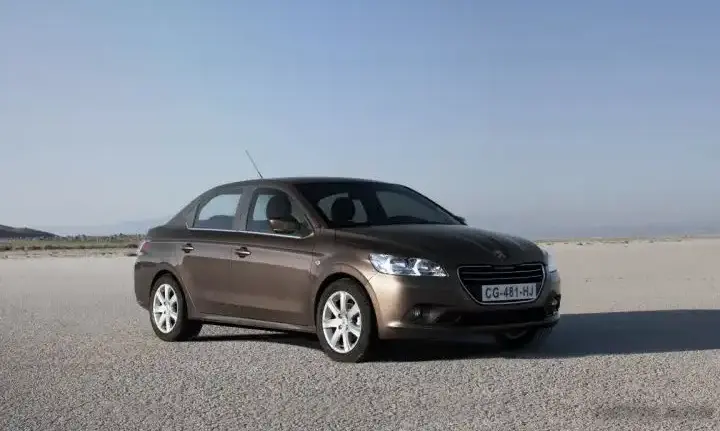
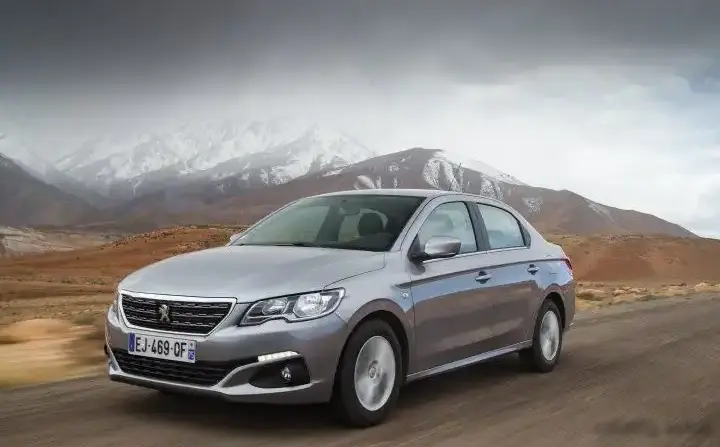
The Peugeot 301 1.6 HDi, introduced with the 2017 facelift, was a compact sedan designed primarily for emerging markets and budget-conscious consumers. This version represented an evolution of the original 301 launched in 2012, offering a refined diesel option within the lineup. Positioned as a mid-range offering, it sat between the less powerful gasoline engines and the more expensive, higher-trim diesel variants. Production of this specific configuration spanned from 2017 to 2018, playing a significant role in Peugeot’s strategy to provide affordable and practical transportation in regions like North Africa, the Middle East, and select European countries.
Powertrain & Engine Architecture
The powertrain of the 301 1.6 HDi centers around the DV6FD engine, specifically the BHY variant. This 1.6-liter, four-cylinder diesel engine belongs to the DW/DV engine family developed by PSA Peugeot Citroën. It features a robust cast iron engine block and an aluminum cylinder head, equipped with two valves per cylinder. The engine employs a common rail direct injection system, delivering fuel at exceptionally high pressure for optimized combustion efficiency. A turbocharger, coupled with an intercooler, is utilized to enhance power and torque output, generating 100 horsepower at 3750 rpm and a substantial 254 Nm (187 lb-ft) of torque at a low 1750 rpm. This characteristic low-end torque is a defining feature of diesel engines and contributes significantly to the 301’s usability in everyday driving scenarios. The engine is mounted transversely in the front of the vehicle. A 5-speed manual transmission was the standard transmission choice for this variant, selected for its simplicity and cost-effectiveness.
Driving Characteristics
The 1.6 HDi 100 hp Peugeot 301 delivered a driving experience focused on fuel efficiency and practicality rather than outright performance. Acceleration from 0 to 60 mph took approximately 11.3 seconds, with a top speed limited to 113.71 mph. While not a particularly fast vehicle, the engine’s strong low-end torque provided a responsive feel in urban driving conditions and sufficient power for comfortable highway cruising. The 5-speed manual transmission was well-suited to the engine’s characteristics, with gear ratios optimized for maximizing fuel economy. Compared to the base gasoline engines, the 1.6 HDi offered a noticeable increase in torque and significantly improved fuel economy. However, it didn’t possess the same level of punch as the higher-output diesel variants available in certain markets. The suspension was tuned for comfort, providing a relatively smooth ride, although it could feel somewhat soft when navigating corners.
Equipment & Trim Levels
The 301 1.6 HDi typically came equipped with a reasonable array of standard features, reflecting its mid-range positioning within the lineup. Standard amenities generally included power steering, central locking, electric front windows, and an audio system with USB connectivity. Air conditioning was frequently included, though its availability could vary depending on the specific market. Interior upholstery was typically cloth, featuring a functional and durable design. Higher trim levels offered optional extras such as alloy wheels, rear parking sensors, and a more sophisticated infotainment system. Safety features included ABS brakes, front airbags, and seatbelt pretensioners. The dashboard layout was straightforward and user-friendly, prioritizing practicality over elaborate styling.
Chassis & Braking
The Peugeot 301 utilized a conventional front-wheel-drive chassis featuring MacPherson strut suspension at the front and a torsion beam axle at the rear. The torsion beam setup was chosen for its cost-effectiveness and space-saving design. Braking was provided by disc brakes at the front and drum brakes at the rear. ABS (Anti-lock Braking System) was standard equipment, enhancing braking performance and stability. The steering system employed a rack and pinion setup, offering reasonable precision and feedback. The suspension was tuned to prioritize ride comfort, resulting in a relatively smooth driving experience. Stabilizer bars were incorporated to minimize body roll during cornering maneuvers.
Market Reception & Comparison
The Peugeot 301 1.6 HDi received generally positive reviews in its target markets, earning praise for its fuel efficiency, practicality, and affordability. Critics acknowledged that it wasn’t the most exhilarating car to drive, but it offered a compelling value proposition for buyers seeking a reliable and economical sedan. When compared to competitors like the Renault Symbol and the Dacia Logan, the 301 offered a slightly more refined interior and a more contemporary design. However, it often carried a higher price tag. The 1.6 HDi engine struck a good balance between performance and fuel economy, making it a popular choice for drivers who frequently undertake long journeys.
Legacy
The Peugeot 301 1.6 HDi, while not a revolutionary vehicle, proved to be a successful model for Peugeot in emerging markets. The DV6 engine family, in particular, has earned a reputation for durability and reliability, although consistent maintenance is essential to prevent potential issues with the diesel particulate filter (DPF). In the used car market, these models are generally affordable and represent a good value for buyers seeking a fuel-efficient and practical sedan. However, prospective buyers should be aware of the potential for DPF-related problems and ensure the vehicle has been properly maintained throughout its life. The 301 played a role in establishing Peugeot as a significant player in the affordable compact sedan segment, laying the groundwork for future models in these regions.