
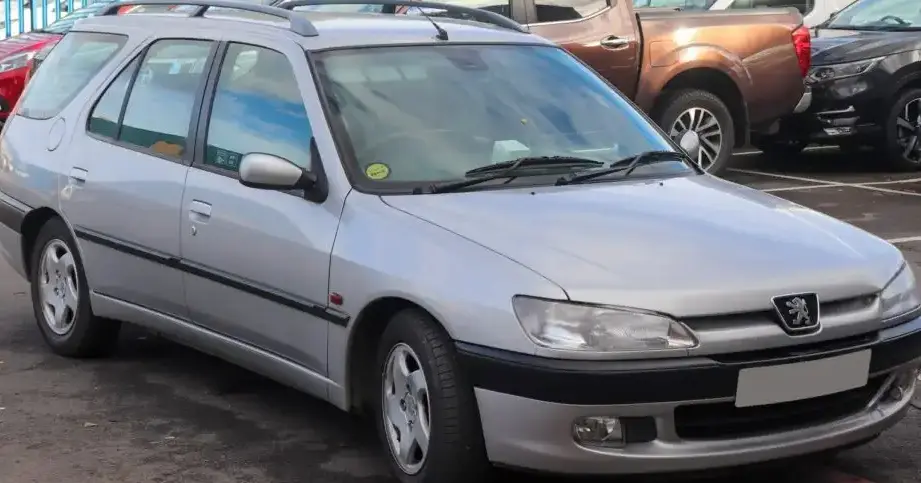
The Peugeot 306 Break 1.8i, produced between 1997 and 2002, was a popular station wagon variant within the broader 306 range (designated 7E). Positioned as a practical and affordable family vehicle, it offered a spacious interior and a large cargo area. This particular version, equipped with the 1.8-liter XU7JP engine and a four-speed automatic transmission, represented a mid-range offering in the 306 Break lineup, prioritizing comfort and ease of use over outright performance. It was primarily sold in European markets, where station wagons held a significant share of the family car segment.
Technical Specifications
| Brand | Peugeot |
| Model | 306 |
| Generation | 306 Break (7E) |
| Type (Engine) | 1.8i (101 Hp) |
| Start of production | 1997 |
| End of production | 2002 |
| Powertrain Architecture | Internal Combustion engine |
| Body type | Station wagon (estate) |
| Seats | 5 |
| Doors | 5 |
| Fuel consumption (urban) | 12.9 l/100 km (18.2 US mpg, 21.9 UK mpg) |
| Fuel consumption (extra urban) | 6.9 l/100 km (34.1 US mpg, 40.9 UK mpg) |
| Fuel Type | Petrol (Gasoline) |
| Acceleration 0 – 100 km/h | 15.7 sec |
| Acceleration 0 – 62 mph | 15.7 sec |
| Acceleration 0 – 60 mph | 14.9 sec |
| Maximum speed | 176 km/h (109.36 mph) |
| Weight-to-power ratio | 11.7 kg/Hp |
| Weight-to-torque ratio | 7.7 kg/Nm |
| Power | 101 Hp @ 6000 rpm |
| Torque | 153 Nm @ 3000 rpm (112.85 lb.-ft. @ 3000 rpm) |
| Engine layout | Front, Transverse |
| Engine Model/Code | LFZ XU7JP |
| Engine displacement | 1762 cm3 (107.52 cu. in.) |
| Number of cylinders | 4 |
| Engine configuration | Inline |
| Cylinder Bore | 83 mm (3.27 in.) |
| Piston Stroke | 81.4 mm (3.2 in.) |
| Compression ratio | 9.3:1 |
| Number of valves per cylinder | 2 |
| Fuel injection system | Multi-port manifold injection |
| Engine aspiration | Naturally aspirated engine |
| Valvetrain | OHC |
| Engine oil capacity | 4.3 l (4.54 US qt | 3.78 UK qt) |
| Coolant capacity | 7.5 l (7.93 US qt | 6.6 UK qt) |
| Kerb Weight | 1185 kg (2612.48 lbs.) |
| Max. weight | 1645 kg (3626.6 lbs.) |
| Max load | 460 kg (1014.13 lbs.) |
| Trunk (boot) space – minimum | 440 l (15.54 cu. ft.) |
| Trunk (boot) space – maximum | 1510 l (53.33 cu. ft.) |
| Fuel tank capacity | 60 l (15.85 US gal | 13.2 UK gal) |
| Length | 4338 mm (170.79 in.) |
| Width | 1680 mm (66.14 in.) |
| Height | 1415 mm (55.71 in.) |
| Wheelbase | 2580 mm (101.57 in.) |
| Front track | 1423-1433 mm (56.02 – 56.42 in.) |
| Rear track | 1424-1432 mm (56.06 – 56.38 in.) |
| Front overhang | 815 mm (32.09 in.) |
| Rear overhang | 943 mm (37.13 in.) |
| Drivetrain Architecture | Front wheel drive |
| Number of gears | 4 |
| Gearbox type | automatic transmission |
| Front suspension | Wishbone |
| Rear suspension | Trailing arm |
| Front brakes | Disc |
| Rear brakes | Drum |
| Assisting systems | ABS (Anti-lock braking system) |
| Steering type | Steering rack and pinion |
| Power steering | Hydraulic |
| Tires size | 185/65 R14 |
Powertrain & Engine Architecture
The heart of the 306 Break 1.8i is the XU7JP engine, a 1.8-liter inline-four cylinder petrol engine. This engine, a staple of Peugeot and Citroën vehicles throughout the 1990s and early 2000s, is known for its relative simplicity and durability. The LFZ engine code specifically denotes a version tuned to produce 101 horsepower at 6000 rpm and 153 Nm (113 lb-ft) of torque at 3000 rpm. It features a single overhead camshaft (OHC) design operating two valves per cylinder. Fuel delivery is managed by a multi-port fuel injection system, providing adequate, though not exceptional, performance. The four-speed automatic transmission, while offering convenience, was not known for its responsiveness or fuel efficiency compared to the available five-speed manual gearbox.
Driving Characteristics
The 1.8i automatic version of the 306 Break offered a comfortable, if not particularly sporty, driving experience. Acceleration was modest, taking approximately 15.7 seconds to reach 62 mph (100 km/h). The automatic transmission, while smooth in operation, contributed to a noticeable power loss compared to the manual transmission variants. Gear ratios were optimized for fuel economy and cruising comfort rather than spirited driving. The engine provided sufficient power for everyday driving and highway cruising, but overtaking maneuvers required careful planning. Compared to the more powerful 2.0-liter 16V models, the 1.8i automatic felt significantly less responsive.
Equipment & Trim Levels
The 306 Break 1.8i typically came equipped with a reasonable level of standard features. These included central locking, power steering, and an AM/FM radio. Interior upholstery was typically cloth, with a relatively simple dashboard layout. Optional extras included air conditioning, electric windows, and a sunroof. Higher trim levels, such as the ‘GLX’, added features like alloy wheels, upgraded interior trim, and a more comprehensive stereo system. The 1.8i automatic was often positioned as a mid-range trim, offering a balance between affordability and comfort.
Chassis & Braking
The 306 Break utilized a relatively conventional chassis setup. Front suspension consisted of independent wishbones, while the rear employed a trailing arm configuration. This setup provided a comfortable ride, although it wasn’t particularly sporty. Braking was handled by disc brakes on the front wheels and drum brakes on the rear. Anti-lock Braking System (ABS) was standard, enhancing safety. The suspension was tuned for comfort and practicality, prioritizing ride quality over handling precision. Stabilizer bars were fitted to both the front and rear axles to reduce body roll.
Market Reception & Comparison
The 306 Break 1.8i automatic was generally well-received as a practical and affordable family vehicle. Critics praised its spacious interior, large cargo area, and comfortable ride. However, the automatic transmission was often criticized for its lack of responsiveness and its impact on fuel economy. Compared to the manual transmission versions and the higher-output engines, the 1.8i automatic offered a less engaging driving experience. Fuel economy was reasonable for its class, averaging around 34 mpg on the extra-urban cycle, but lower in city driving. Reliability was generally good, although the automatic transmission could be prone to issues if not properly maintained.
Legacy
The Peugeot 306 Break 1.8i automatic remains a relatively common sight on European roads today, testament to its durability and practicality. The XU7JP engine is known for its longevity, and with regular maintenance, can provide many years of reliable service. While not a particularly sought-after model by enthusiasts, it represents a solid and affordable option for those seeking a practical and spacious estate car. The automatic transmission, while not the most refined, is generally reliable if serviced according to the manufacturer’s recommendations. In the used car market, these models are typically priced affordably, making them an attractive option for budget-conscious buyers.
