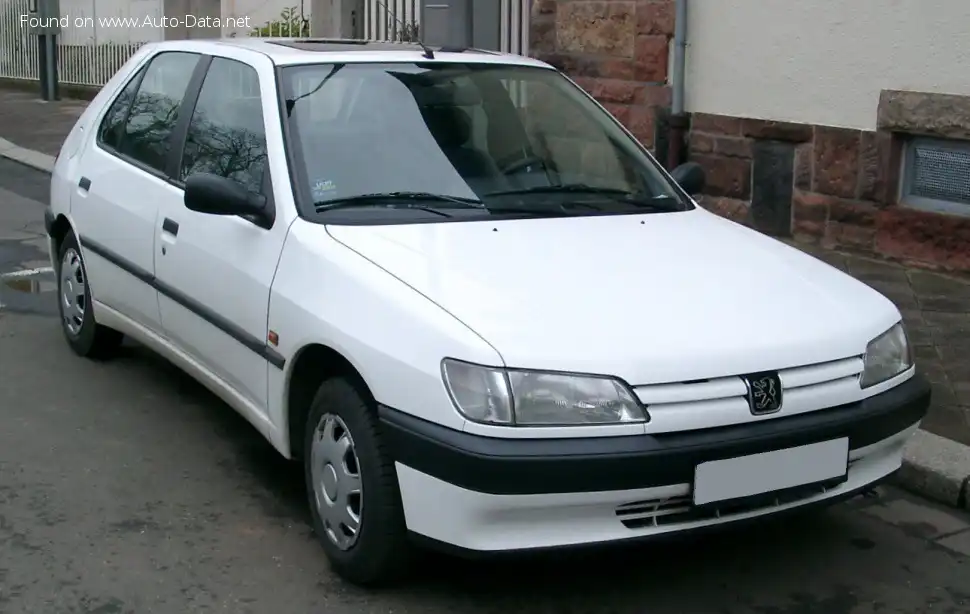
The Peugeot 306 Hatchback, specifically the 1.9 D variant produced between 1994 and 1997, represented a practical and economical offering within the broader 306 range (designated 7A/C). Positioned as an entry-level model, it catered to buyers prioritizing fuel efficiency and affordability over outright performance. The 306 itself was a significant model for Peugeot, replacing the aging 205 and serving as the company’s mainstay in the compact family car segment throughout the 1990s. This diesel-powered version was particularly popular in European markets where diesel fuel was more affordable and offered superior mileage compared to gasoline alternatives.
Technical Specifications
| Brand | Peugeot |
| Model | 306 |
| Generation | 306 Hatchback (7A/C) |
| Type (Engine) | 1.9 D (68 Hp) |
| Start of production | 1994 |
| End of production | 1997 |
| Powertrain Architecture | Internal Combustion engine |
| Body type | Hatchback |
| Seats | 5 |
| Doors | 3-5 |
| Fuel consumption (combined) | 6 l/100 km (39.2 US mpg, 47.1 UK mpg, 16.7 km/l) |
| Fuel Type | Diesel |
| Acceleration 0 – 100 km/h | 17.5 sec |
| Acceleration 0 – 62 mph | 17.5 sec |
| Acceleration 0 – 60 mph | 16.6 sec |
| Maximum speed | 158 km/h (98.18 mph) |
| Weight-to-power ratio | 15.9 kg/Hp |
| Weight-to-torque ratio | 9 kg/Nm |
| Power | 68 Hp @ 4600 rpm |
| Power per litre | 35.7 Hp/l |
| Torque | 120 Nm @ 2000 rpm (88.51 lb.-ft. @ 2000 rpm) |
| Engine layout | Front, Transverse |
| Engine Model/Code | DJY XUD9A |
| Engine displacement | 1905 cm3 (116.25 cu. in.) |
| Number of cylinders | 4 |
| Engine configuration | Inline |
| Cylinder Bore | 83 mm (3.27 in.) |
| Piston Stroke | 88 mm (3.46 in.) |
| Compression ratio | 23:1 |
| Number of valves per cylinder | 2 |
| Fuel injection system | Precombustion chamber injection |
| Engine aspiration | Naturally aspirated engine |
| Valvetrain | OHC |
| Engine oil capacity | 4 l (4.23 US qt | 3.52 UK qt) |
| Coolant | 9 l (9.51 US qt | 7.92 UK qt) |
| Kerb Weight | 1080 kg (2380.99 lbs.) |
| Max. weight | 1590 kg (3505.35 lbs.) |
| Max load | 510 kg (1124.36 lbs.) |
| Trunk (boot) space – minimum | 338 l (11.94 cu. ft.) |
| Trunk (boot) space – maximum | 637 l (22.5 cu. ft.) |
| Fuel tank capacity | 60 l (15.85 US gal | 13.2 UK gal) |
| Length | 3995 mm (157.28 in.) |
| Width | 1692 mm (66.61 in.) |
| Height | 1380 mm (54.33 in.) |
| Wheelbase | 2580 mm (101.57 in.) |
| Front track | 1462 mm (57.56 in.) |
| Rear (Back) track | 1435 mm (56.5 in.) |
| Drivetrain Architecture | The Internal combustion engine (ICE) drives the front wheels of the vehicle. |
| Drive wheel | Front wheel drive |
| Number of gears and type of gearbox | 5 gears, manual transmission |
| Front suspension | Wishbone |
| Rear suspension | Trailing arm |
| Front brakes | Disc |
| Rear brakes | Drum |
| Assisting systems | ABS (Anti-lock braking system) |
| Steering type | Steering rack and pinion |
| Power steering | Hydraulic Steering |
| Tires size | 175/70 R13 |
Powertrain & Engine Architecture
The heart of the 306 1.9 D was the XUD9A engine, specifically the DJY variant. This 1.9-liter inline-four diesel engine was a mainstay of Peugeot and Citroën vehicles for many years. It employed precombustion chamber injection, a system where fuel is injected into a small chamber within the cylinder head, promoting more complete combustion, especially in older diesel designs. The engine featured a single overhead camshaft (OHC) operating two valves per cylinder. While relatively simple in design, the XUD9A was known for its durability and ability to withstand high mileage. The 68 horsepower output was achieved at 4600 rpm, while peak torque of 120 Nm (88.51 lb-ft) arrived at 2000 rpm. The engine was transversely mounted, driving the front wheels through a five-speed manual transmission. An automatic transmission was not offered with this engine configuration.
Driving Characteristics
The 306 1.9 D, with its 68 horsepower, was not designed for spirited driving. Acceleration was leisurely, taking approximately 17.5 seconds to reach 62 mph (100 km/h). The focus was on fuel economy and practicality. The engine’s torque delivery was relatively flat, providing adequate pulling power for everyday driving, but lacking the responsiveness of higher-output gasoline engines or even later-generation diesel engines. The five-speed manual transmission was well-matched to the engine’s characteristics, allowing drivers to keep the engine in its optimal operating range. Compared to the more powerful 2.0-liter gasoline versions of the 306, the 1.9 D offered significantly less performance but substantially better fuel economy. It also differed markedly from the later 2.0 HDI diesel models, which offered considerably more power and torque thanks to direct injection and turbocharging.
Equipment & Trim Levels
The 1.9 D typically represented the base trim level in the 306 range. Standard equipment generally included power steering, central locking, and basic instrumentation. Interior upholstery was typically cloth, and the dashboard featured a functional but relatively spartan design. Optional extras included power windows, a sunroof, and upgraded audio systems. The 306 offered a range of body styles – three-door and five-door hatchbacks – and the 1.9 D was available in both configurations. The trim level was often denoted by a simple badge on the rear of the vehicle.
Chassis & Braking
The 306 1.9 D utilized a relatively simple chassis design. Front suspension consisted of independent wishbones, while the rear employed a trailing arm setup. Brakes were discs on the front wheels and drums on the rear, a common configuration for vehicles in this price range during the 1990s. ABS (Anti-lock Braking System) was often included as standard equipment, enhancing safety. Stabilizer bars were fitted to both the front and rear axles to reduce body roll during cornering. The suspension was tuned for comfort rather than outright handling prowess, providing a reasonably compliant ride on most road surfaces.
Market Reception & Comparison
The Peugeot 306 1.9 D was generally well-received as a practical and economical family car. Critics praised its fuel efficiency and durability, but noted its lack of performance. Compared to other vehicles in its class, such as the Volkswagen Golf or Ford Escort, the 306 1.9 D offered a competitive price point and a comfortable interior. However, it lagged behind some rivals in terms of refinement and driving dynamics. The 1.9 D’s fuel economy was a key selling point, particularly in Europe, where diesel fuel was significantly cheaper than gasoline. Reliability was generally good, although the precombustion chamber injection system could require occasional maintenance.
Legacy
The Peugeot 306 1.9 D, while not a performance icon, has proven to be a remarkably durable and long-lasting vehicle. Many examples are still on the road today, testament to the robustness of the XUD9A engine and the overall build quality of the 306. In the used car market, these models are often sought after by those looking for an affordable and reliable means of transportation. The XUD9A engine, in particular, is highly regarded for its simplicity and ease of maintenance. While modern diesel engines offer significantly more power and refinement, the 306 1.9 D remains a popular choice for those seeking a classic, economical, and dependable vehicle.