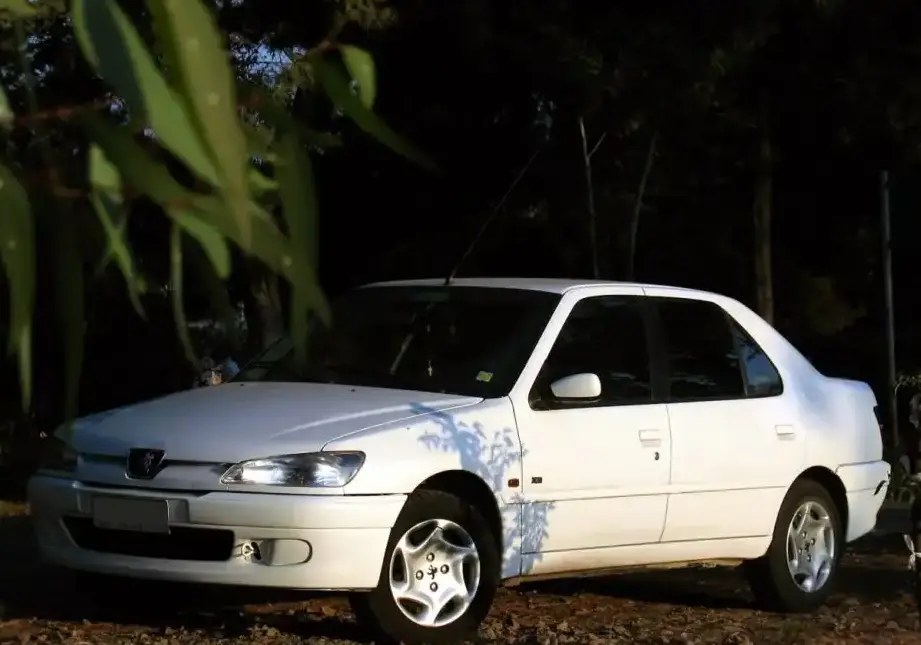
Technical Specifications
| Brand | Peugeot |
| Model | 306 |
| Generation | 306 Sedan (facelift 1997) |
| Type (Engine) | 1.6i (98 Hp) |
| Start of production | 2000 year |
| End of production | 2002 year |
| Powertrain Architecture | Internal Combustion engine |
| Body type | Sedan |
| Seats | 5 |
| Doors | 4 |
| Fuel consumption (urban) | 9.1 l/100 km (25.8 US mpg, 31 UK mpg, 11 km/l) |
| Fuel consumption (extra urban) | 5.6 l/100 km (42 US mpg, 50.4 UK mpg, 17.9 km/l) |
| Fuel consumption (combined) | 6.9 l/100 km (34.1 US mpg, 40.9 UK mpg, 14.5 km/l) |
| CO2 emissions | 165 g/km |
| Fuel Type | Petrol (Gasoline) |
| Acceleration 0 – 100 km/h | 10.6 sec |
| Acceleration 0 – 62 mph | 10.6 sec |
| Acceleration 0 – 60 mph | 10.1 sec |
| Maximum speed | 188 km/h (116.82 mph) |
| Weight-to-power ratio | 11.2 kg/Hp, 89.1 Hp/tonne |
| Weight-to-torque ratio | 8 kg/Nm, 125.5 Nm/tonne |
| Power | 98 Hp @ 5700 rpm |
| Power per litre | 61.8 Hp/l |
| Torque | 138 Nm @ 3250 rpm (101.78 lb.-ft. @ 3250 rpm) |
| Engine layout | Front, Transverse |
| Engine Model/Code | NFT TU5JP |
| Engine displacement | 1587 cm3 (96.84 cu. in.) |
| Number of cylinders | 4 |
| Engine configuration | Inline |
| Cylinder Bore | 78.5 mm (3.09 in.) |
| Piston Stroke | 82 mm (3.23 in.) |
| Compression ratio | 9.6:1 |
| Number of valves per cylinder | 2 |
| Fuel injection system | Multi-port manifold injection |
| Engine aspiration | Naturally aspirated engine |
| Valvetrain | SOHC |
| Engine oil capacity | 3.2 l (3.38 US qt | 2.82 UK qt) |
| Coolant | 6.1 l (6.45 US qt | 5.37 UK qt) |
| Kerb Weight | 1100 kg (2425.08 lbs.) |
| Max. weight | 1575 kg (3472.28 lbs.) |
| Max load | 475 kg (1047.2 lbs.) |
| Trunk (boot) space – minimum | 463 l (16.35 cu. ft.) |
| Fuel tank capacity | 60 l (15.85 US gal | 13.2 UK gal) |
| Permitted trailer load with brakes (12%) | 1200 kg (2645.55 lbs.) |
| Permitted trailer load without brakes | 585 kg (1289.7 lbs.) |
| Length | 4267 mm (167.99 in.) |
| Width | 1689 mm (66.5 in.) |
| Height | 1386 mm (54.57 in.) |
| Wheelbase | 2580 mm (101.57 in.) |
| Front track | 1454 mm (57.24 in.) |
| Rear (Back) track | 1423 mm (56.02 in.) |
| Ride height (ground clearance) | 120 mm (4.72 in.) |
| Drag coefficient (Cd) | 0.32 |
| Minimum turning circle (turning diameter) | 11.0 m (36.09 ft.) |
| Drivetrain Architecture | The Internal combustion engine (ICE) drives the front wheels of the vehicle. |
| Drive wheel | Front wheel drive |
| Number of gears and type of gearbox | 5 gears, manual transmission |
| Front suspension | Wishbone |
| Rear suspension | Trailing arm |
| Front brakes | Ventilated discs |
| Rear brakes | Drum |
| Assisting systems | ABS (Anti-lock braking system) |
| Steering type | Steering rack and pinion |
| Power steering | Hydraulic Steering |
| Tires size | 185/65 R14 T |
| Wheel rims size | 14 |
The Peugeot 306 Sedan 1.6i, produced from 2000 to 2002, was a significant iteration of Peugeot’s popular compact sedan. This version represented a facelift of the original 306 sedan, incorporating styling updates and refinements while maintaining the core values of practicality and affordability. Positioned as an entry-level to mid-range offering, the 1.6i sedan aimed to provide reliable transportation for families and commuters, primarily within European markets. It was a key member of the broader 306 range, which included hatchback, cabriolet, and wagon body styles.
Powertrain & Engine Architecture
The 306 1.6i was powered by the NFT TU5JP engine, a 1.6-liter inline-four cylinder petrol engine. This engine was widely used across various Peugeot and Citroën models during that period. The TU5 series was known for its inherent simplicity and robust construction. The NFT variant featured a single overhead camshaft (SOHC) operating two valves per cylinder. Fuel delivery was managed by a multi-port fuel injection system, striking a balance between fuel efficiency and performance. The engine generated 98 horsepower at 5700 rpm and 138 Nm (101.78 lb-ft) of torque at 3250 rpm. The engine’s transverse mounting and front-wheel-drive configuration were typical for vehicles in its class. While a 5-speed manual transmission was standard, a 4-speed automatic transmission was offered as an option. The automatic, while convenient, resulted in a slight decrease in both acceleration and fuel economy compared to the manual version.
Driving Characteristics
Equipped with the 5-speed manual transmission, the 1.6i engine delivered adequate performance for daily driving. Acceleration from 0 to 60 mph took approximately 10.1 seconds, with a top speed around 116.82 mph. It wasn’t a particularly sporty setup, but it provided enough power for overtaking and highway travel. The automatic transmission version, however, felt noticeably slower, with a 0-60 mph time closer to 10.6 seconds. The manual transmission’s gear ratios were well-chosen, allowing for efficient cruising and reasonable acceleration. Power delivery was linear, lacking any pronounced power bands. The suspension, tuned for comfort, provided a relatively smooth ride, though it wasn’t designed for enthusiastic driving.
Equipment & Trim Levels
The 306 1.6i Sedan came standard with a reasonable array of features. These included power steering, central locking, electric front windows, and an adjustable steering column. Interior upholstery was typically cloth, and the dashboard layout was simple and functional. Optional extras included air conditioning, alloy wheels, and a radio/cassette player. Higher trim levels, such as the GLX, added features like upgraded upholstery, a sunroof, and more detailed instrumentation. The interior design prioritized practicality and durability over luxury.
Chassis & Braking
The 306 Sedan utilized a front-wheel-drive chassis with independent wishbone suspension at the front and a trailing arm suspension at the rear. This configuration offered a good compromise between ride comfort and handling. The front brakes were ventilated discs, providing good stopping power, while the rear brakes were drums, a cost-saving measure common in this segment. Anti-lock Braking System (ABS) was available as an optional extra, enhancing safety. The steering system was a rack and pinion type with hydraulic power assistance, offering light and precise steering feel.
Market Reception & Comparison
The Peugeot 306 1.6i Sedan was generally well-received by automotive critics as a practical and affordable family car. It was praised for its comfortable ride and good value for money. However, the 1.6i engine was sometimes criticized for being somewhat underpowered, particularly when compared to the more powerful 2.0i or diesel versions of the 306. The automatic transmission version was often seen as a trade-off, sacrificing performance for convenience. Fuel economy was competitive for its class, averaging around 34.1 US mpg in combined driving. Compared to competitors like the Ford Focus and Volkswagen Golf, the 306 1.6i offered a slightly more comfortable ride but lacked the same level of driving engagement.
Legacy
The Peugeot 306 1.6i Sedan, while not the most performance-oriented version of the 306, proved to be a reliable and durable vehicle. The TU5JP engine is known for its longevity, and many examples remain on the road today. Its relatively simple mechanical design makes it reasonably easy and affordable to maintain. In the used car market, the 306 1.6i Sedan represents a budget-friendly option for those seeking a practical and dependable vehicle. Despite lacking the performance or features of more modern cars, its simplicity and reliability continue to appeal to a wide range of buyers.