
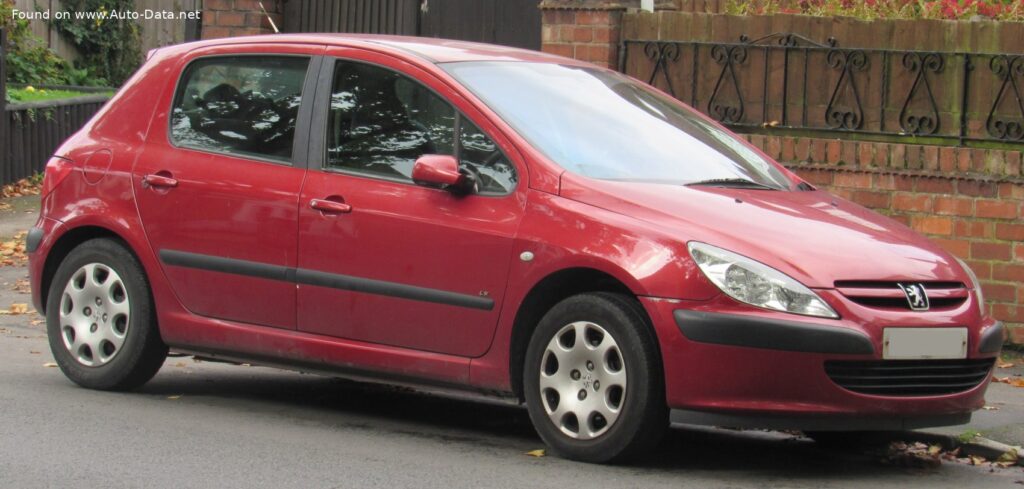
The Peugeot 307 2.0 (136 Hp) Automatic: A European Compact Pioneer
The Peugeot 307 2.0 (136 Hp) Automatic represents a significant chapter in the evolution of the European C-segment hatchback, a class renowned for its versatility and widespread appeal across the continent. Launched in 2001, the first-generation Peugeot 307 was a bold departure from its predecessor, the 306, introducing a “tall” design philosophy that prioritized interior space and visibility. While never officially sold in the United States market, the 307 quickly became a familiar sight on European roads, earning the prestigious European Car of the Year award in 2002 for its innovative design, practical interior, and comfortable ride. This particular variant, equipped with a 2.0-liter gasoline engine and an automatic transmission, aimed to offer a blend of effortless urban driving and capable highway performance for the discerning European consumer from its production start in 2001 until 2005.
Positioned squarely against stalwarts like the Volkswagen Golf and Ford Focus, the 307 sought to carve out its niche by offering a more airy cabin and a distinctively French approach to ride comfort. The 2.0-liter engine, a common choice for those desiring more power than the entry-level options, provided a respectable performance envelope, making the automatic transmission a popular choice for congested European city traffic and longer journeys alike.
Engine and Performance of the Peugeot 307
At the heart of the Peugeot 307 2.0 (136 Hp) Automatic lies Peugeot’s well-regarded RFN EW10J4 engine, a naturally aspirated inline-four gasoline unit. This powerplant boasts a displacement of 1997 cubic centimeters (121.86 cu. in.), featuring a DOHC (Double Overhead Camshaft) valvetrain with four valves per cylinder, a configuration designed for efficient breathing and a broad powerband. With a compression ratio of 10.8:1 and a multi-port manifold injection system, the engine delivers a robust 136 horsepower at 6000 rpm. This output translated to a power per liter figure of 68.1 horsepower, a competitive number for a naturally aspirated engine of its era.
Torque production is equally important for everyday drivability, and the 307’s 2.0-liter engine provides 190 Newton-meters (140.14 lb.-ft.) peaking at 4100 rpm. This ample torque, delivered relatively low in the rev range, contributes to the car’s responsive feel in various driving conditions. Power is sent to the front wheels via a 4-speed automatic transmission, which, while not as sophisticated as modern multi-speed units, was a common and reliable choice for convenience in the early 2000s. The drivetrain architecture is a conventional front-engine, front-wheel-drive setup, optimizing interior space and manufacturing simplicity.
In terms of raw performance, the Peugeot 307 2.0 Automatic was capable of accelerating from 0 to 60 mph in a respectable 10.5 seconds, with a top speed reaching 124.27 mph (200 km/h). These figures positioned it as a capable performer within its class, suitable for both urban commutes and sustained highway cruising. Fuel economy was rated at a combined 28.3 US mpg (8.3 liters per 100 km), which, considering the engine size and automatic transmission of the time, offered a reasonable balance between performance and running costs. The vehicle adhered to the Euro 3 emission standard, with CO2 emissions of 198 g/km.
Design and Features of the Peugeot 307 Hatchback
The first-generation Peugeot 307, available in both 3-door and 5-door hatchback configurations, redefined the compact segment’s approach to interior volume. Measuring 165.43 inches in length, 68.11 inches in width, and 59.45 inches in height, the 307 adopted a noticeably taller stance than many of its contemporaries. This “tall car” design was a deliberate strategy by Peugeot to maximize cabin space, offering generous headroom and a more upright seating position that contributed to ease of entry and exit, as well as enhanced visibility for the driver. The wheelbase of 102.68 inches further contributed to a stable ride and ample legroom for its five occupants.
Aesthetically, the 307 featured Peugeot’s distinctive design language of the early 2000s, characterized by large, almond-shaped headlights, a prominent grille, and a clean, uncluttered profile. The exterior design aimed for a modern and approachable look, which resonated well with European buyers seeking a stylish yet practical family car.
Inside, the 307’s interior emphasized ergonomics and functionality. The elevated seating position provided a commanding view of the road, a feature often associated with larger vehicles. Storage solutions were plentiful, and the overall fit and finish were competitive for the segment. Practicality was a strong suit, with a minimum trunk capacity of 12.04 cubic feet (341 liters) that could expand to a substantial 46.9 cubic feet (1328 liters) with the rear seats folded down, making it highly adaptable for cargo needs.
In terms of chassis and safety, the 307 was equipped with a robust setup. The front suspension utilized a trailing arm design, while the rear featured a wishbone setup, contributing to the comfortable ride quality for which Peugeot cars are often praised. Braking performance was handled by ventilated discs at the front and solid discs at the rear, complemented by an Anti-lock Braking System (ABS) as a crucial safety feature for its time. The hydraulic power steering, employing a rack and pinion system, offered a balanced feel between effort and feedback, making city maneuvering and highway driving pleasant. Standard tire size was 205/55 R16 on 16-inch wheel rims, providing a good balance of grip and ride comfort.
Technical Specifications: Peugeot 307 2.0 (136 Hp) Automatic
| Category | Specification | US/Imperial Equivalent |
|---|---|---|
| General Information | ||
| Brand | Peugeot | |
| Model | 307 | |
| Generation | 307 (First Generation) | |
| Type (Engine) | 2.0 (136 Hp) Automatic | |
| Start of Production | 2001 year | |
| End of Production | 2005 year | |
| Powertrain Architecture | Internal Combustion engine | |
| Body type | Hatchback | |
| Seats | 5 | |
| Doors | 3-5 | |
| Performance Specs | ||
| Fuel consumption (economy) – urban | 12.4 l/100 km | 19 US mpg |
| Fuel consumption (economy) – extra urban | 6 l/100 km | 39.2 US mpg |
| Fuel consumption (economy) – combined | 8.3 l/100 km | 28.3 US mpg |
| CO2 emissions | 198 g/km | |
| Fuel Type | Petrol (Gasoline) | |
| Acceleration 0 – 60 mph | 10.5 sec | |
| Maximum speed | 200 km/h | 124.27 mph |
| Emission standard | Euro 3 | |
| Weight-to-power ratio | 9.1 kg/Hp | 109.9 Hp/tonne |
| Weight-to-torque ratio | 6.5 kg/Nm | 153.5 Nm/tonne |
| Engine Specs | ||
| Power | 136 Hp @ 6000 rpm | |
| Power per liter | 68.1 Hp/l | |
| Torque | 190 Nm @ 4100 rpm | 140.14 lb.-ft. @ 4100 rpm |
| Engine layout | Front, Transverse | |
| Engine Model/Code | RFN EW10J4 | |
| Engine displacement | 1997 cm3 | 121.86 cu. in. |
| Number of cylinders | 4 | |
| Engine configuration | Inline | |
| Cylinder Bore | 85 mm | 3.35 in. |
| Piston Stroke | 88 mm | 3.46 in. |
| Compression ratio | 10.8:1 | |
| Number of valves per cylinder | 4 | |
| Fuel injection system | Multi-port manifold injection | |
| Engine aspiration | Naturally aspirated engine | |
| Valvetrain | DOHC | |
| Engine oil capacity | 4.25 l | 4.49 US qt |
| Coolant capacity | 6.8 l | 7.19 US qt |
| Space, Volume and Weights | ||
| Kerb Weight | 1238 kg | 2729.32 lbs. |
| Max. weight | 1738 kg | 3831.63 lbs. |
| Max load | 500 kg | 1102.31 lbs. |
| Trunk (boot) space – minimum | 341 l | 12.04 cu. ft. |
| Trunk (boot) space – maximum | 1328 l | 46.9 cu. ft. |
| Fuel tank capacity | 60 l | 15.85 US gal |
| Permitted trailer load with brakes (12%) | 1300 kg | 2866.01 lbs. |
| Permitted trailer load without brakes | 640 kg | 1410.96 lbs. |
| Dimensions | ||
| Length | 4202 mm | 165.43 in. |
| Width | 1730 mm | 68.11 in. |
| Height | 1510 mm | 59.45 in. |
| Wheelbase | 2608 mm | 102.68 in. |
| Front track | 1505 mm | 59.25 in. |
| Rear (Back) track | 1500 mm | 59.06 in. |
| Ride height (ground clearance) | 120 mm | 4.72 in. |
| Drag coefficient (Cd) | 0.31 | |
| Minimum turning circle (turning diameter) | 11.13 m | 36.52 ft. |
| Drivetrain, Brakes and Suspension Specs | ||
| Drivetrain Architecture | The Internal combustion engine (ICE) drives the front wheels of the vehicle. | |
| Drive wheel | Front wheel drive | |
| Number of gears and type of gearbox | 4 gears, automatic transmission | |
| Front suspension | Trailing arm | |
| Rear suspension | Wishbone | |
| Front brakes | Ventilated discs | |
| Rear brakes | Disc | |
| Assisting systems | ABS (Anti-lock braking system) | |
| Steering type | Steering rack and pinion | |
| Power steering | Hydraulic Steering | |
| Tires size | 205/55 R16 | |
| Wheel rims size | 16 inches | |
Legacy and Market Impact of the Peugeot 307
The Peugeot 307 made a significant splash in the European compact car market, a segment that is fiercely competitive and crucial for many manufacturers. Its “tall car” design philosophy, which prioritized interior volume and comfort, set it apart from rivals like the more conventionally styled Volkswagen Golf IV and the dynamically focused Ford Focus (European version). This approach resonated strongly with families and individuals who valued practicality, ease of access, and a comfortable ride over outright sporty handling.
Winning the European Car of the Year award in 2002 was a testament to its innovative design and overall package. The award recognized the 307 for its spacious interior, high level of safety for its class, and pleasant driving characteristics. Its reputation was built on offering a typically French blend of compliant suspension, which absorbed road imperfections with ease, and a light, airy cabin environment. While some critics noted that its handling wasn’t as sharp as the Ford Focus, the 307 excelled in providing a relaxed and comfortable motoring experience, especially on longer journeys.
In its primary markets, the 307 competed with a broad range of vehicles including the Opel/Vauxhall Astra, Renault Mégane, Citroën C4 (with which it shared a platform later in its life), and various Japanese and Korean offerings. The 2.0-liter automatic variant specifically appealed to buyers seeking a more refined and less strenuous driving experience, particularly in urban environments where the automatic transmission offered a welcome reprieve from constant gear changes. Its performance capabilities also made it suitable for highway travel, providing sufficient power for overtaking and maintaining cruising speeds.
The 307 also played a pivotal role in shaping Peugeot’s design direction for the early 21st century. Its emphasis on a larger glass area, a more capacious interior, and a slightly higher driving position influenced subsequent models in the Peugeot lineup. It demonstrated that a compact car could offer many of the benefits traditionally associated with larger vehicles or even small minivans, without sacrificing the maneuverability and efficiency expected of a C-segment hatchback.
Despite its success in Europe and other international markets, the Peugeot 307 was never officially imported or sold in the United States. This is typical for many European compacts, as American consumers historically preferred larger sedans and SUVs, and the cost of homologation and establishing a dealer network for a single compact model was often deemed prohibitive. However, its influence on global automotive design and its success in its intended markets underscore its significance as a well-engineered and thoughtfully designed vehicle. The 307 paved the way for its successor, the Peugeot 308, carrying forward many of the lessons learned regarding space, comfort, and market appeal. Its legacy is one of a practical, comfortable, and award-winning compact car that competently served the needs of millions of drivers outside of North America.
