The Peugeot 307 CC (facelift 2005): A European Compact Coupe-Cabriolet Icon
The Peugeot 307 CC (facelift 2005) 1.6i (109 Hp) represents a significant chapter in the European automotive landscape, particularly within the burgeoning compact coupe-cabriolet segment of the mid-2000s. Introduced in 2005 as an updated version of the original 307 CC, this vehicle underscored Peugeot’s commitment to offering stylish, open-top motoring with the practicality of a hardtop. While never officially sold in the United States, the 307 CC played a crucial role in popularizing the retractable hardtop design across Europe, offering a versatile blend of a secure coupe and an exhilarating convertible in a single package. Its facelift brought subtle but important refinements, ensuring its competitive edge in a segment that was rapidly gaining traction.
The 307 CC, part of the broader 307 family, distinguished itself with its innovative two-door, four-seat body style, designed to appeal to a wide demographic seeking both elegance and everyday usability. Its production run from 2005 to 2009 saw it compete fiercely in a market segment characterized by a desire for affordable luxury and leisure-oriented vehicles. This particular variant, equipped with the 1.6-liter gasoline engine, aimed to provide a balance of adequate performance and commendable fuel efficiency, making it a sensible choice for urban commuting and relaxed cruising on European roads.
Engine and Performance of the Peugeot 307 CC (facelift 2005) 1.6i
Under the hood of the Peugeot 307 CC (facelift 2005) 1.6i lies a naturally aspirated 1.6-liter (1587 cm3 or 96.84 cu. in.) inline four-cylinder engine, designated by Peugeot as the NFU TU5JP4. This powerplant was a familiar and well-regarded unit within Peugeot’s lineup, known for its reliability and smooth operation. It produced a respectable 109 horsepower at 5750 rpm, delivering its power in a linear and accessible manner. Torque output stood at 147 Nm (108.42 lb.-ft.) at a relatively low 3900 rpm, providing sufficient grunt for daily driving and comfortable acceleration.
Paired with a 5-speed manual transmission, the 1.6i engine propelled the 307 CC from 0 to 60 mph in a measured 12.1 seconds, with a top speed of 118.68 mph (191 km/h). While these figures might not suggest a sports car, they were entirely appropriate for its intended market and purpose: a stylish cruiser rather than a performance machine. The powertrain architecture featured a front, transverse engine layout, driving the front wheels, a common and efficient setup for compact European vehicles. The engine’s DOHC (Double Overhead Camshaft) valvetrain and multi-port manifold injection system ensured efficient combustion and adherence to the Euro 4 emission standard, reflecting a focus on environmental responsibility for its era.
Fuel efficiency was a key consideration for European buyers, and the 307 CC 1.6i delivered competitive numbers. The combined fuel consumption was rated at 7.6 liters per 100 km, translating to an estimated 30.9 US mpg. Urban driving saw consumption rise to 10.2 l/100 km (23.1 US mpg), while extra-urban cruising yielded a more impressive 6.2 l/100 km (37.9 US mpg). With CO2 emissions of 178 g/km, the vehicle struck a balance between performance and ecological footprint, aligning with the prevailing automotive trends in its primary markets.
Design and Features
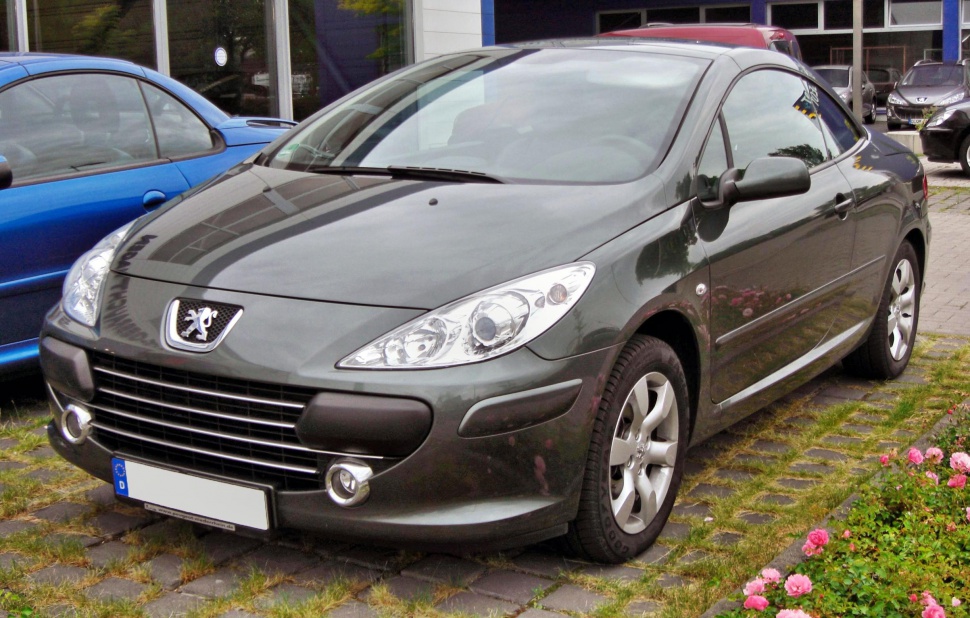
The defining characteristic of the Peugeot 307 CC (facelift 2005) was its innovative coupe-cabriolet body type, featuring an electrically operated retractable hardtop. This design offered the best of both worlds: the security, refinement, and weather protection of a fixed-roof coupe when closed, and the exhilarating open-air experience of a convertible at the touch of a button. The facelift introduced subtle but effective styling enhancements, aligning the CC with the updated aesthetics of the broader 307 range. These changes typically included revised front fascias with new headlights, grille designs, and bumpers, giving the car a fresher, more contemporary look.
Measuring 171.65 inches (4360 mm) in length, 69.25 inches (1759 mm) in width, and 56.06 inches (1424 mm) in height, the 307 CC maintained a compact footprint suitable for European city streets and parking. Its wheelbase of 102.68 inches (2608 mm) provided a stable ride and adequate interior space for four occupants, although the rear seats were more suited for shorter journeys or children, especially with the roof down. The trunk space was cleverly designed to accommodate the folding roof mechanism, offering 12.36 cu. ft. (350 liters) with the roof up, which reduced to 7.2 cu. ft. (204 liters) when the top was stowed. This compromise was typical for retractable hardtop vehicles of the era but still offered reasonable utility.
Standard features for the 2005 facelift model often included power windows, remote central locking, air conditioning, and a CD stereo system. Safety was addressed with standard ABS (Anti-lock Braking System) and a comprehensive airbag system, providing a solid foundation for occupant protection. The suspension setup, with ventilated discs at the front and disc brakes at the rear, ensured confident stopping power. The steering system utilized a rack and pinion setup, providing direct and responsive handling, complemented by 205/55 R16 H tires on 16-inch wheel rims, which offered a good balance of grip and ride comfort. The vehicle’s drag coefficient (Cd) of 0.31 was competitive for a convertible, contributing to its fuel efficiency and reduced wind noise when the roof was up.
Technical Specifications
| Category | Specification |
|---|---|
| General Information | |
| Brand | Peugeot |
| Model | 307 CC (facelift 2005) |
| Engine Type | 1.6i (109 Hp) |
| Production Start | 2005 |
| Production End | 2009 |
| Body Type | Coupe – Cabriolet |
| Seats | 4 |
| Doors | 2 |
| Powertrain Architecture | Internal Combustion Engine, Front Wheel Drive |
| Performance Specs | |
| Fuel Consumption (Urban) | 23.1 US mpg (10.2 l/100 km) |
| Fuel Consumption (Extra Urban) | 37.9 US mpg (6.2 l/100 km) |
| Fuel Consumption (Combined) | 30.9 US mpg (7.6 l/100 km) |
| CO2 Emissions | 178 g/km |
| Fuel Type | Petrol (Gasoline) |
| Acceleration 0-60 mph | 12.1 sec |
| Maximum Speed | 118.68 mph (191 km/h) |
| Emission Standard | Euro 4 |
| Weight-to-Power Ratio | 13.3 kg/Hp |
| Engine Specs | |
| Power | 109 Hp @ 5750 rpm |
| Torque | 108.42 lb.-ft. @ 3900 rpm (147 Nm) |
| Engine Layout | Front, Transverse |
| Engine Model/Code | NFU TU5JP4 |
| Engine Displacement | 1.6 liters (1587 cm3 / 96.84 cu. in.) |
| Number of Cylinders | 4, Inline |
| Cylinder Bore | 3.09 in. (78.5 mm) |
| Piston Stroke | 3.23 in. (82 mm) |
| Compression Ratio | 11:1 |
| Valves per Cylinder | 4 |
| Fuel Injection System | Multi-port manifold injection |
| Engine Aspiration | Naturally aspirated |
| Valvetrain | DOHC |
| Engine Oil Capacity | 3.49 US qt (3.3 l) |
| Coolant Capacity | 6.55 US qt (6.2 l) |
| Space, Volume and Weights | |
| Kerb Weight | 3203.32 lbs. (1453 kg) |
| Max. Weight | 4078.55 lbs. (1850 kg) |
| Max Load | 875.24 lbs. (397 kg) |
| Trunk Space (Min) | 7.2 cu. ft. (204 l) |
| Trunk Space (Max) | 12.36 cu. ft. (350 l) |
| Fuel Tank Capacity | 15.85 US gal (60 l) |
| Permitted Trailer Load (with brakes) | 2645.55 lbs. (1200 kg) |
| Permitted Trailer Load (without brakes) | 1609.37 lbs. (730 kg) |
| Dimensions | |
| Length | 171.65 in. (4360 mm) |
| Width | 69.25 in. (1759 mm) |
| Height | 56.06 in. (1424 mm) |
| Wheelbase | 102.68 in. (2608 mm) |
| Front Track | 58.94 in. (1497 mm) |
| Rear Track | 58.74 in. (1492 mm) |
| Ride Height (Ground Clearance) | 4.72 in. (120 mm) |
| Drag Coefficient (Cd) | 0.31 |
| Minimum Turning Circle | 36.42 ft. (11.1 m) |
| Drivetrain, Brakes and Suspension | |
| Drive Wheel | Front Wheel Drive |
| Gearbox Type | 5 gears, manual transmission |
| Front Brakes | Ventilated discs |
| Rear Brakes | Disc |
| Assisting Systems | ABS (Anti-lock braking system) |
| Steering Type | Steering rack and pinion |
| Tires Size | 205/55 R16 H |
| Wheel Rims Size | 16 inches |
Legacy and Market Impact
The Peugeot 307 CC, especially after its 2005 facelift, solidified its position as a significant player in the European compact convertible market. It built upon the success of its predecessor, the 206 CC, which had pioneered the concept of an affordable, mainstream retractable hardtop. The 307 CC elevated this concept with a more sophisticated design, improved refinement, and greater practicality, including its ability to comfortably seat four passengers (at least for shorter trips).
In its primary European markets, the 307 CC faced stiff competition from a growing number of rivals eager to capitalize on the coupe-cabriolet trend. Key competitors included the Renault Mégane CC, Opel Astra TwinTop (known as Vauxhall Astra TwinTop in the UK), and later, the Volkswagen Eos. Each of these models offered their own interpretation of the retractable hardtop formula, but the 307 CC distinguished itself with Peugeot’s characteristic blend of elegant styling, comfortable ride quality, and a generally well-appointed interior for its class.
The 307 CC’s impact extended beyond just sales figures; it helped normalize the idea of a hardtop convertible for a broader audience, moving it from a niche luxury item to a more accessible lifestyle vehicle. Its success demonstrated that consumers desired the versatility of a coupe combined with the allure of open-top driving, without the compromises often associated with soft-top convertibles (such as security concerns or reduced refinement). The 1.6i engine variant, in particular, contributed to its appeal by offering a more economical entry point into the segment, making the dream of a stylish convertible attainable for many.
While its successor, the 308 CC, would later refine the concept further, the Peugeot 307 CC (facelift 2005) remains an important vehicle in Peugeot’s history and in the evolution of the European automotive market. It proved that a stylish, practical, and relatively affordable coupe-cabriolet could thrive, paving the way for a generation of similar vehicles and leaving a lasting legacy as a car that successfully blended everyday usability with the joy of open-air motoring. Its enduring presence on European roads years after its production ceased is a testament to its design and functional appeal.