The Peugeot 307 (facelift 2005) 1.6i (109 Hp): A European Compact Car Stalwart
The Peugeot 307, specifically the refreshed model launched in 2005, represents a significant chapter in the history of compact family cars in Europe. As a prominent player in the highly competitive C-segment, this five-door hatchback, powered by its 1.6-liter gasoline engine, aimed to solidify Peugeot’s reputation for combining practical design with a comfortable driving experience. While never officially sold in the United States, the 307 was a ubiquitous sight on European roads, serving as a versatile daily driver for countless families and individuals. This particular iteration, the Peugeot 307 (facelift 2005) 1.6i (109 Hp), brought subtle yet impactful updates to its exterior styling, interior refinement, and technological offerings, keeping it competitive against a formidable array of rivals from other European and Asian manufacturers. Produced from 2005 until 2008, this facelifted model continued the 307’s legacy as a car designed with European sensibilities in mind, prioritizing fuel efficiency, maneuverability in urban environments, and a spacious cabin within a relatively compact footprint.
Engine and Performance of the Peugeot 307 (facelift 2005) 1.6i (109 Hp)
At the heart of the Peugeot 307 (facelift 2005) 1.6i (109 Hp) is a well-proven 1.6-liter (1587 cm3 or 96.84 cu. in.) naturally aspirated inline four-cylinder gasoline engine, identified by the engine code NFU TU5JP4. This powerplant was a workhorse for Peugeot, renowned for its balance of adequate power output and reasonable fuel economy. It delivered a respectable 109 horsepower at 5750 rpm, providing sufficient motivation for the 307’s intended purpose as a family hatchback. Torque figures stood at 108.42 lb.-ft. (147 Nm) peaking at 4000 rpm, ensuring decent pulling power in everyday driving scenarios, particularly in city traffic and on secondary roads.
Power was transmitted to the front wheels via a smooth-shifting 5-speed manual transmission, a common and reliable setup for compact cars of this era. This drivetrain architecture contributed to the vehicle’s efficiency and user-friendly nature. In terms of acceleration, the 307 1.6i could sprint from 0 to 60 mph in a calculated 10.1 seconds (0-100 km/h in 10.6 seconds), making it capable enough for highway merging and overtakes without feeling sluggish. The top speed was rated at 118 mph (190 km/h), a more than adequate figure for European highway speeds.
Fuel efficiency was a key consideration for European buyers, and the 307 1.6i delivered competitive figures for its time. The combined fuel consumption was an estimated 31.8 US mpg (7.4 l/100 km), with urban driving yielding approximately 23.5 US mpg (10 l/100 km) and extra-urban figures reaching an impressive 40.6 US mpg (5.8 l/100 km). These numbers were achieved thanks to the engine’s multi-port manifold injection system and its DOHC (Double Overhead Camshaft) valvetrain with four valves per cylinder, optimizing combustion efficiency. Furthermore, the vehicle met the Euro 4 emission standard, with CO2 emissions of 174 g/km, reflecting its compliance with the environmental regulations prevalent in Europe during its production run.
Design and Features
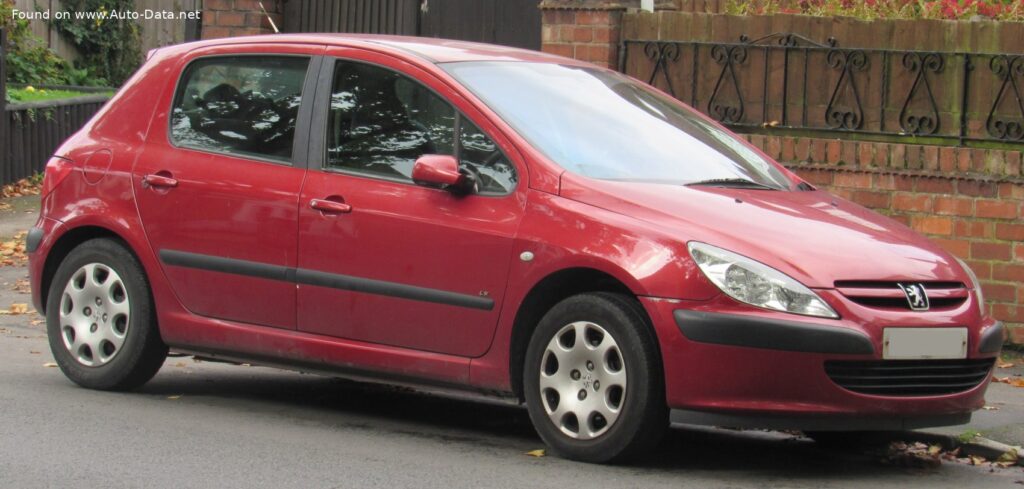
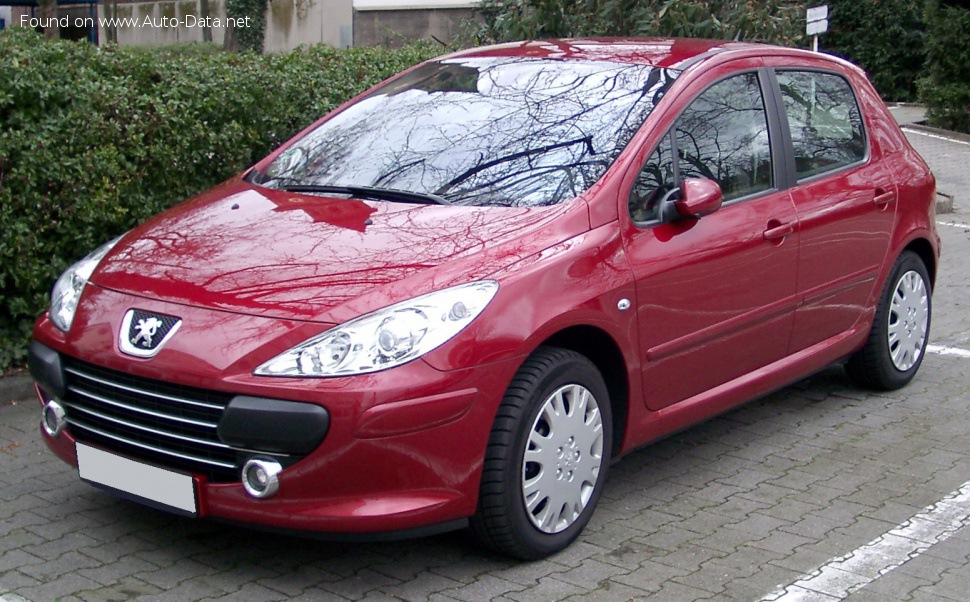
The Peugeot 307 (facelift 2005) retained the core “tall boy” design philosophy of its pre-facelift predecessor, which aimed to maximize interior space and provide an airy cabin feel. The facelift, however, brought a more refined and modern aesthetic. The most noticeable changes were concentrated at the front, featuring a larger, more aggressive grille that mirrored Peugeot’s new corporate face, updated headlights with clear lenses, and a revised bumper design. These modifications gave the 307 a more contemporary and assertive presence on the road. The vehicle was available in both 3-door and 5-door hatchback configurations, offering versatility to cater to different customer needs, from sportier individual use to practical family transportation.
Inside, the 307 offered seating for five occupants, with a focus on comfort and practicality. The “tall boy” design translated into generous headroom for all passengers, a significant advantage in its class. Cargo capacity was also impressive for a compact hatchback, with a minimum trunk space of 12.04 cu. ft. (341 liters), expandable to a cavernous 46.9 cu. ft. (1328 liters) with the rear seats folded down. This flexibility made the 307 a highly practical choice for grocery runs, family vacations, or transporting larger items.
Standard features for the era included power steering (rack and pinion type) for easy maneuverability, especially in tight urban spaces, and an Anti-lock Braking System (ABS) with ventilated discs at the front and disc brakes at the rear, providing robust stopping power and enhanced safety. The car rode on 195/65 R15 tires, fitted on 15-inch wheel rims, offering a comfortable and compliant ride quality. The overall dimensions—165.83 inches (4212 mm) in length, 68.74 inches (1746 mm) in width, and 59.45 inches (1510 mm) in height—along with a wheelbase of 102.68 inches (2608 mm), contributed to its stable road manners and relatively compact footprint, crucial for navigating narrow European streets and parking.
Technical Specifications: Peugeot 307 (facelift 2005) 1.6i (109 Hp)
| Category | Specification | US Equivalent (where applicable) |
|---|---|---|
General Information |
||
| Brand | Peugeot | |
| Model | 307 | |
| Generation | 307 (facelift 2005) | |
| Type (Engine) | 1.6i (109 Hp) | |
| Production Start | 2005 | |
| Production End | 2008 | |
| Powertrain Architecture | Internal Combustion Engine | |
| Body Type | Hatchback | |
| Seats | 5 | |
| Doors | 3-5 | |
Performance Specifications |
||
| Fuel Consumption (Urban) | 10 l/100 km | 23.5 US mpg |
| Fuel Consumption (Extra Urban) | 5.8 l/100 km | 40.6 US mpg |
| Fuel Consumption (Combined) | 7.4 l/100 km | 31.8 US mpg |
| CO2 Emissions | 174 g/km | |
| Fuel Type | Petrol (Gasoline) | |
| Acceleration 0 – 60 mph | 10.1 sec | |
| Acceleration 0 – 100 km/h | 10.6 sec | |
| Maximum Speed | 190 km/h | 118.06 mph |
| Emission Standard | Euro 4 | |
| Weight-to-Power Ratio | 10.9 kg/Hp | 91.8 Hp/tonne |
| Weight-to-Torque Ratio | 8.1 kg/Nm | 123.8 Nm/tonne |
Engine Specifications |
||
| Power | 109 Hp @ 5750 rpm | |
| Power per liter | 68.7 Hp/l | |
| Torque | 147 Nm @ 4000 rpm | 108.42 lb.-ft. @ 4000 rpm |
| Engine Layout | Front, Transverse | |
| Engine Model/Code | NFU TU5JP4 | |
| Engine Displacement | 1587 cm3 | 1.6 liters / 96.84 cu. in. |
| Number of Cylinders | 4 | |
| Engine Configuration | Inline | |
| Cylinder Bore | 78.5 mm | 3.09 in. |
| Piston Stroke | 82 mm | 3.23 in. |
| Compression Ratio | 11:1 | |
| Number of Valves per Cylinder | 4 | |
| Fuel Injection System | Multi-port manifold injection | |
| Engine Aspiration | Naturally aspirated engine | |
| Valvetrain | DOHC | |
| Engine Oil Capacity | 3.3 l | 3.49 US qt |
| Engine Oil Specification | Not specified in data | |
| Coolant Capacity | 6.2 l | 6.55 US qt |
Space, Volume and Weights |
||
| Kerb Weight | 1187 kg | 2616.89 lbs. |
| Max. Weight (Gross Vehicle Weight) | 1700 kg | 3747.86 lbs. |
| Max Load | 513 kg | 1130.97 lbs. |
| Trunk (Boot) Space – Minimum | 341 l | 12.04 cu. ft. |
| Trunk (Boot) Space – Maximum | 1328 l | 46.9 cu. ft. |
| Fuel Tank Capacity | 60 l | 15.85 US gal |
| Permitted Trailer Load with Brakes (12%) | 1200 kg | 2645.55 lbs. |
| Permitted Trailer Load without Brakes | 630 kg | 1388.91 lbs. |
Dimensions |
||
| Length | 4212 mm | 165.83 in. |
| Width | 1746 mm | 68.74 in. |
| Height | 1510 mm | 59.45 in. |
| Wheelbase | 2608 mm | 102.68 in. |
| Front Track | 1505 mm | 59.25 in. |
| Rear (Back) Track | 1500 mm | 59.06 in. |
| Ride Height (Ground Clearance) | 120 mm | 4.72 in. |
| Drag Coefficient (Cd) | 0.31 | |
| Minimum Turning Circle (Turning Diameter) | 11.13 m | 36.52 ft. |
Drivetrain, Brakes and Suspension Specs |
||
| Drivetrain Architecture | Front-wheel drive, Internal Combustion Engine | |
| Drive Wheel | Front wheel drive | |
| Number of Gears and Type of Gearbox | 5 gears, manual transmission | |
| Front Brakes | Ventilated discs | |
| Rear Brakes | Disc | |
| Assisting Systems | ABS (Anti-lock braking system) | |
| Steering Type | Steering rack and pinion | |
| Tires Size | 195/65 R15 | |
| Wheel Rims Size | 15 inches | |
Legacy and Market Impact
The Peugeot 307 played a crucial role in Peugeot’s European lineup, bridging the gap between the smaller 206 hatchback and larger family sedans. The facelifted 2005 model, including the 1.6i (109 Hp) variant, continued to build upon the original 307’s reputation as a comfortable, practical, and stylish compact car. Its “tall boy” design, which offered excellent visibility and interior room, was a key differentiator in a segment often constrained by conventional proportions. This design philosophy proved popular with European families seeking maximum utility from a relatively small footprint.
In its primary European market, the Peugeot 307 (facelift 2005) 1.6i (109 Hp) faced intense competition. Its main rivals included segment leaders like the Volkswagen Golf, Ford Focus, Renault Mégane, Opel Astra, and the platform-sharing Citroën C4. Against these formidable opponents, the 307 carved out its niche by offering a distinctively French blend of comfort-oriented suspension tuning, a characterful design, and a generally pleasant driving experience. While early models of the 307 had faced some criticism regarding reliability and electrical issues, the facelift aimed to address many of these concerns, improving the car’s overall quality perception during its later production years.
The 307 was a commercial success for Peugeot, selling millions of units worldwide. Its legacy lies in its contribution to shaping the modern compact car landscape, demonstrating that a small car could offer generous interior space and a comfortable ride without sacrificing style. It was also a critical step in Peugeot’s evolution, paving the way for its successor, the 308, which continued to refine the brand’s offerings in the compact segment. For many European drivers, the 307, especially in its facelifted 1.6-liter guise, represented a sensible, economical, and enjoyable choice for everyday transportation, embodying the practical yet charming characteristics often associated with French automotive engineering. It remains a testament to Peugeot’s ability to produce compelling vehicles for its core markets, even if those models never officially crossed the Atlantic.