The Peugeot 307 (facelift 2005): A Refined European Compact
The Peugeot 307 (facelift 2005) represents a significant refresh of Peugeot’s popular C-segment compact car, first introduced in 2001. Manufactured by the French automaker Peugeot, the 307 was a cornerstone of its lineup, primarily targeting the competitive European and Asian markets. The 2005 facelift brought a series of aesthetic and technical enhancements designed to keep the model competitive against formidable rivals in its class, such as the Volkswagen Golf, Ford Focus, and Renault Mégane. This particular variant, the 1.6i (109 Hp) Automatic, offered a blend of practical performance, fuel efficiency, and ease of use, making it a popular choice for urban and suburban drivers seeking a comfortable and versatile hatchback.
The 307 was notable for its “tall car” design philosophy, which aimed to maximize interior space and improve visibility, a characteristic that carried over into the facelifted model. While never officially sold in the United States, the Peugeot 307 (facelift 2005) played a crucial role in solidifying Peugeot’s presence in international markets, embodying the brand’s commitment to comfort, distinctive styling, and everyday usability. Its production ran from 2005 until 2008, when it was succeeded by the Peugeot 308.
Engine & Performance: The 1.6i (109 Hp) Automatic Powertrain
At the heart of this particular Peugeot 307 (facelift 2005) variant was a robust and widely utilized 1.6-liter (1587 cm3 or 96.84 cu. in.) naturally aspirated inline-four gasoline engine, internally designated as the NFU TU5JP4. This powerplant was a familiar and reliable unit within the Peugeot-Citroën group, known for its smooth operation and adequate power delivery for a car of its size and intended purpose. Featuring a Double Overhead Camshaft (DOHC) valvetrain with four valves per cylinder and multi-port manifold injection, the engine produced a respectable 109 horsepower at 5750 rpm.
Torque output stood at 147 Nm, or approximately 108.42 lb.-ft., peaking at 4000 rpm. This torque curve provided a flexible driving experience, offering sufficient pulling power for daily commutes and highway cruising. The engine’s compression ratio was 11:1, a common figure for naturally aspirated engines of its time, contributing to its efficiency. Power was routed to the front wheels via a 4-speed automatic transmission. While a 4-speed automatic might seem modest by today’s standards, it was a common offering in the compact segment during the mid-2000s, prioritizing smooth shifts and ease of driving over outright performance or cutting-edge fuel economy.
Performance figures for the Peugeot 307 (facelift 2005) 1.6i Automatic were practical rather than sporting. The car could accelerate from 0 to 60 mph in a calculated 11.9 seconds, with a top speed of 115.58 mph (186 km/h). Fuel economy was rated at a combined 29.8 US mpg (7.9 l/100 km), with urban consumption at 21 US mpg (11.2 l/100 km) and extra-urban at 39.2 US mpg (6 l/100 km). These figures, combined with CO2 emissions of 189 g/km, placed it within the Euro 4 emission standard, reflecting its environmental compliance for the era.
Design & Features: Facelift Enhancements and Practicality
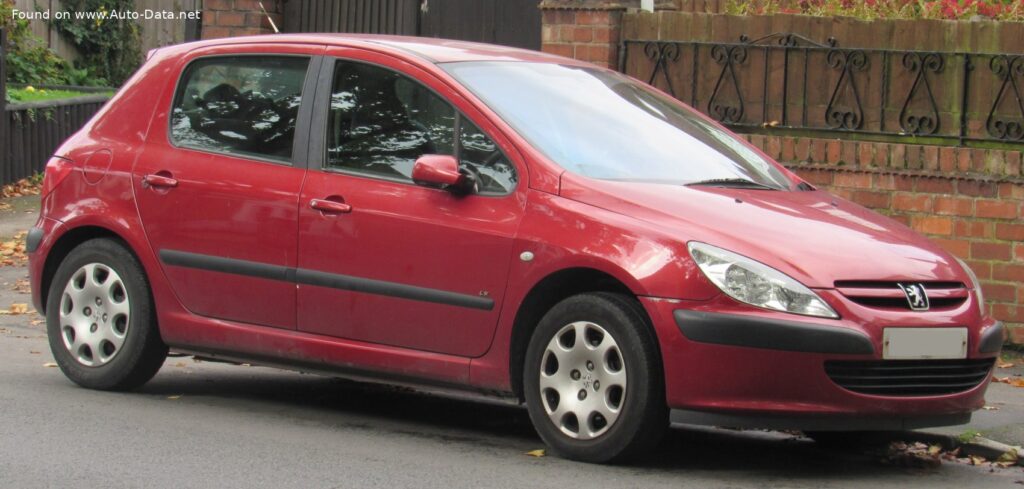
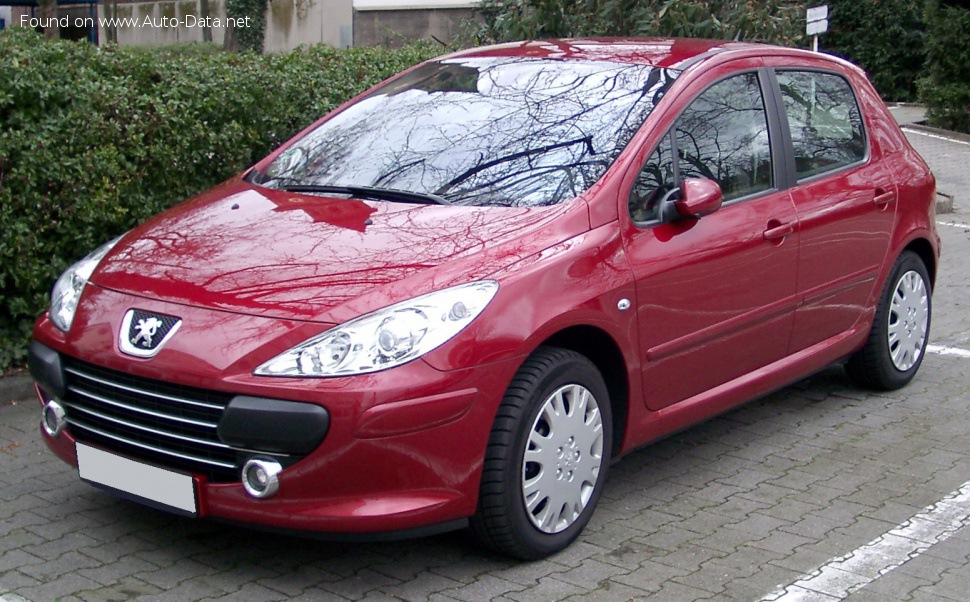
The 2005 facelift brought a refreshed aesthetic to the Peugeot 307 (facelift 2005), primarily focusing on the front fascia to align it with Peugeot’s evolving design language, which included larger, more aggressive grilles and swept-back headlights. The changes gave the 307 a more modern and assertive look, moving away from the somewhat softer lines of the pre-facelift model. The body type remained a versatile hatchback, available in both 3-door and 5-door configurations, offering seating for five occupants.
Despite its compact exterior dimensions (Length: 165.83 in., Width: 68.74 in., Height: 59.45 in.), the 307 was praised for its spacious interior, a direct benefit of its “tall car” architecture and relatively long wheelbase of 102.68 inches. This design provided generous headroom and a comfortable cabin environment, appealing to families and those who valued practicality. The trunk space was also commendable for its class, offering 12.04 cubic feet (341 liters) with the rear seats up, expanding to a substantial 46.9 cubic feet (1328 liters) when folded down, making it highly adaptable for various cargo needs.
Standard features for the Peugeot 307 (facelift 2005) typically included power steering with a rack and pinion system, ensuring easy maneuverability. Safety was addressed with an Anti-lock Braking System (ABS), and the car utilized ventilated disc brakes at the front and solid disc brakes at the rear, providing confident stopping power. The vehicle rode on 195/65 R15 tires mounted on 15-inch wheel rims, a common setup for comfort and cost-effectiveness. The car’s ground clearance of 4.72 inches (120 mm) was typical for a compact passenger car, suitable for urban environments but limiting its off-road capabilities. The drag coefficient (Cd) of 0.31 was competitive for its segment, contributing to its highway efficiency.
Technical Specifications
| Category | Specification | US Equivalent |
|---|---|---|
| General Information | ||
| Brand | Peugeot | |
| Model | 307 | |
| Generation | 307 (facelift 2005) | |
| Type (Engine) | 1.6i (109 Hp) Automatic | |
| Start of production | 2005 year | |
| End of production | 2008 year | |
| Powertrain Architecture | Internal Combustion engine | |
| Body type | Hatchback | |
| Seats | 5 | |
| Doors | 3-5 | |
| Performance Specs | ||
| Fuel consumption (economy) – urban | 11.2 l/100 km | 21 US mpg |
| Fuel consumption (economy) – extra urban | 6 l/100 km | 39.2 US mpg |
| Fuel consumption (economy) – combined | 7.9 l/100 km | 29.8 US mpg |
| CO2 emissions | 189 g/km | |
| Fuel Type | Petrol (Gasoline) | |
| Acceleration 0 – 100 km/h | 12.5 sec | |
| Acceleration 0 – 62 mph | 12.5 sec | |
| Acceleration 0 – 60 mph (Calculated) | 11.9 sec | |
| Maximum speed | 186 km/h | 115.58 mph |
| Emission standard | Euro 4 | |
| Weight-to-power ratio | 11.2 kg/Hp | 24.69 lbs/Hp |
| Weight-to-torque ratio | 8.3 kg/Nm | 5.62 lbs/lb.-ft. |
| Engine Specs | ||
| Power | 109 Hp @ 5750 rpm. | |
| Power per liter | 68.7 Hp/l | |
| Torque | 147 Nm @ 4000 rpm. | 108.42 lb.-ft. @ 4000 rpm. |
| Engine layout | Front, Transverse | |
| Engine Model/Code | NFU TU5JP4 | |
| Engine displacement | 1587 cm3 | 96.84 cu. in. |
| Number of cylinders | 4 | |
| Engine configuration | Inline | |
| Cylinder Bore | 78.5 mm | 3.09 in. |
| Piston Stroke | 82 mm | 3.23 in. |
| Compression ratio | 11:1 | |
| Number of valves per cylinder | 4 | |
| Fuel injection system | Multi-port manifold injection | |
| Engine aspiration | Naturally aspirated engine | |
| Valvetrain | DOHC | |
| Engine oil capacity | 3.3 l | 3.49 US qt |
| Engine oil specification | Not provided | |
| Coolant capacity | 6.7 l | 7.08 US qt |
| Space, Volume and Weights | ||
| Kerb Weight | 1226 kg | 2702.87 lbs. |
| Max. weight | 1720 kg | 3791.95 lbs. |
| Max load | 494 kg | 1089.08 lbs. |
| Trunk (boot) space – minimum | 341 l | 12.04 cu. ft. |
| Trunk (boot) space – maximum | 1328 l | 46.9 cu. ft. |
| Fuel tank capacity | 60 l | 15.85 US gal |
| Permitted trailer load with brakes (12%) | 1200 kg | 2645.55 lbs. |
| Permitted trailer load without brakes | 640 kg | 1410.96 lbs. |
| Dimensions | ||
| Length | 4212 mm | 165.83 in. |
| Width | 1746 mm | 68.74 in. |
| Height | 1510 mm | 59.45 in. |
| Wheelbase | 2608 mm | 102.68 in. |
| Front track | 1505 mm | 59.25 in. |
| Rear (Back) track | 1500 mm | 59.06 in. |
| Ride height (ground clearance) | 120 mm | 4.72 in. |
| Drag coefficient (Cd) | 0.31 | |
| Minimum turning circle (turning diameter) | 11.13 m | 36.52 ft. |
| Drivetrain, Brakes and Suspension Specs | ||
| Drivetrain Architecture | The Internal combustion engine (ICE) drives the front wheels of the vehicle. | |
| Drive wheel | Front wheel drive | |
| Number of gears and type of gearbox | 4 gears, automatic transmission | |
| Front brakes | Ventilated discs | |
| Rear brakes | Disc | |
| Assisting systems | ABS (Anti-lock braking system) | |
| Steering type | Steering rack and pinion | |
| Tires size | 195/65 R15 | |
| Wheel rims size | 15 |
Legacy & Market Impact of the Peugeot 307 (facelift 2005)
The Peugeot 307 (facelift 2005), building on the success of its pre-facelift iteration, maintained a strong presence in the highly competitive European compact car segment. Its primary competitors included the segment-defining Volkswagen Golf, the dynamic Ford Focus, the practical Opel Astra, and its domestic rival, the Renault Mégane. Peugeot aimed to distinguish the 307 through its emphasis on comfort, interior space, and a distinctively French ride quality that prioritized suppleness over ultimate sportiness.
The 307 was a critical model for Peugeot, serving as the successor to the popular 306 and paving the way for the later 308. Its “tall car” design, while initially somewhat polarizing, ultimately proved successful in offering a more versatile and family-friendly package than many of its lower-slung rivals. This design philosophy contributed to its reputation as a practical and comfortable everyday vehicle, particularly appreciated in European markets where urban driving and varied road conditions are common.
Despite its absence from the North American market, the Peugeot 307 (facelift 2005) left a lasting impression in its primary sales regions. It was recognized for its robust engine options, including the reliable 1.6i gasoline unit, and its commitment to safety, often achieving good ratings in European crash tests for its time. The facelift ensured that the 307 remained visually fresh and technologically relevant through the mid-2000s, helping Peugeot maintain its market share and brand identity during a period of intense competition. Its legacy is one of a solid, dependable, and comfortable compact car that effectively met the needs of a wide range of European buyers, embodying the pragmatic and stylish characteristics often associated with the Peugeot brand.