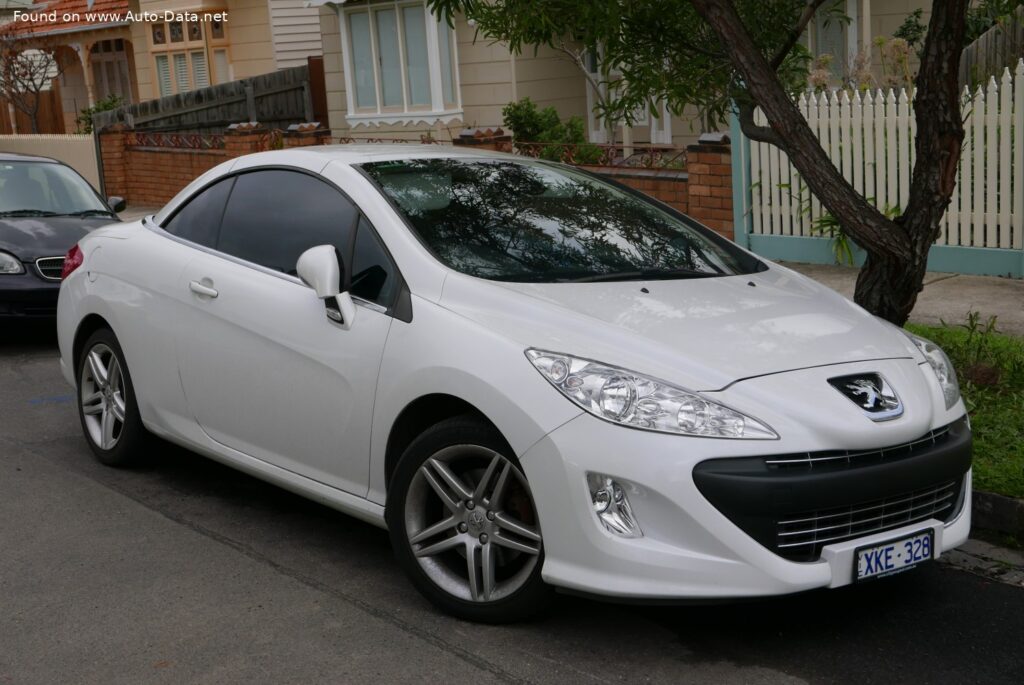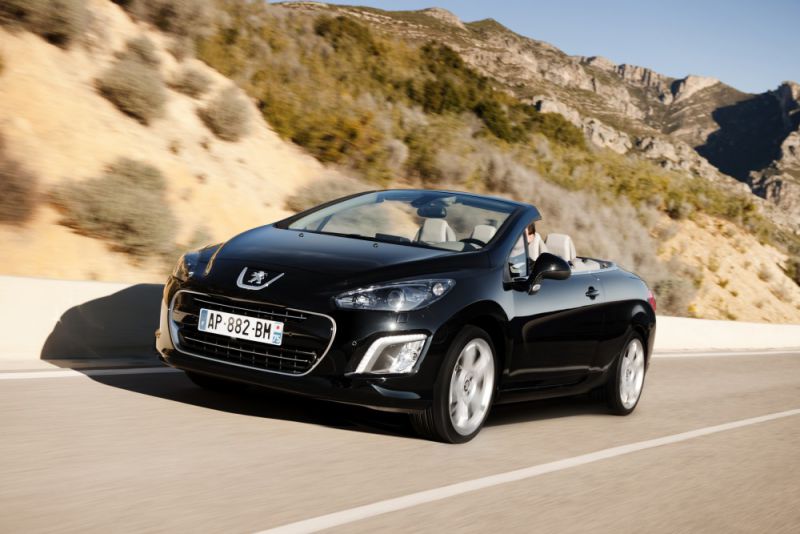
The Peugeot 308 CC I (Phase II, 2011) stands as a notable example of the French automaker’s commitment to stylish and accessible open-air motoring, particularly within the European market. This specific variant, featuring the robust 1.6 16V THP (200 Hp) engine, represented a compelling offering during its production run from 2011 to 2013. As part of the first generation’s mid-cycle refresh, or “Phase II,” it aimed to refine the original 308 CC’s blend of coupe elegance and cabriolet freedom, targeting consumers seeking a versatile and engaging driving experience without the premium price tag often associated with luxury convertibles. Positioned in the compact segment, the 308 CC I (Phase II, 2011) was designed to offer four-seat practicality, making it a more family-friendly option than many traditional two-seater roadsters, while still delivering a spirited performance thanks to its turbocharged powertrain.
The Peugeot 308 CC I (Phase II, 2011): A European Open-Air Experience
While Peugeot vehicles are not typically sold in the United States market today, the Peugeot 308 CC I (Phase II, 2011) played a significant role in its native European landscape. It embodied a popular trend of the time: the coupe-cabriolet, characterized by a retractable hardtop that offered the security and refinement of a coupe when closed, and the exhilarating sensation of a convertible when open. This particular iteration, with its enhanced engine and updated styling cues, aimed to solidify its position against rivals by offering a compelling package of performance, design, and practicality. The “Phase II” designation indicated a series of improvements over the initial 308 CC, focusing on aesthetic refinements and potentially minor mechanical tweaks to keep the model competitive and appealing to its target audience.
Engine & Performance
At the heart of the Peugeot 308 CC I (Phase II, 2011) lies the potent 1.6 16V THP (Turbo High Pressure) engine, an inline four-cylinder unit renowned for its blend of power and efficiency. Codenamed EP6CDTX, this turbocharged and intercooled gasoline engine delivered a robust 200 horsepower at 5800 revolutions per minute (rpm), making it a surprisingly sprightly performer for its class. Its power output of 125.2 horsepower per liter showcased advanced engineering for its time. Torque figures were equally impressive, reaching 275 Nm (202.83 lb.-ft.) at a relatively accessible 4500 rpm, which contributed to its responsive acceleration and flexible in-gear performance. The engine’s architecture, featuring a front, transverse layout, and 4 valves per cylinder, was complemented by a direct injection fuel system, optimizing fuel delivery and combustion efficiency.
This powertrain, coupled with a precise 6-speed manual transmission driving the front wheels, allowed the 308 CC I (Phase II, 2011) to achieve a 0 to 60 mph acceleration time of a swift 7.9 seconds (0-100 km/h in 8.3 seconds). The top speed was rated at 240 km/h (149.13 mph), underscoring its capabilities as a capable cruiser on European highways. Despite its performance potential, the vehicle also demonstrated reasonable fuel economy for its segment. The combined fuel consumption was rated at 7 liters per 100 kilometers, translating to approximately 33.6 US miles per gallon. Urban driving yielded about 25.3 US mpg, while extra-urban cruising improved to an estimated 42 US mpg. These figures, combined with its Euro 5 emission standard compliance, highlighted Peugeot’s efforts to balance performance with environmental considerations.
Design & Features
The defining characteristic of the Peugeot 308 CC I (Phase II, 2011) is its elegant Coupe-Cabriolet body style, offering the best of both worlds with its sophisticated retractable hardtop. This design provided the weather protection and security of a fixed-roof coupe, along with the undeniable allure of open-air motoring, all at the touch of a button. The car featured a 2-door configuration but offered seating for four occupants, a significant advantage over many two-seater convertibles in terms of practicality. Its dimensions were well-proportioned for the compact segment: a length of 4440 mm (174.8 inches), a width of 1872 mm (73.7 inches), and a height of 1426 mm (56.14 inches). The wheelbase measured 2605 mm (102.56 inches), contributing to both passenger comfort and stable handling.
The exterior design of the Phase II refresh subtly enhanced the original 308 CC’s lines, featuring updated front fascias and possibly revised lighting elements to give it a fresh, modern appearance. The vehicle rode on 18-inch wheel rims, shod with 225/40 R18 tires, providing a sporty stance and ample grip. Inside, the 4-seat configuration was designed to offer adequate space, though the rear seats, as is common in coupe-cabriolets, were best suited for shorter journeys or smaller passengers. Trunk space was versatile, ranging from 226 liters (7.98 cubic feet) with the top down to a more generous 403 liters (14.23 cubic feet) with the hardtop closed, accommodating a variety of luggage needs. Safety features for the era included an Anti-lock Braking System (ABS), complementing the ventilated disc brakes at the front and disc brakes at the rear, ensuring confident stopping power. The suspension system featured an independent McPherson type with coil springs and an anti-roll bar at the front, paired with a torsion beam at the rear, aiming for a balance of comfort and dynamic handling.
Technical Specifications of the Peugeot 308 CC I (Phase II, 2011) 1.6 16V THP (200 Hp)
| General Information | |
|---|---|
| Brand | Peugeot |
| Model | 308 |
| Generation | 308 CC I (Phase II, 2011) |
| Type (Engine) | 1.6 16V THP (200 Hp) |
| Start of Production | 2011 year |
| End of Production | 2013 year |
| Powertrain Architecture | Internal Combustion engine |
| Body type | Coupe – Cabriolet |
| Seats | 4 |
| Doors | 2 |
| Performance Specifications | |
| Fuel Consumption (Economy) – Urban | 9.3 l/100 km (25.3 US mpg) |
| Fuel Consumption (Economy) – Extra Urban | 5.6 l/100 km (42 US mpg) |
| Fuel Consumption (Economy) – Combined | 7 l/100 km (33.6 US mpg) |
| Fuel Type | Petrol (Gasoline) |
| Acceleration 0 – 60 mph | 7.9 sec |
| Acceleration 0 – 100 km/h | 8.3 sec |
| Maximum Speed | 240 km/h (149.13 mph) |
| Emission Standard | Euro 5 |
| Weight-to-power ratio | 7.7 kg/Hp (130.3 Hp/tonne) |
| Weight-to-torque ratio | 5.6 kg/Nm (179.2 Nm/tonne) |
| Engine Specifications | |
| Power | 200 Hp @ 5800 rpm |
| Power per liter | 125.2 Hp/l |
| Torque | 275 Nm @ 4500 rpm (202.83 lb.-ft. @ 4500 rpm) |
| Engine Layout | Front, Transverse |
| Engine Model/Code | EP6CDTX |
| Engine Displacement | 1598 cm3 (1.6 liters / 97.52 cu. in.) |
| Number of Cylinders | 4 |
| Engine Configuration | Inline |
| Number of Valves per Cylinder | 4 |
| Fuel Injection System | Direct injection |
| Engine Aspiration | Turbocharger, Intercooler |
| Engine Oil Capacity | 4.25 l (4.49 US qt) |
| Space, Volume and Weights | |
| Kerb Weight | 1535 kg (3384.1 lbs.) |
| Max. Weight | 1984 kg (4373.97 lbs.) |
| Max Load | 449 kg (989.88 lbs.) |
| Trunk (Boot) Space – Minimum | 226 l (7.98 cu. ft.) |
| Trunk (Boot) Space – Maximum | 403 l (14.23 cu. ft.) |
| Fuel Tank Capacity | 60 l (15.85 US gal) |
| Dimensions | |
| Length | 4440 mm (174.8 in.) |
| Width | 1872 mm (73.7 in.) |
| Height | 1426 mm (56.14 in.) |
| Wheelbase | 2605 mm (102.56 in.) |
| Drivetrain, Brakes and Suspension Specifications | |
| Drivetrain Architecture | Front wheel drive, Internal Combustion engine |
| Drive Wheel | Front wheel drive |
| Number of Gears and Type of Gearbox | 6 gears, manual transmission |
| Front Suspension | Independent, type McPherson with coil spring and anti-roll bar |
| Rear Suspension | Torsion beam |
| Front Brakes | Ventilated discs |
| Rear Brakes | Disc |
| Assisting Systems | ABS (Anti-lock braking system) |
| Steering type | Steering rack and pinion |
| Tires Size | 225/40 R18 |
| Wheel Rims Size | 18 inches |
Legacy & Market Impact
The Peugeot 308 CC I (Phase II, 2011) carved out a distinct niche in the European automotive landscape. As part of a segment that emphasized versatility and style, it competed against other popular coupe-cabriolets such as the Volkswagen Eos, Renault Mégane CC, and Ford Focus CC. Its primary appeal lay in its ability to transform from a secure, well-insulated coupe into an exhilarating open-top convertible, offering drivers the best of both worlds without requiring ownership of two separate vehicles. The 1.6 16V THP (200 Hp) engine variant, in particular, provided a more performance-oriented option within the range, catering to those who desired a sportier driving experience alongside the inherent practicality and aesthetic appeal.
The 308 CC’s historical significance for Peugeot lies in its embodiment of the brand’s long-standing tradition of producing stylish and innovative convertibles, dating back to models like the 402 Éclipse in the 1930s. The 308 CC continued this legacy by bringing the retractable hardtop technology to a more mainstream compact segment. While its market impact was primarily felt in Europe, it contributed to Peugeot’s image as a manufacturer capable of producing vehicles that combined emotional appeal with robust engineering. Its relatively short production run for this specific Phase II variant (2011-2013) reflects the fast-paced nature of the automotive industry and the continuous evolution of models. Today, the Peugeot 308 CC I (Phase II, 2011) remains a testament to a specific era of automotive design, offering an accessible entry into the world of open-top motoring with a distinct French flair.