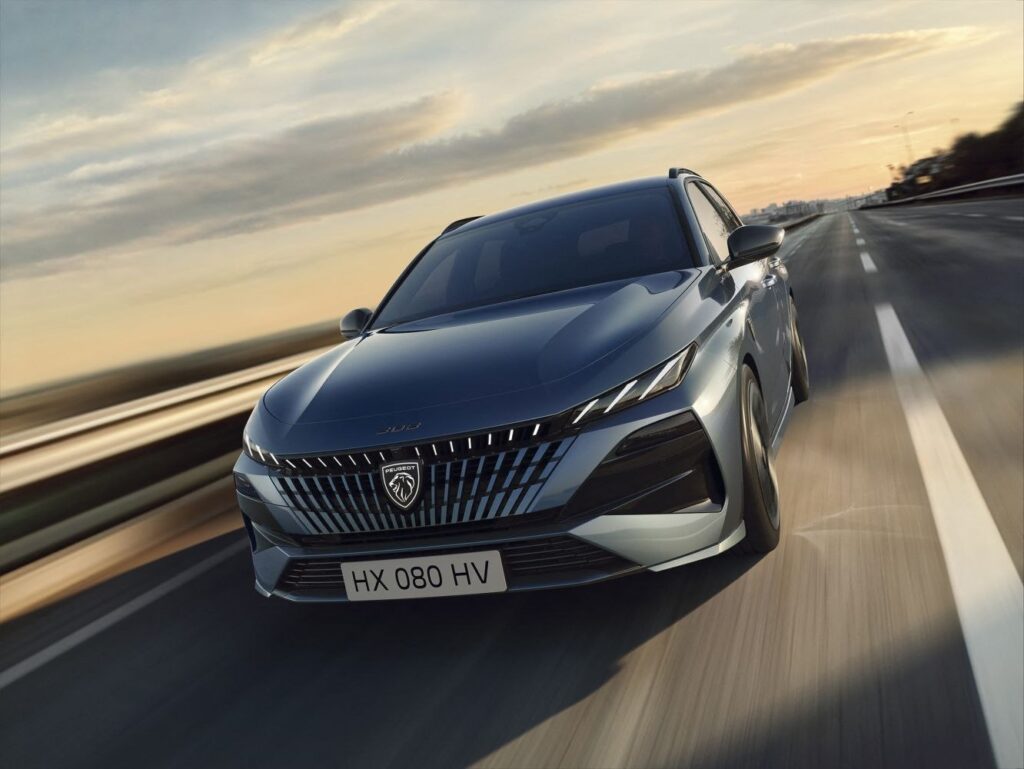
The 2025 Peugeot 308 SW III (Phase II, 2025) 1.5 BlueHDi (131 Hp) EAT represents the latest evolution of Peugeot’s highly competitive compact station wagon, primarily catering to the discerning European market. As a Phase II refresh of the third-generation 308 SW, this model builds upon a foundation of distinctive design, advanced technology, and exceptional practicality. While not offered in the United States, the 308 SW plays a crucial role in Europe’s C-segment, where it directly competes with other family-oriented wagons, offering a compelling blend of style, efficiency, and driving dynamics. This particular iteration, powered by the efficient 1.5-liter BlueHDi diesel engine paired with an 8-speed automatic transmission, exemplifies Peugeot’s commitment to delivering sophisticated, environmentally conscious vehicles that meet the diverse needs of modern European families and businesses. Its updated design and refined powertrain underscore its position as a contemporary and forward-thinking choice in a segment renowned for its versatility and value.
Peugeot 308 SW III (Phase II, 2025) 1.5 BlueHDi (131 Hp) EAT: Engineering and Performance
At the heart of the 2025 Peugeot 308 SW III (Phase II) lies a meticulously engineered powertrain designed for both robust performance and remarkable fuel efficiency. The 1.5-liter (1499 cm3 or 91.47 cubic inches) BlueHDi inline-four diesel engine, designated YHZ DV5RC, is a testament to modern diesel technology. This compact yet potent powerplant delivers a healthy 131 horsepower at 3750 rpm, providing ample thrust for daily driving and highway cruising. More impressively, it generates a substantial 221.27 lb.-ft. of torque at a low 1750 rpm, ensuring strong acceleration from a standstill and flexible in-gear performance, crucial for a family-oriented station wagon often laden with passengers and cargo.
The engine’s advanced architecture includes a turbocharger and intercooler, optimizing air intake for enhanced power delivery, while a common rail fuel injection system ensures precise fuel metering for efficiency and reduced emissions. With four valves per cylinder and a bore of 2.95 inches (75 mm) and a stroke of 3.34 inches (84.8 mm), the engine is designed for smooth operation and durability. Complementing this refined diesel engine is Peugeot’s sophisticated 8-speed EAT (Efficient Automatic Transmission), which provides seamless gear changes and contributes significantly to the vehicle’s overall efficiency and driving comfort. This automatic gearbox is expertly calibrated to maximize the engine’s torque band, delivering a responsive and engaging driving experience while optimizing fuel consumption.
Performance figures for the 1.5 BlueHDi (131 Hp) EAT are respectable for its class, with the vehicle accelerating from 0 to 60 mph in an estimated 10.4 seconds and achieving a top speed of 128.62 mph (207 km/h). These metrics indicate a car that is perfectly capable of keeping up with highway traffic and executing confident overtakes. Power is channeled to the front wheels, a common and effective drivetrain architecture for vehicles in this segment, offering predictable handling and traction. The weight-to-power ratio stands at 10.8 kg per horsepower, or 93 horsepower per tonne, reflecting a well-balanced power-to-weight dynamic.
Environmental considerations are paramount for the 2025 308 SW III. The 1.5 BlueHDi engine complies with the stringent Euro 6e-bis emission standard, incorporating a Start & Stop System and a particulate filter to minimize its environmental footprint. This commitment to cleaner emissions is matched by impressive fuel economy. According to WLTP (Worldwide Harmonized Light Vehicles Test Procedure) figures, the combined fuel consumption is an outstanding 5.0 liters per 100 kilometers, translating to an estimated 47 US miles per gallon. This efficiency is further broken down across various driving cycles: 6.0 l/100 km (39.2 US mpg) at low speed, 5.0 l/100 km (47 US mpg) at medium speed, 4.3 l/100 km (54.7 US mpg) at high speed, and 5.1 l/100 km (46.1 US mpg) at very high speed. These figures highlight the diesel powertrain’s enduring advantage in long-distance cruising and overall operational cost, making the 308 SW a highly economical choice in its segment.
Design, Practicality, and Advanced Features of the 2025 Peugeot 308 SW III
The 2025 Peugeot 308 SW III (Phase II) continues to impress with its distinctive design language, embodying Peugeot’s contemporary aesthetic that blends elegance with dynamism. As a station wagon (often referred to as an “estate” in Europe), its body type prioritizes practicality without compromising on style. With five doors and seating for five occupants, the 308 SW is designed to be a versatile family vehicle, capable of adapting to a wide range of needs.
Dimensionally, the 308 SW III measures 182.52 inches (4636 mm) in length, 72.91 inches (1852 mm) in width (81.18 inches or 2062 mm including mirrors), and 56.61 inches (1438 mm) in height. Its generous wheelbase of 107.56 inches (2732 mm) contributes significantly to a spacious interior and stable ride quality. The careful balance of front and rear overhangs (35.59 inches / 904 mm and 39.37 inches / 1000 mm, respectively) ensures a balanced visual stance and optimized interior packaging. A minimum turning circle of 35.1 feet (10.7 meters) makes it surprisingly agile for its size, an advantage in urban environments.
Practicality is a cornerstone of the 308 SW’s appeal. The trunk (boot) space is highly commendable, offering a minimum of 19.46 cubic feet (551 liters) with all seats in place, expanding to a cavernous 51.17 cubic feet (1449 liters) when the rear seats are folded down. This extensive cargo capacity makes it ideal for everything from weekly grocery runs to hauling luggage for family vacations. The vehicle also boasts a maximum roof load of 187.39 lbs (85 kg) and impressive towing capabilities, with a permitted trailer load of 3306.93 lbs (1500 kg) with brakes, further enhancing its utility.
Underneath its stylish exterior, the 308 SW III features a robust and refined chassis. The front suspension employs an independent McPherson type, known for its excellent balance of comfort and handling. At the rear, an independent multi-link suspension system provides superior ride quality and stability, especially when the vehicle is fully loaded. Braking is handled by ventilated discs at the front and solid discs at the rear, complemented by an Anti-lock Braking System (ABS) for enhanced safety and control in various conditions. The electric power steering system, featuring a rack and pinion setup, offers precise feedback and effortless maneuverability, contributing to an engaging driving experience.
While specific interior features are not detailed, as a 2025 model in the European market, the 308 SW III is expected to come equipped with a comprehensive suite of modern amenities and advanced driver-assistance systems (ADAS). These would typically include a sophisticated infotainment system with connectivity options, digital instrumentation, automatic climate control, and a range of safety features such as lane-keeping assist, adaptive cruise control, and blind-spot monitoring, all designed to enhance driver and passenger safety and comfort. The standard tire size is 205/55 R16 90H, mounted on 16-inch wheel rims, providing a good balance of grip, comfort, and rolling resistance for optimal efficiency. The 308 SW III (Phase II) truly embodies a modern European station wagon: stylish, efficient, incredibly practical, and equipped with technology to meet the demands of contemporary driving.
Technical Specifications: Peugeot 308 SW III (Phase II, 2025) 1.5 BlueHDi (131 Hp) EAT
| Brand | Peugeot |
| Model | 308 |
| Generation | 308 SW III (Phase II, 2025) |
| Type (Engine) | 1.5 BlueHDi (131 Hp) EAT |
| Start of production | October, 2025 year |
| Powertrain Architecture | Internal Combustion engine |
| Body type | Station wagon (estate) |
| Seats | 5 |
| Doors | 5 |
| Fuel consumption at Low speed (WLTP) | 6.0 l/100 km (39.2 US mpg) |
| Fuel consumption at Medium speed (WLTP) | 5.0 l/100 km (47 US mpg) |
| Fuel consumption at High speed (WLTP) | 4.3 l/100 km (54.7 US mpg) |
| Fuel consumption at Very High speed (WLTP) | 5.1 l/100 km (46.1 US mpg) |
| Combined fuel consumption (WLTP) | 5.0 l/100 km (47 US mpg) |
| CO2 emissions (WLTP) | 130 g/km |
| Fuel Type | Diesel |
| Acceleration 0 – 60 mph | 10.4 sec |
| Acceleration 0 – 100 km/h | 10.9 sec |
| Maximum speed | 207 km/h (128.62 mph) |
| Emission standard | Euro 6e-bis |
| Weight-to-power ratio | 10.8 kg/Hp (93 Hp/tonne) |
| Weight-to-torque ratio | 4.7 kg/Nm (212.9 Nm/tonne) |
| Power | 131 Hp @ 3750 rpm |
| Power per liter | 87.4 Hp/l |
| Torque | 300 Nm @ 1750 rpm (221.27 lb.-ft.) |
| Engine layout | Front, Transverse |
| Engine Model/Code | YHZ DV5RC |
| Engine displacement | 1499 cm3 (91.47 cu. in.) |
| Number of cylinders | 4 |
| Engine configuration | Inline |
| Cylinder Bore | 75 mm (2.95 in.) |
| Piston Stroke | 84.8 mm (3.34 in.) |
| Number of valves per cylinder | 4 |
| Fuel injection system | Diesel Commonrail |
| Engine aspiration | Turbocharger, Intercooler |
| Engine oil capacity | 4 l (4.23 US qt) |
| Engine systems | Start & Stop System, Particulate filter |
| Kerb Weight | 1409-1515 kg (3106.31 – 3340 lbs.) |
| Max. weight | 1950 kg (4299.01 lbs.) |
| Max load | 435-541 kg (959.01 – 1192.7 lbs.) |
| Trunk (boot) space – minimum | 551 l (19.46 cu. ft.) |
| Trunk (boot) space – maximum | 1449 l (51.17 cu. ft.) |
| Fuel tank capacity | 52 l (13.74 US gal) |
| Max. roof load | 85 kg (187.39 lbs.) |
| Permitted trailer load with brakes (12%) | 1500 kg (3306.93 lbs.) |
| Permitted trailer load without brakes | 730 kg (1609.37 lbs.) |
| Permitted towbar download | 70 kg (154.32 lbs.) |
| Length | 4636 mm (182.52 in.) |
| Width | 1852 mm (72.91 in.) |
| Width with mirrors folded | 1859 mm (73.19 in.) |
| Width including mirrors | 2062 mm (81.18 in.) |
| Height | 1438 mm (56.61 in.) |
| Wheelbase | 2732 mm (107.56 in.) |
| Front track | 1559 mm (61.38 in.) |
| Rear (Back) track | 1552 mm (61.1 in.) |
| Front overhang | 904 mm (35.59 in.) |
| Rear overhang | 1000 mm (39.37 in.) |
| Minimum turning circle (turning diameter) | 10.7 m (35.1 ft.) |
| Drivetrain Architecture | The Internal combustion engine (ICE) drives the front wheels of the vehicle. |
| Drive wheel | Front wheel drive |
| Number of gears and type of gearbox | 8 gears, automatic transmission EAT |
| Front suspension | Independent type McPherson |
| Rear suspension | Independent multi-link suspension |
| Front brakes | Ventilated discs |
| Rear brakes | Disc |
| Assisting systems | ABS (Anti-lock braking system) |
| Steering type | Steering rack and pinion |
| Power steering | Electric Steering |
| Tires size | 205/55 R16 90H |
| Wheel rims size | 16 |