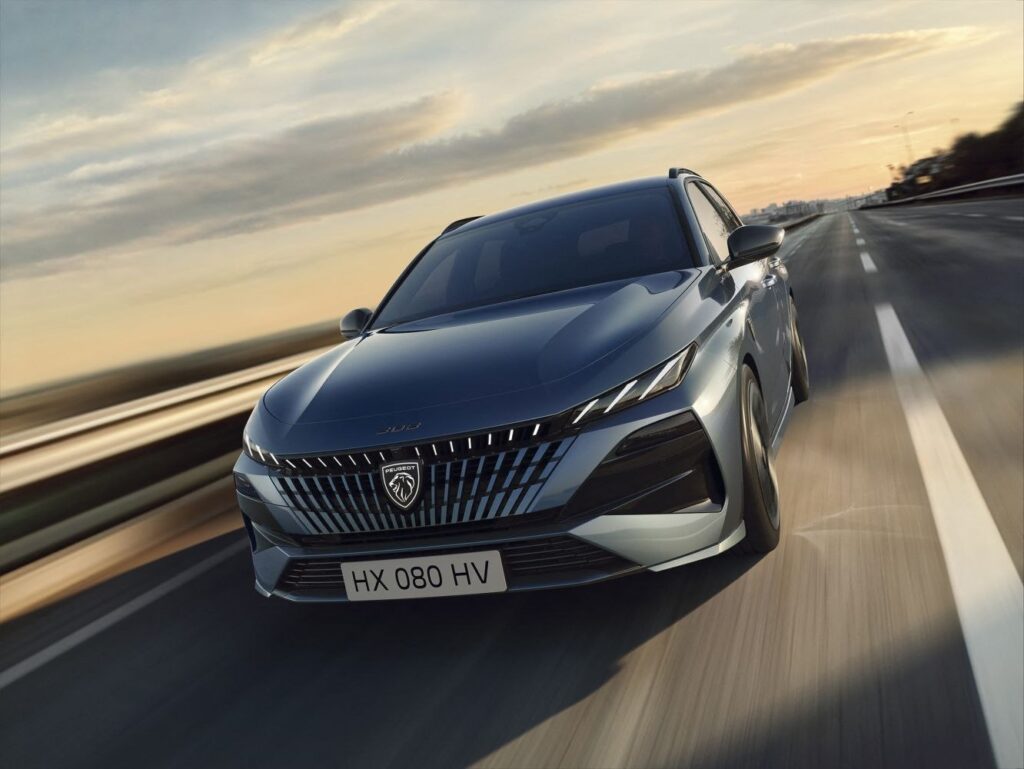
The 2025 Peugeot 308 SW III (Phase II) 1.6 (195 Hp) Plug-in Hybrid e-DCS represents a significant evolution in the compact station wagon segment, particularly for the European market where such versatile vehicles maintain strong appeal. As part of Peugeot’s third generation 308 lineup, this Phase II iteration introduces refined styling and, crucially, an advanced plug-in hybrid powertrain designed for both efficiency and dynamic performance. While not directly available in the United States, this model showcases Peugeot’s commitment to electrification and sophisticated automotive engineering, reflecting global trends towards sustainable mobility without compromising practicality or driving enjoyment. The 308 SW, or ‘Station Wagon,’ as it is commonly known in the US, is a five-door, five-seat vehicle that blends family-friendly utility with a sleek, contemporary design language, positioning it as a compelling option for discerning buyers seeking a balance of eco-consciousness and everyday usability in its primary European strongholds.
Engine & Performance: The Peugeot 308 SW III (Phase II, 2025) 1.6 (195 Hp) Plug-in Hybrid e-DCS Powertrain
At the heart of the 2025 Peugeot 308 SW III (Phase II) lies a sophisticated Plug-in Hybrid Electric Vehicle (PHEV) powertrain, meticulously engineered to deliver an optimal blend of power, efficiency, and environmental responsibility. This system combines a 1.6-liter (1598 cm³ or 97.52 cu. in.) turbocharged inline-four petrol engine with a potent electric motor, creating a seamless and responsive driving experience. The internal combustion engine (ICE), identified by model code 5G11, generates a robust 150 horsepower at 5500 rpm and 184.39 lb.-ft. of torque at a low 1750 rpm, thanks to its direct injection system and turbocharger with intercooler. This engine is designed for efficiency, featuring a Start & Stop System and a particulate filter to meet stringent Euro 6e emission standards.
Complementing the petrol engine is a synchronous electric motor, strategically placed between the combustion engine and the transmission. This motor contributes 125 horsepower at 2500 rpm and a substantial 87.03 lb.-ft. of torque across a broad range from 300 to 7320 rpm, ensuring immediate electric response. Together, the combined system output reaches an impressive 195 horsepower and a total system torque of 265.52 lb.-ft., channeled to the front wheels via an advanced 7-speed automatic e-DCS transmission. This drivetrain architecture allows the vehicle to operate in full electric mode, hybrid mode, or purely on the combustion engine, adapting to driving conditions for maximum efficiency.
Performance figures underscore the dynamic capabilities of this hybrid wagon. The 308 SW III (Phase II) can accelerate from 0 to 60 mph in a brisk 7.6 seconds, with a top speed reaching 139.81 mph. Despite this spirited performance, fuel economy is a standout feature, with a combined WLTP rating of an exceptional 94.1 US mpg (2.5 liters per 100 km). CO2 emissions are remarkably low at just 57 g/km, reflecting its plug-in hybrid advantage. The vehicle boasts a gross battery capacity of 17.2 kWh, utilizing advanced Lithium-ion technology operating at 400 volts. This battery, weighing 310.85 lbs. and intelligently located below the floor under the rear seats to maintain cabin and cargo space, provides an all-electric range of 52.82 miles (WLTP), allowing for significant emission-free commuting and reduced reliance on the petrol engine for daily errands. The weight-to-power ratio stands at 8.6 kg/Hp, or 116.4 Hp/tonne, while the weight-to-torque ratio is 4.7 kg/Nm, or 214.9 Nm/tonne, indicating a well-balanced power delivery for its class.
Design & Features: Practicality Meets Modernity
The Peugeot 308 SW III (Phase II, 2025) embodies a contemporary design philosophy that skillfully merges aesthetic appeal with practical utility, a hallmark of the station wagon body type. With its sleek lines and assertive stance, it projects a sophisticated image characteristic of Peugeot’s latest design language. The vehicle measures 182.68 inches in length, 72.83 inches in width, and 58.27 inches in height, with a wheelbase of 107.48 inches, providing a stable and spacious platform. The aerodynamic profile is further enhanced by a drag coefficient (Cd) of 0.29, contributing to both its efficiency and quietness at speed.
As a five-door, five-seat station wagon, the 308 SW III (Phase II) prioritizes passenger comfort and cargo versatility. The interior is designed to be ergonomic and inviting, although specific details beyond the technical data are not provided, Peugeot’s recent cabins are known for their i-Cockpit layout and premium materials. Practicality is a strong suit, with a minimum trunk (boot) space of 16.49 cubic feet (467 liters), offering ample room for luggage, groceries, or sports equipment. The fuel tank capacity is 10.57 US gallons, providing a generous combined range when factoring in both electric and petrol power. The vehicle’s kerb weight is 3692.74 lbs., with a maximum permissible weight of 4817.1 lbs., allowing for a maximum load capacity of 1124.36 lbs. It also boasts a permitted trailer load with brakes of 2899.08 lbs., adding to its utility.
Underneath its stylish exterior, the 308 SW III (Phase II) integrates a range of advanced chassis and safety features. The front suspension utilizes an independent McPherson type, known for its balance of comfort and handling precision, while the rear features a torsion beam setup, a common and efficient solution for compact vehicles. Braking performance is handled by ventilated discs measuring 330×30 mm at the front and solid discs measuring 290×12 mm at the rear, complemented by an Anti-lock Braking System (ABS) for enhanced stopping control. The steering system is a rack and pinion type with electric power steering, offering light and precise maneuverability, evident in its minimum turning circle of 36.52 feet. The vehicle is fitted with tires sized 225/45 R17 V or 225/40 R18 Y, mounted on 17-inch or 18-inch wheel rims, providing a confident grip and enhancing its modern aesthetic.
Technical Specifications
| Brand | Peugeot |
| Model | 308 |
| Generation | 308 SW III (Phase II, 2025) |
| Type (Engine) | 1.6 (195 Hp) Plug-in Hybrid e-DCS |
| Start of production | August, 2025 year |
| Powertrain Architecture | PHEV (Plug-in Hybrid Electric Vehicle) |
| Body type | Station wagon (estate) |
| Seats | 5 |
| Doors | 5 |
| Combined fuel consumption (WLTP) | 2.5 l/100 km (94.1 US mpg) |
| CO2 emissions (WLTP) | 57 g/km |
| Fuel Type | Petrol / electricity |
| Acceleration 0 – 60 mph | 7.6 sec |
| Maximum speed | 225 km/h (139.81 mph) |
| Emission standard | Euro 6e |
| Weight-to-power ratio | 8.6 kg/Hp (116.4 Hp/tonne) |
| Weight-to-torque ratio | 4.7 kg/Nm (214.9 Nm/tonne) |
| Gross battery capacity | 17.2 kWh |
| Battery voltage | 400 V |
| Battery technology | Lithium-ion (Li-Ion) |
| Battery weight | 141 kg (310.85 lbs.) |
| Battery location | Below the floor, under the rear seats |
| All-electric range (WLTP) | 85 km (52.82 mi) |
| Electric motor power | 125 Hp @ 2500 rpm. |
| Electric motor Torque | 118 Nm @ 300-7320 rpm. (87.03 lb.-ft. @ 300-7320 rpm.) |
| Electric motor location | Between the combustion engine and the transmission |
| Electric motor type | Synchronous |
| System power | 195 Hp |
| System torque | 360 Nm (265.52 lb.-ft.) |
| ICE Power | 150 Hp @ 5500 rpm. |
| Power per litre | 93.9 Hp/l |
| ICE Torque | 250 Nm @ 1750 rpm. (184.39 lb.-ft. @ 1750 rpm.) |
| Engine layout | Front, Transverse |
| Engine Model/Code | 5G11 |
| Engine displacement | 1598 cm3 (97.52 cu. in.) |
| Number of cylinders | 4 |
| Engine configuration | Inline |
| Number of valves per cylinder | 4 |
| Fuel injection system | Direct injection |
| Engine aspiration | Turbocharger, Intercooler |
| Engine oil capacity | 4.25 l (4.49 US qt) |
| Engine systems | Start & Stop System, Particulate filter |
| Kerb Weight | 1675 kg (3692.74 lbs.) |
| Max. weight | 2185 kg (4817.1 lbs.) |
| Max load | 510 kg (1124.36 lbs.) |
| Trunk (boot) space – minimum | 467 l (16.49 cu. ft.) |
| Fuel tank capacity | 40 l (10.57 US gal) |
| Permitted trailer load with brakes (12%) | 1315 kg (2899.08 lbs.) |
| Length | 4640 mm (182.68 in.) |
| Width | 1850 mm (72.83 in.) |
| Height | 1480 mm (58.27 in.) |
| Wheelbase | 2730 mm (107.48 in.) |
| Drag coefficient (Cd) | 0.29 |
| Minimum turning circle (turning diameter) | 11.13 m (36.52 ft.) |
| Drivetrain Architecture | ICE and electric motor drive front wheels (full electric or mixed mode) |
| Drive wheel | Front wheel drive |
| Number of gears and type of gearbox | 7 gears, automatic transmission e-DCS |
| Front suspension | Independent type McPherson |
| Rear suspension | Torsion |
| Front brakes | Ventilated discs, 330×30 mm |
| Rear brakes | Disc, 290×12 mm |
| Assisting systems | ABS (Anti-lock braking system) |
| Steering type | Steering rack and pinion |
| Power steering | Electric Steering |
| Tires size | 225/45 R17 V; 225/40 R18 Y |
| Wheel rims size | 17; 18 |