
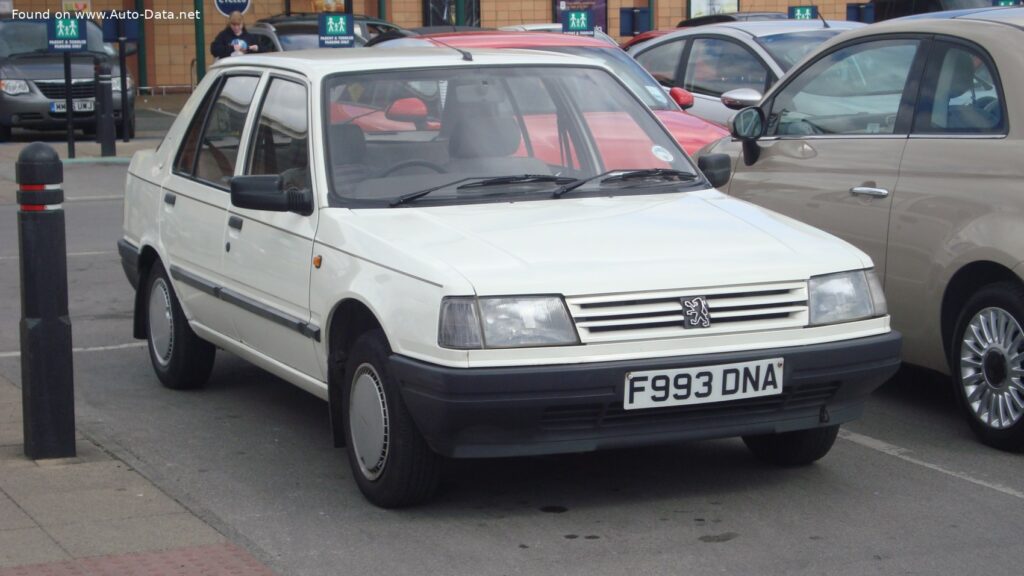
The Peugeot 309 (10C,10A) 1.1 (54 Hp) represents a pivotal moment in the history of the French automaker, serving as a robust and practical offering in the highly competitive European compact car segment during the late 1980s. Launched in 1985, this particular generation, designated 10C for the three-door and 10A for the five-door, was produced until 1989 in this specific powertrain configuration. Positioned by Peugeot to bridge the gap between the hugely successful 205 supermini and the larger 405 family sedan, the 309 was initially conceived as a replacement for the Talbot Horizon, a legacy model from the acquired Chrysler Europe operations. Despite its origins, Peugeot extensively re-engineered the platform, integrating many components from the 205, particularly its suspension and drivetrain, to create a distinct Peugeot identity. The 1.1-liter variant, with its modest 54 horsepower, was designed primarily for economy and reliability, catering to a broad European market that prioritized low running costs and everyday usability over outright performance. It quickly established a reputation as a dependable and spacious hatchback, embodying the pragmatic automotive engineering of its era.
Engine & Performance of the Peugeot 309 (10C,10A) 1.1 (54 Hp)
At the heart of the Peugeot 309 (10C,10A) 1.1 (54 Hp) lies an internal combustion engine architecture that was a hallmark of economical European vehicles of its time. The E1 engine, a naturally aspirated, transverse-mounted inline-four, boasted an engine displacement of 1118 cubic centimeters, or approximately 1.1 liters. This robust powerplant delivered a respectable 54 horsepower at 6000 revolutions per minute, providing sufficient motivation for urban commutes and light highway travel. Torque output stood at 63.43 pound-feet, peaking at a relatively low 3000 rpm, which contributed to its tractable nature and ease of driving in city traffic, reducing the need for constant gear changes. This power-to-torque profile was carefully calibrated for efficiency and everyday usability rather than aggressive acceleration.
The engine featured a time-proven overhead valve (OHV) valvetrain with two valves per cylinder, a configuration known for its simplicity, durability, and ease of maintenance. Fuel delivery was managed by a carburetor system, a standard technology before the widespread adoption of electronic fuel injection, ensuring reliable operation across various conditions, albeit with less precision than modern systems. With a compression ratio of 9.6:1, the engine was designed to run efficiently on standard gasoline, further emphasizing its economical appeal. Its power per liter measured 48.3 horsepower per liter, a solid figure for a naturally aspirated unit of its vintage.
Performance metrics for the 1.1-liter 309 reflected its focus on practicality. The vehicle could accelerate from 0 to 60 miles per hour in an estimated 16.4 seconds, with 0 to 62 mph (100 km/h) taking 17.3 seconds. While not a speed demon, these figures were competitive for an entry-level family hatchback of the mid-to-late 1980s. The maximum speed achieved by the 309 1.1 was 93.21 miles per hour (150 km/h), adequate for European highway speeds but indicating its design priority for efficiency over high-speed cruising. The drivetrain architecture featured front-wheel drive, with power transmitted through a four-speed manual transmission. This combination was typical for the segment, offering a balance of manufacturing cost, mechanical simplicity, and driver engagement.
Fuel economy was a key selling point for the 309 1.1. In urban driving conditions, it achieved approximately 31.8 US miles per gallon, while on extra-urban cycles, it could deliver an impressive 44.4 US miles per gallon. These figures underscored its role as a cost-effective mode of transport, an essential consideration for European consumers. With a fuel tank capacity of 14.53 US gallons, the 309 offered a substantial cruising range, reducing the frequency of fuel stops. The vehicle’s kerb weight of 1851.88 pounds contributed to its favorable weight-to-power ratio of 15.6 kg/Hp, or 64.3 Hp per tonne, allowing the modest engine to deliver acceptable performance without excessive strain.
Design & Features
The Peugeot 309 (10C,10A) presented a design aesthetic that was quintessentially 1980s European – functional, angular, and with an emphasis on practicality. As a five-door hatchback, it offered a versatile body type that appealed to families and individuals seeking a compact vehicle with ample cargo and passenger space. The design, while distinctly Peugeot, incorporated elements that subtly acknowledged its Talbot heritage, particularly in its overall silhouette and window lines, though Peugeot’s own design language, heavily influenced by the 205, was clearly evident in the front fascia and interior.
Measuring 159.49 inches in length, 64.09 inches in width, and 54.33 inches in height, the 309 occupied a compact footprint, making it maneuverable in crowded European city streets while still providing a surprisingly spacious interior. The wheelbase of 97.2 inches contributed to a stable ride and allowed for a comfortable cabin for up to five occupants. The vehicle’s modest kerb weight of 1851.88 pounds (840 kg) was a testament to efficient construction and material use, contributing positively to both its fuel economy and dynamic characteristics. With a maximum permissible weight of 2843.96 pounds (1290 kg) and a maximum load capacity of 992.08 pounds (450 kg), the 309 was well-equipped to handle typical family duties, including luggage and passengers.
Practicality was a cornerstone of the 309’s design. The hatchback configuration provided excellent cargo versatility, with a minimum trunk space of 14.02 cubic feet (397 liters) that could expand significantly to a maximum of 45.17 cubic feet (1279 liters) with the rear seats folded down. This flexibility made it a popular choice for everything from weekly grocery runs to vacation trips. The relatively low drag coefficient (Cd) of 0.33 was a respectable figure for its time, indicating careful aerodynamic consideration aimed at improving fuel efficiency and reducing wind noise at higher speeds.
The chassis and suspension systems were engineered for a comfortable yet engaging driving experience, characteristic of Peugeot vehicles. The front suspension utilized an independent McPherson strut setup with coil springs and an anti-roll bar, providing precise steering and good road holding. The rear suspension featured a torsion bar system, a compact and effective design that allowed for a flatter load floor and maximized cargo space. Braking duties were handled by disc brakes at the front and drum brakes at the rear, a common and effective combination for a vehicle of this size and performance. The steering system was a traditional rack and pinion setup, offering direct feedback to the driver. The 309 rode on 13-inch wheel rims, fitted with 145/70 R13 tires, a size chosen for its balance of comfort, grip, and cost-effectiveness.
Technical Specifications
| Brand | Peugeot |
| Model | 309 |
| Generation | 309 (10C,10A) |
| Type (Engine) | 1.1 (54 Hp) |
| Start of production | 1985 year |
| End of production | 1989 year |
| Powertrain Architecture | Internal Combustion engine |
| Body type | Hatchback |
| Seats | 5 |
| Doors | 5 |
| Fuel consumption (economy) – urban | 7.4 l/100 km (31.8 US mpg) |
| Fuel consumption (economy) – extra urban | 5.3 l/100 km (44.4 US mpg) |
| Fuel Type | Petrol (Gasoline) |
| Acceleration 0 – 100 km/h | 17.3 sec |
| Acceleration 0 – 62 mph | 17.3 sec |
| Acceleration 0 – 60 mph (Calculated) | 16.4 sec |
| Maximum speed | 150 km/h (93.21 mph) |
| Weight-to-power ratio | 15.6 kg/Hp (64.3 Hp/tonne) |
| Weight-to-torque ratio | 9.8 kg/Nm (102.4 Nm/tonne) |
| Power | 54 Hp @ 6000 rpm |
| Power per litre | 48.3 Hp/l |
| Torque | 86 Nm @ 3000 rpm (63.43 lb.-ft. @ 3000 rpm) |
| Engine layout | Front, Transverse |
| Engine Model/Code | E1 |
| Engine displacement | 1118 cm3 (68.22 cu. in.) |
| Number of cylinders | 4 |
| Engine configuration | Inline |
| Cylinder Bore | 74 mm (2.91 in.) |
| Piston Stroke | 65 mm (2.56 in.) |
| Compression ratio | 9.6:1 |
| Number of valves per cylinder | 2 |
| Fuel injection system | Carburettor |
| Engine aspiration | Naturally aspirated engine |
| Valvetrain | OHV |
| Engine oil capacity | 3.3 l (3.49 US qt) |
| Coolant | 6.6 l (6.97 US qt) |
| Kerb Weight | 840 kg (1851.88 lbs) |
| Max. weight | 1290 kg (2843.96 lbs) |
| Max load | 450 kg (992.08 lbs) |
| Trunk (boot) space – minimum | 397 l (14.02 cu. ft.) |
| Trunk (boot) space – maximum | 1279 l (45.17 cu. ft.) |
| Fuel tank capacity | 55 l (14.53 US gal) |
| Permitted trailer load with brakes (12%) | 800 kg (1763.7 lbs) |
| Length | 4051 mm (159.49 in.) |
| Width | 1628 mm (64.09 in.) |
| Height | 1380 mm (54.33 in.) |
| Wheelbase | 2469 mm (97.2 in.) |
| Front track | 1408 mm (55.43 in.) |
| Rear (Back) track | 1376 mm (54.17 in.) |
| Front overhang | 753 mm (29.65 in.) |
| Rear overhang | 829 mm (32.64 in.) |
| Drag coefficient (Cd) | 0.33 |
| Drivetrain Architecture | Front wheel drive (Internal Combustion engine drives front wheels) |
| Drive wheel | Front wheel drive |
| Number of gears and type of gearbox | 4 gears, manual transmission |
| Front suspension | Independent, type McPherson with coil spring and anti-roll bar |
| Rear suspension | Torsion |
| Front brakes | Disc |
| Rear brakes | Drum |
| Steering type | Steering rack and pinion |
| Tires size | 145/70 R13 |
| Wheel rims size | 13 |
