
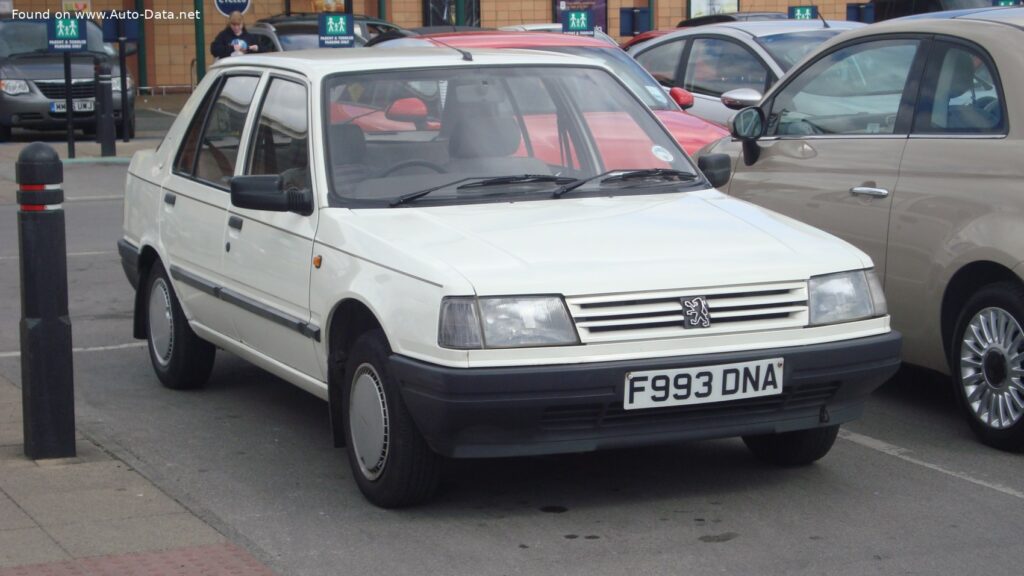
The Peugeot 309 (10C,10A) 1.3 (64 Hp) represents a pivotal model in the French automaker’s history, launched in 1985 and produced until 1989. Positioned firmly within the highly competitive European C-segment, this compact five-door hatchback was conceived as a replacement for the aging Talbot Horizon, effectively bridging the gap between the smaller Peugeot 205 and the larger 405. While never officially sold in the United States, the 309 played a crucial role in consolidating Peugeot’s market share across Europe, particularly in France, the UK, and Spain, where it was praised for its robust build, practical design, and engaging driving dynamics typical of Peugeot vehicles of that era. Its introduction marked a strategic shift for Peugeot, leveraging existing platforms to create a cost-effective yet appealing family vehicle, embodying the utilitarian design philosophies prevalent in European compact cars of the mid-1980s.
The Peugeot 309 (10C,10A): An Era of European Compacts
The Peugeot 309, specifically the 10C,10A generation, emerged during a dynamic period for European automotive manufacturers. Designed to offer a blend of practicality, efficiency, and driving pleasure, it was built on a modified version of the Peugeot 205’s platform, sharing many components to optimize production costs. Despite its humble origins and utilitarian purpose, the 309 quickly established itself as a reliable and spacious option for families and individuals seeking an economical yet capable vehicle. Its market placement saw it directly competing with stalwarts like the Volkswagen Golf, Ford Escort, and Opel/Vauxhall Astra, a segment characterized by fierce competition and a strong emphasis on value for money and running costs. The 1.3-liter variant, with its 64 horsepower engine, was a popular choice, offering a balance between performance suitable for urban commuting and reasonable fuel efficiency for longer journeys.
Engine and Performance Characteristics
At the heart of the Peugeot 309 (10C,10A) 1.3 (64 Hp) lies a naturally aspirated 1.3-liter (1294 cubic centimeters) inline-four gasoline engine, designated with the model code G1A. This powerplant, configured with an overhead valve (OHV) valvetrain and fed by a carburetor, was engineered for dependable performance and ease of maintenance, reflecting the technical standards of the mid-1980s. It produced a modest yet adequate 64 horsepower at 5600 revolutions per minute, delivering a power-per-liter output of 49.5 horsepower per liter. Torque figures stood at 75.97 pound-feet (103 Newton-meters) available at a relatively low 2800 rpm, which contributed to good low-end responsiveness, essential for city driving and overcoming inclines without excessive downshifting. This engine layout featured a front, transverse configuration, driving the front wheels through a five-speed manual transmission, a common and efficient setup for compact cars of its time.
Performance-wise, the 309 1.3 (64 Hp) was characterized by its practicality rather than outright speed. It achieved a 0-60 mph acceleration time of 14.1 seconds (calculated) and a top speed of 98.8 mph (159 km/h). While these figures might seem leisurely by modern standards, they were competitive for a family hatchback in its class during the mid-1980s. Fuel economy was a significant selling point, especially in Europe where fuel prices were consistently higher than in the US. The vehicle returned an estimated 28.3 US miles per gallon in urban driving conditions and an impressive 47 US mpg on the extra-urban cycle, translating to combined efficiency that made it an economical choice for daily use. With a compression ratio of 9.4:1 and two valves per cylinder, the engine was designed for durability and straightforward operation, requiring 3.3 liters of engine oil and 6.6 liters of coolant for optimal functioning.
Design and Features
The Peugeot 309 (10C,10A) adopted a practical and unpretentious five-door hatchback body style, a highly popular configuration in Europe for its versatility. Measuring 159.49 inches (4051 mm) in length, 64.09 inches (1628 mm) in width, and 54.33 inches (1380 mm) in height, the 309 was a compact vehicle that offered surprising interior space. Its wheelbase extended to 97.2 inches (2469 mm), contributing to a stable ride and ample cabin room for five occupants. The design featured a relatively low drag coefficient of 0.33, which was commendable for its era and contributed to its fuel efficiency.
Inside, the 309 prioritized functionality and comfort. While specific luxury features were reserved for higher trims, the 1.3-liter model provided a straightforward and ergonomic cabin. Storage was a strong suit, with a minimum trunk capacity of 14.02 cubic feet (397 liters), expandable to a generous 45.56 cubic feet (1290 liters) with the rear seats folded down, making it highly practical for hauling luggage or groceries. The vehicle’s kerb weight of 1873.93 pounds (850 kg) underscored its lightweight construction, contributing to both its performance and fuel economy. The maximum permissible weight was 2843.96 pounds (1290 kg), allowing for a maximum load of 970.03 pounds (440 kg), further enhancing its utility.
From a chassis perspective, the 309 featured an independent McPherson strut front suspension with coil springs and an anti-roll bar, a setup known for its balance of comfort and handling precision. The rear suspension employed a torsion beam system, a compact and effective design for front-wheel-drive vehicles that also helped maximize interior space. Braking was handled by disc brakes at the front and drum brakes at the rear, a common and cost-effective configuration for cars of this segment and era. Steering was managed by a rack and pinion system, providing direct feedback and ease of maneuverability. The car rode on 13-inch wheels fitted with 145/70 R13 tires, a standard size for compact cars that emphasized ride comfort and economy over outright grip. The front-wheel-drive architecture ensured predictable handling and good traction in various conditions, reinforcing its role as a dependable family car.
Technical Specifications
| Brand | Peugeot |
| Model | 309 |
| Generation | 309 (10C,10A) |
| Type (Engine) | 1.3 (64 Hp) |
| Start of production | 1985 year |
| End of production | 1989 year |
| Powertrain Architecture | Internal Combustion engine |
| Body type | Hatchback |
| Seats | 5 |
| Doors | 5 |
| Fuel consumption (economy) – urban | 8.3 l/100 km (28.3 US mpg) |
| Fuel consumption (economy) – extra urban | 5 l/100 km (47 US mpg) |
| Fuel Type | Petrol (Gasoline) |
| Acceleration 0 – 60 mph | 14.1 sec |
| Maximum speed | 159 km/h (98.8 mph) |
| Weight-to-power ratio | 13.3 kg/Hp (75.3 Hp/tonne) |
| Weight-to-torque ratio | 8.3 kg/Nm (121.2 Nm/tonne) |
| Power | 64 Hp @ 5600 rpm |
| Power per litre | 49.5 Hp/l |
| Torque | 103 Nm @ 2800 rpm (75.97 lb.-ft. @ 2800 rpm) |
| Engine layout | Front, Transverse |
| Engine Model/Code | G1A |
| Engine displacement | 1294 cm3 (78.96 cu. in.) |
| Number of cylinders | 4 |
| Engine configuration | Inline |
| Cylinder Bore | 76.7 mm (3.02 in.) |
| Piston Stroke | 70 mm (2.76 in.) |
| Compression ratio | 9.4:1 |
| Number of valves per cylinder | 2 |
| Fuel injection system | Carburettor |
| Engine aspiration | Naturally aspirated engine |
| Valvetrain | OHV |
| Engine oil capacity | 3.3 l (3.49 US qt) |
| Coolant | 6.6 l (6.97 US qt) |
| Kerb Weight | 850 kg (1873.93 lbs.) |
| Max. weight | 1290 kg (2843.96 lbs.) |
| Max load | 440 kg (970.03 lbs.) |
| Trunk (boot) space – minimum | 397 l (14.02 cu. ft.) |
| Trunk (boot) space – maximum | 1290 l (45.56 cu. ft.) |
| Fuel tank capacity | 55 l (14.53 US gal) |
| Permitted trailer load with brakes (12%) | 800 kg (1763.7 lbs.) |
| Length | 4051 mm (159.49 in.) |
| Width | 1628 mm (64.09 in.) |
| Height | 1380 mm (54.33 in.) |
| Wheelbase | 2469 mm (97.2 in.) |
| Front track | 1408 mm (55.43 in.) |
| Rear (Back) track | 1376 mm (54.17 in.) |
| Front overhang | 753 mm (29.65 in.) |
| Rear overhang | 829 mm (32.64 in.) |
| Drag coefficient (Cd) | 0.33 |
| Drivetrain Architecture | Front wheel drive, Internal Combustion engine |
| Drive wheel | Front wheel drive |
| Number of gears and type of gearbox | 5 gears, manual transmission |
| Front suspension | Independent, type McPherson with coil spring and anti-roll bar |
| Rear suspension | Torsion |
| Front brakes | Disc |
| Rear brakes | Drum |
| Steering type | Steering rack and pinion |
| Tires size | 145/70 R13 |
| Wheel rims size | 13 |
