
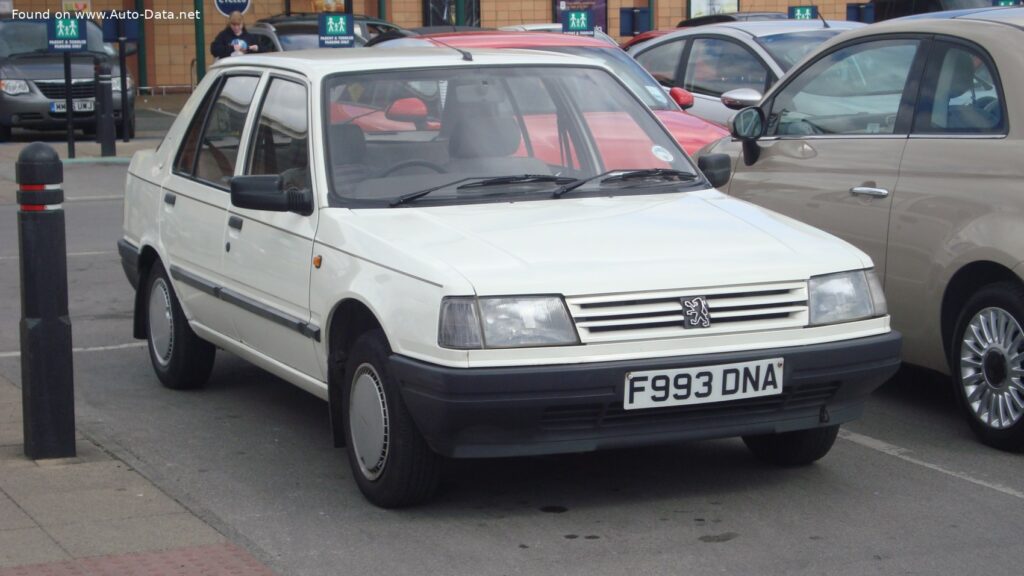
The Peugeot 309 (10C,10A) 1.6 (105 Hp) represents a significant chapter in the history of the French automaker, serving as a robust and practical compact family car during the mid-to-late 1980s. Introduced in 1985, this particular variant, identifiable by its 10C or 10A chassis code, was a crucial model for Peugeot, bridging the gap between the immensely popular 205 supermini and the larger 405 sedan. Primarily targeting the discerning European market, where it was lauded for its blend of performance, economy, and practicality, the 309 was never officially sold in the United States. Its inception was rooted in the remnants of the Talbot brand, with the 309 originally intended to be the Talbot Arizona. However, following Peugeot’s acquisition of Chrysler Europe, the project was rebadged and integrated into the Peugeot lineup, inheriting some components from the Talbot Horizon but crucially adopting the advanced chassis and powertrain elements from the contemporary Peugeot 205. The 1.6 (105 Hp) model, produced from 1985 to 1988, carved out a niche as a spirited yet economical five-door hatchback, embodying the pragmatic design and engaging driving dynamics that characterized Peugeot vehicles of that era.
Engine and Performance of the Peugeot 309 (10C,10A) 1.6 (105 Hp)
At the heart of the Peugeot 309 (10C,10A) 1.6 (105 Hp) lies a transversely mounted, front-wheel-drive internal combustion engine, specifically Peugeot’s acclaimed XU5JP unit. This naturally aspirated, 1.6-liter (1580 cm3 or 96.42 cu. in.) inline-four cylinder engine was a hallmark of Peugeot’s engineering prowess, known for its robust construction and lively character. Featuring an Overhead Camshaft (OHC) valvetrain with two valves per cylinder, the engine delivered a respectable 105 horsepower at a relatively high 6250 rpm. This power output, combined with its modest displacement, resulted in a power per liter figure of 66.5 Hp/l, showcasing efficient engine design for its time. Torque figures stood at 129 Nm, or 95.15 lb.-ft., peaking at 4000 rpm, providing a strong mid-range pull that made the 309 feel responsive in everyday driving conditions.
The performance metrics of the 1.6 (105 Hp) variant were quite competitive for a compact hatchback of the mid-1980s. The vehicle could accelerate from 0 to 60 mph in a brisk 10.5 seconds, and achieve a top speed of 115.58 mph (186 km/h). These figures underscored the 309’s ability to offer more than just utilitarian transport; it provided an engaging driving experience. Power was transmitted to the front wheels via a precise 5-speed manual transmission, a common and reliable setup that allowed drivers to maximize the engine’s output. The car’s relatively low curb weight of 2006.21 lbs (910 kg) contributed significantly to its agility and performance, yielding an excellent weight-to-power ratio of 8.7 kg/Hp (115.4 Hp/tonne) and a weight-to-torque ratio of 7.1 kg/Nm (141.8 Nm/tonne).
Fuel efficiency, a critical factor for European consumers, was also a strong suit for the 309 1.6. It achieved an urban fuel economy of 25.6 US mpg (9.2 l/100 km) and an even more impressive extra-urban figure of 37.9 US mpg (6.2 l/100 km). This combination of spirited performance and commendable economy made the 309 a compelling choice for a wide range of buyers. The engine’s compression ratio of 9.8:1 and its multi-port manifold injection system ensured efficient combustion and reliable operation on readily available petrol (gasoline). With an engine oil capacity of 5.28 US quarts and a coolant capacity of 7.93 US quarts, the powertrain was designed for straightforward maintenance, contributing to the vehicle’s long-term reliability and appeal.
Design and Engineering Legacy of the Peugeot 309
The design of the Peugeot 309, while clearly bearing the familial resemblance to other Peugeot models of its era, particularly the 205, was distinctive in its own right. Conceived as a five-door hatchback, it offered a practical and versatile body style that resonated well with European families. Measuring 159.49 inches (4051 mm) in length, 64.09 inches (1628 mm) in width, and 54.33 inches (1380 mm) in height, the 309 struck a balance between compact maneuverability and interior spaciousness. Its wheelbase of 97.2 inches (2469 mm) provided a stable platform, contributing to both ride comfort and handling dynamics. The exterior styling, characterized by clean lines and functional aesthetics, was a product of Peugeot’s in-house design team, rather than the more common Pininfarina collaboration for other models, yet it maintained a harmonious and aerodynamic profile with a drag coefficient (Cd) of 0.33, which was respectable for its time and aided in both fuel efficiency and high-speed stability.
Inside, the 309 prioritized practicality and ergonomic simplicity. Designed to comfortably seat five occupants, the cabin offered a straightforward layout with clear instrumentation, typical of 1980s automotive design. The hatchback configuration provided excellent cargo versatility, with a minimum trunk space of 14.02 cubic feet (397 liters) that could expand significantly to 45.17 cubic feet (1279 liters) with the rear seats folded. This adaptability made the 309 a highly functional vehicle for families and individuals needing flexible load-carrying capabilities.
Underneath its skin, the Peugeot 309 inherited much of its mechanical sophistication from the lauded 205. The chassis featured an independent MacPherson strut front suspension with coil springs and an anti-roll bar, a setup known for its precise handling and comfortable ride. The rear suspension employed a torsion beam arrangement, a compact and effective design that contributed to the car’s agile road manners and maximized interior space. This combination provided the 309 with a reputation for engaging handling, a characteristic often associated with Peugeot vehicles. Braking duties were handled by front disc brakes and rear drum brakes, a standard configuration for its class, offering reliable stopping power. The steering system utilized a rack and pinion setup, providing direct and communicative feedback to the driver, further enhancing the driving experience. The vehicle rode on 175/65 R14 tires mounted
