
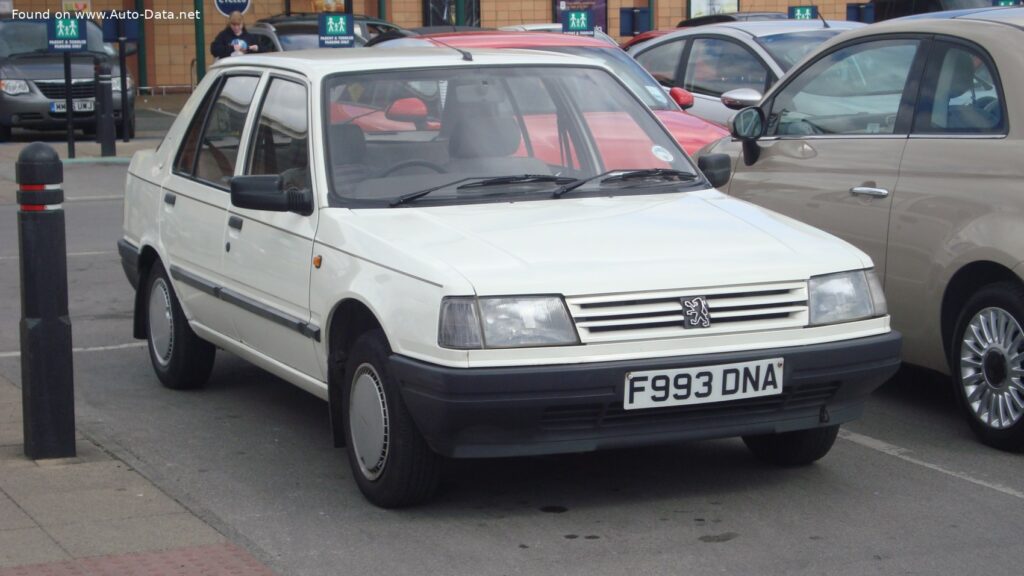
The Peugeot 309 (10C,10A) represents a significant chapter in the history of the French automaker, serving as a pivotal compact family car for the European market from its introduction in 1986 until the end of its production run in 1989. Positioned above the smaller 205 and below the larger 405, the 309 was initially conceived as a Talbot model, inheriting much of the Horizon’s underpinnings. However, following Peugeot’s acquisition of Chrysler Europe (which included Talbot), the car was rebranded and integrated into the Peugeot lineup. This particular generation, known internally as the 10C or 10A depending on the body style, was crucial for Peugeot as it solidified its presence in the highly competitive European C-segment, offering a blend of practical design, robust engineering, and engaging driving dynamics that characterized the brand during that era. While never officially imported to the United States, the 309 earned a reputation in its primary markets for its reliability and spirited performance, particularly in its higher-specification variants.
Engine & Performance of the Peugeot 309 (10C,10A)
At the heart of the Peugeot 309 (10C,10A) 1.9 (98 Hp) variant was a highly regarded 1.9-liter naturally aspirated gasoline engine, bearing the internal code DFZ XU9J1. This engine was a member of Peugeot’s renowned XU family, which was celebrated for its durability and excellent power delivery across a range of models, including the iconic 205 GTi. With an output of 98 horsepower, this powerplant delivered a lively and responsive driving experience, especially considering the vehicle’s relatively modest curb weight for its class. The naturally aspirated design, common for the period, provided a linear power band and an engaging throttle response that enthusiasts appreciated. Unlike modern turbocharged engines, the XU9J1 required drivers to work the engine through its rev range to extract maximum performance, fostering a more connected and tactile driving experience.
The 1.9-liter engine’s characteristics made the 309 a capable performer for everyday driving and longer journeys across European motorways. Its fuel type was standard petrol (gasoline), readily available across its target markets. The engine oil capacity was specified at 4.6 liters (approximately 4.86 US quarts), indicating a conventional lubrication system for the time. Similarly, the cooling system held 7.5 liters (around 7.93 US quarts) of coolant, ensuring efficient thermal management for sustained operation. The robust design and straightforward mechanicals of the XU9J1 engine contributed to the 309’s reputation for reliability and ease of maintenance, qualities that were highly valued by European consumers seeking dependable transportation. This particular engine configuration offered a compelling balance between performance and economy, making it a popular choice within the 309 lineup.
Design & Features: The Peugeot 309 Hatchback
The Peugeot 309 (10C,10A) was exclusively offered as a hatchback, a body style that perfectly encapsulated the European preference for practicality, versatility, and compact dimensions. Its design, while sharing some visual cues with the smaller 205, presented a more angular and mature aesthetic, reflecting its position as a larger family car. The two-box silhouette provided excellent interior space and a highly flexible cargo area, a hallmark of European hatchbacks. The rear tailgate opened wide, facilitating easy loading and unloading of luggage or groceries, a critical feature for families.
Inside, the 309 prioritized functionality and ergonomics. While specific luxury features varied by trim level, the cabin generally offered a straightforward layout with clear instrumentation and accessible controls. Seating was designed for comfort on long drives, and visibility was typically good, enhancing driver confidence in urban environments and on winding roads. For its era, safety features would have included basic seatbelts and a robust body structure designed to meet European crash standards, which were evolving rapidly during the late 1980s. The focus was on passive safety through structural integrity rather than active electronic aids common in modern vehicles. The car’s overall design emphasized efficiency of space and ease of maneuverability, making it a practical choice for crowded European cities and varied driving conditions.
Legacy and Market Impact of the Peugeot 309
The Peugeot 309 (10C,10A) played a vital role in Peugeot’s strategy to consolidate its market share in Europe during the late 1980s. By effectively replacing the Talbot Horizon and bridging the gap between the hugely successful 205 supermini and the newly introduced 405 family sedan, the 309 helped to streamline Peugeot’s product offering. Its strong mechanical underpinnings, particularly the XU engine range, meant it inherited a reputation for reliability and enjoyable driving dynamics. The 309 competed fiercely with established rivals such as the Volkswagen Golf, Ford Escort, and Opel Kadett/Vauxhall Astra, holding its own through a combination of competitive pricing, practical design, and engaging performance. While it never achieved the iconic status of the 205 GTi, the 309 GTi variants were highly regarded for their handling and performance, further cementing Peugeot’s reputation for building driver-focused cars.
The car’s production span from 1986 to 1989 for this specific generation marked a period of significant growth and innovation for Peugeot. The 309 helped to modernize the brand’s image and demonstrated its capability to produce well-engineered and versatile vehicles for the mainstream market. Its success contributed to Peugeot’s continued expansion across Europe and laid the groundwork for future models that would carry the brand into the 1990s and beyond. Even today, the Peugeot 309 is remembered fondly by enthusiasts for its robust build quality, straightforward mechanics, and the pure, unadulterated driving experience offered by its naturally aspirated engines. It stands as a testament to the era of practical, no-nonsense European motoring, before the advent of widespread electronic aids and increasingly complex powertrains.
Technical Specifications
| Brand | Peugeot |
| Model | 309 |
| Generation | 309 (10C,10A) |
| Type (Engine) | 1.9 (98 Hp) |
| Start of production | 1986 year |
| End of production | 1989 year |
| Powertrain Architecture | Internal Combustion engine |
| Body type | Hatchback |
| Fuel Type | Petrol (Gasoline) |
| Power | 98 Hp |
| Engine Model/Code | DFZ XU9J1 |
| Engine aspiration | Naturally aspirated engine |
| Engine oil capacity | 4.6 l (4.86 US qt | 4.05 UK qt) |
| Coolant capacity | 7.5 l (7.93 US qt | 6.6 UK qt) |
| Drivetrain | Internal Combustion engine |
