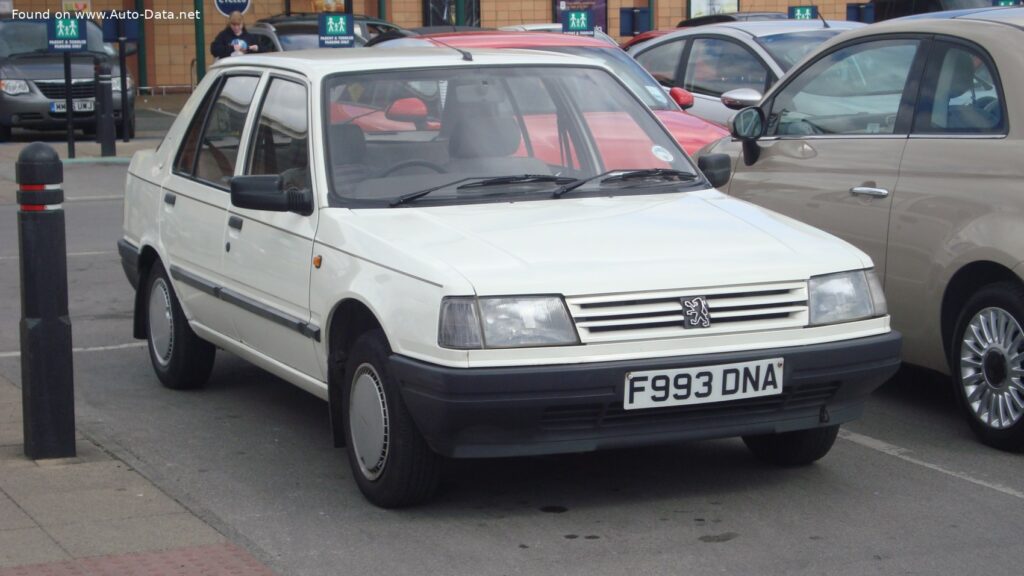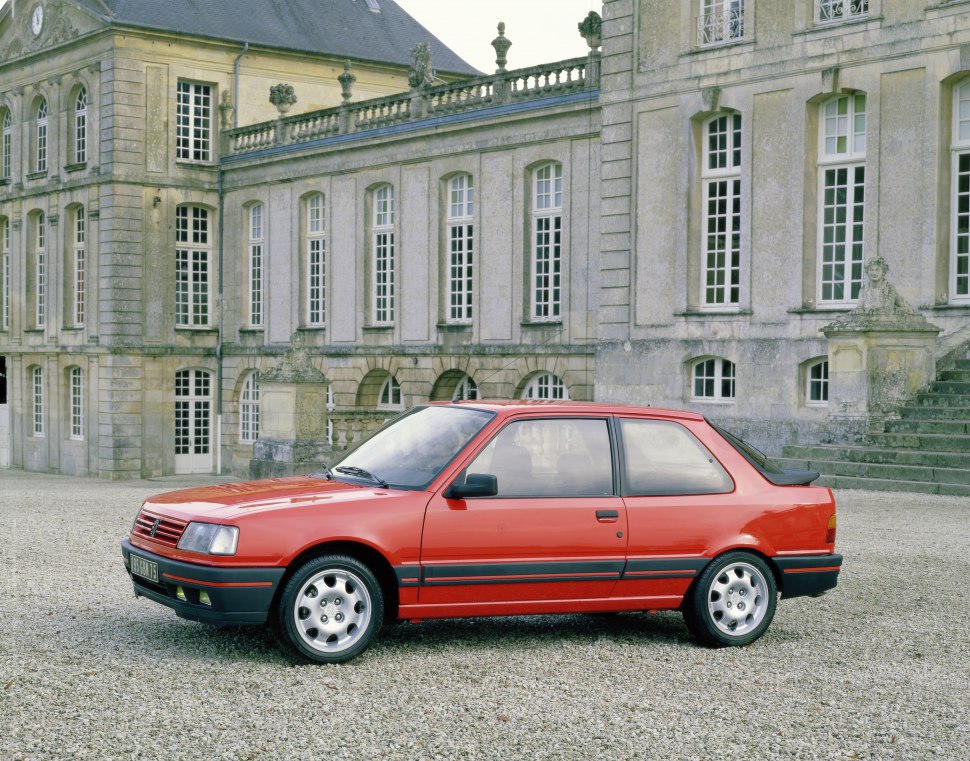
The Peugeot 309, specifically the 10C,10A generation 3-door 1.1 (54 Hp) variant, represents a significant chapter in the history of compact European automobiles. Launched in 1985 and produced until 1989, this model was a key player in the fiercely competitive European hatchback market, a segment where practicality, efficiency, and nimble handling were paramount. Unlike many of its contemporaries, the 309 was not designed for the North American market, instead focusing its efforts on establishing a strong foothold across Europe. It was developed as a successor to the Peugeot 305 and, somewhat controversially, replaced the Talbot Horizon, a car from Peugeot’s recently acquired Chrysler Europe (formerly Simca) subsidiary. The 309 was notable for being the first Peugeot to use the new ’09’ designation, signaling a departure from the traditional ’05’ series and hinting at future model numbering conventions. This particular 1.1-liter variant served as an entry-level offering, providing an economical and accessible option for a broad range of consumers seeking reliable daily transportation.
Engine and Performance of the Peugeot 309 (10C,10A) 3-door 1.1 (54 Hp)
At the heart of the 1985-1989 Peugeot 309 (10C,10A) 3-door 1.1 (54 Hp) was a robust and proven powertrain, characteristic of Peugeot’s engineering philosophy during that era. The vehicle was equipped with a naturally aspirated, front-transverse mounted 1.1-liter (1118 cm³, or 68.22 cubic inches) inline-four engine, designated with the code E1. This powerplant delivered a modest but effective 54 horsepower at 6000 rpm, which, when combined with its lightweight chassis, provided adequate performance for urban commuting and reasonable highway cruising. Torque output stood at 63.43 pound-feet (86 Nm) at a relatively low 3000 rpm, ensuring decent low-end grunt for navigating city traffic.
The engine featured a simple yet reliable overhead valve (OHV) valvetrain with two valves per cylinder, a common and cost-effective design choice for entry-level vehicles of the period. Fuel delivery was managed by a carburetion system, a technology that was still prevalent in the mid-1980s before the widespread adoption of electronic fuel injection. This setup contributed to the engine’s straightforward maintenance and durability. With a compression ratio of 9.6:1, the engine was designed to run efficiently on standard unleaded gasoline.
Performance figures, while not groundbreaking by today’s standards, were competitive for its class at the time. The 309 1.1 (54 Hp) could accelerate from 0 to 60 mph in 16.4 seconds, with a top speed of 93.21 mph (150 km/h). These numbers underscore its role as a practical, economical vehicle rather than a performance-oriented hot hatch. The power-to-weight ratio of 15.2 kg/Hp (65.7 Hp/tonne) and a torque-to-weight ratio of 9.6 kg/Nm (104.6 Nm/tonne) further illustrate its balanced design for everyday usability.
Fuel economy was a strong suit for the 309 1.1, reflecting its design brief for cost-effective motoring. It achieved an urban fuel consumption of 31.8 US mpg (7.4 l/100 km) and an even more impressive extra-urban figure of 44.4 US mpg (5.3 l/100 km). These figures were crucial for attracting buyers in Europe where fuel prices were a significant consideration. Power was transmitted to the front wheels via a four-speed manual transmission, a common choice for economy cars of the era, prioritizing simplicity and efficiency over a wider range of ratios.
Design and Features of the Peugeot 309 (10C,10A)
The Peugeot 309 (10C,10A) 3-door presented a contemporary and functional design for its time, embodying the practical aesthetic common in European compact hatchbacks of the mid-to-late 1980s. Its body type was a classic 3-door hatchback, a configuration that offered a blend of sporty appearance, compact dimensions for city maneuverability, and surprising interior versatility. Measuring 159.49 inches (4051 mm) in length, 64.09 inches (1628 mm) in width, and 54.33 inches (1380 mm) in height, the 309 was designed to be agile and easy to park, characteristics highly valued in congested European urban environments. The wheelbase of 97.2 inches (2469 mm) contributed to a stable ride quality for its class, while the front and rear track measurements of 55.43 inches (1408 mm) and 54.17 inches (1376 mm) respectively provided a solid stance.
Despite its compact exterior, the 309 was engineered to maximize interior space, accommodating five occupants comfortably for short to medium journeys. The hatchback design was inherently practical, offering excellent cargo flexibility. The trunk (boot) space ranged from a generous 14.02 cubic feet (397 liters) with the rear seats in place, expanding significantly to 45.17 cubic feet (1279 liters) when the rear seats were folded down. This adaptability made the 309 a popular choice for young families and individuals who required a versatile vehicle for everyday tasks, from grocery shopping to weekend trips.
Aerodynamics were a consideration in its design, with a drag coefficient (Cd) of 0.33, a respectable figure for a car of its class and era. This contributed not only to its fuel efficiency but also to reduced wind noise at higher speeds. The chassis featured a well-engineered suspension system, with an independent MacPherson strut setup with coil springs and an anti-roll bar at the front, providing a good balance of comfort and handling precision. The rear utilized a torsion beam suspension, a compact and efficient design that allowed for a larger cargo area. This combination delivered a ride that was compliant enough for rough city streets yet capable on winding rural roads.
Braking performance was handled by disc brakes at the front and drum brakes at the rear, a standard configuration for front-wheel-drive cars in this segment. This system provided reliable stopping power for the vehicle’s weight and performance capabilities. Steering was managed by a rack and pinion system, offering direct and predictable control, which was appreciated by drivers. The car rode on 145/70 R13 tires mounted on 13-inch wheel rims, providing a comfortable ride and economical replacement costs. With a kerb weight of 1812.2 pounds (822 kg) and a maximum permissible weight of 2843.96 pounds (1290 kg), the 309 was a lightweight vehicle, further enhancing its agility and fuel economy. Its fuel tank capacity of 14.53 US gallons (55 liters) provided a respectable cruising range, making it suitable for longer journeys despite its primary role as a city car. The permitted trailer load with brakes (12%) of 1763.7 pounds (800 kg) also added to its utility, allowing for light towing capabilities.
Technical Specifications
| Brand | Peugeot |
| Model | 309 |
| Generation | 309 (10C,10A) 3-door |
| Type (Engine) | 1.1 (54 Hp) |
| Start of production | 1985 year |
| End of production | 1989 year |
| Powertrain Architecture | Internal Combustion engine |
| Body type | Hatchback |
| Seats | 5 |
| Doors | 3 |
| Fuel consumption (economy) – urban | 7.4 l/100 km (31.8 US mpg) |
| Fuel consumption (economy) – extra urban | 5.3 l/100 km (44.4 US mpg) |
| Fuel Type | Petrol (Gasoline) |
| Acceleration 0 – 100 km/h | 17.3 sec |
| Acceleration 0 – 62 mph | 17.3 sec |
| Acceleration 0 – 60 mph (Calculated) | 16.4 sec |
| Maximum speed | 150 km/h (93.21 mph) |
| Weight-to-power ratio | 15.2 kg/Hp (65.7 Hp/tonne) |
| Weight-to-torque ratio | 9.6 kg/Nm (104.6 Nm/tonne) |
| Power | 54 Hp @ 6000 rpm. |
| Power per liter | 48.3 Hp/l |
| Torque | 86 Nm @ 3000 rpm (63.43 lb.-ft. @ 3000 rpm) |
| Engine layout | Front, Transverse |
| Engine Model/Code | E1 |
| Engine displacement | 1118 cm³ (1.1 l, 68.22 cu. in.) |
| Number of cylinders | 4 |
| Engine configuration | Inline |
| Cylinder Bore | 74 mm (2.91 in.) |
| Piston Stroke | 65 mm (2.56 in.) |
| Compression ratio | 9.6:1 |
| Number of valves per cylinder | 2 |
| Fuel injection system | Carburettor |
| Engine aspiration | Naturally aspirated engine |
| Valvetrain | OHV |
| Engine oil capacity | 3.3 l (3.49 US qt) |
| Coolant | 6.6 l (6.97 US qt) |
| Kerb Weight | 822 kg (1812.2 lbs.) |
| Max. weight | 1290 kg (2843.96 lbs.) |
| Max load | 468 kg (1031.76 lbs.) |
| Trunk (boot) space – minimum | 397 l (14.02 cu. ft.) |
| Trunk (boot) space – maximum | 1279 l (45.17 cu. ft.) |
| Fuel tank capacity | 55 l (14.53 US gal) |
| Permitted trailer load with brakes (12%) | 800 kg (1763.7 lbs.) |
| Length | 4051 mm (159.49 in.) |
| Width | 1628 mm (64.09 in.) |
| Height | 1380 mm (54.33 in.) |
| Wheelbase | 2469 mm (97.2 in.) |
| Front track | 1408 mm (55.43 in.) |
| Rear (Back) track | 1376 mm (54.17 in.) |
| Front overhang | 753 mm (29.65 in.) |
| Rear overhang | 829 mm (32.64 in.) |
| Drag coefficient (Cd) | 0.33 |
| Drivetrain Architecture | The Internal combustion engine (ICE) drives the front wheels of the vehicle. |
| Drive wheel | Front wheel drive |
| Number of gears and type of gearbox | 4 gears, manual transmission |
| Front suspension | Independent, type McPherson with coil spring and anti-roll bar |
| Rear suspension | Torsion |
| Front brakes | Disc |
| Rear brakes | Drum |
| Steering type | Steering rack and pinion |
| Tires size | 145/70 R13 |
| Wheel rims size | 13 |