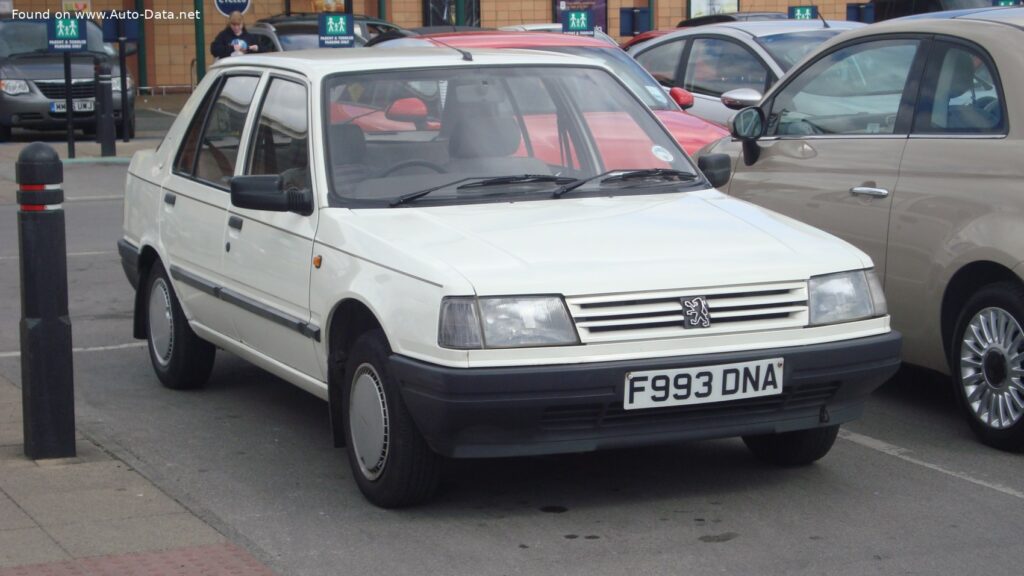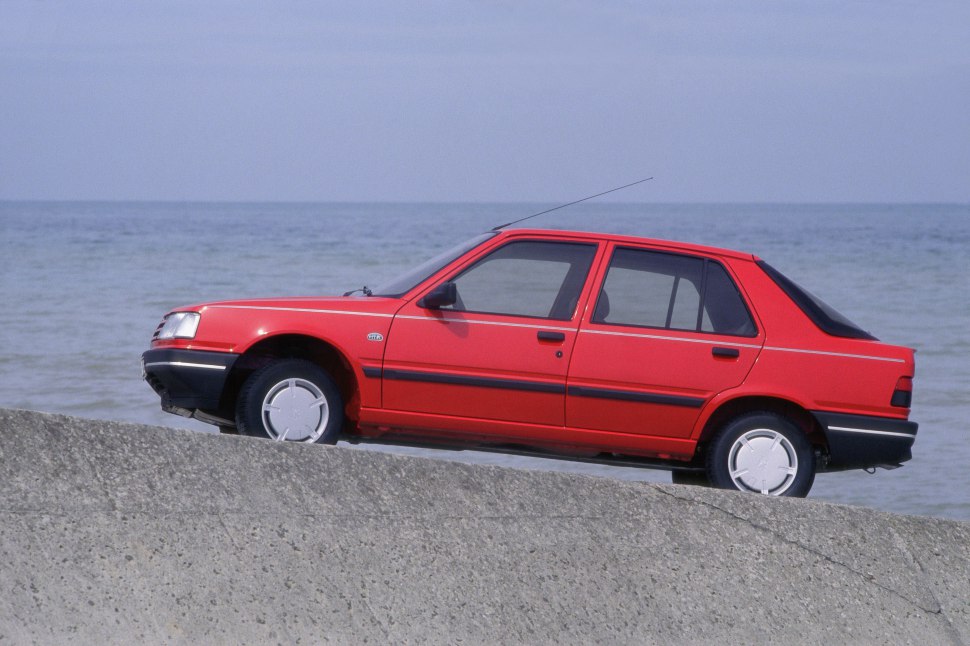
The Peugeot 309, particularly the 3C,3A facelift variant from 1989, represents a significant chapter in the French automaker’s history, bridging the gap between the outgoing 305 and the popular 306. While never officially sold in the United States, this compact family car, specifically the Peugeot 309 (3C,3A facelift 1989) 1.6i (88 Hp) Automatic, carved out a strong niche in the European market. Launched in 1985, the 309 was initially conceived as a Talbot Arizona, a consequence of Peugeot’s acquisition of Chrysler’s European operations and the subsequent rebranding of Talbot. By the time of its 1989 facelift, the 309 had firmly established itself as a Peugeot, shedding its Talbot origins and integrating fully into the Peugeot lineup. This particular model, produced from 1989 to 1993, showcases the practical, robust, and moderately efficient characteristics that defined European compact cars of its era. It was offered as a versatile hatchback, available with either three or five doors, accommodating five passengers comfortably within its relatively modest dimensions. This generation of the 309 benefited from subtle styling refinements and mechanical updates, ensuring its continued competitiveness in a fiercely contested segment, emphasizing accessibility and everyday usability for the average European family.
Engine and Performance: The Heart of the Peugeot 309
Powering the Peugeot 309 1.6i (88 Hp) Automatic is a naturally aspirated 1.6-liter (1580 cubic centimeters or 96.42 cubic inches) inline four-cylinder engine, designated by the code BDY XU5M3Z. This robust powerplant, positioned transversely at the front, was a staple of Peugeot’s engine family during this period, known for its reliability and straightforward overhead camshaft (OHC) valvetrain. With two valves per cylinder and a compression ratio of 9.2:1, the engine delivers a respectable 88 horsepower at 6000 revolutions per minute. Its multi-port manifold injection system was a modern touch for the late 1980s, optimizing fuel delivery and efficiency compared to earlier carbureted systems. The engine’s power output translates to a power per liter figure of 55.7 horsepower per liter, indicating a balanced approach between performance and longevity.
Crucially, the engine produces 95.88 pound-feet (130 Newton-meters) of torque at a relatively low 2600 rpm. This low-end torque characteristic is particularly beneficial for urban driving and provides a responsive feel, especially when paired with the four-speed automatic transmission. While modern automatic transmissions boast more gears, the four-speed unit in the 309 was a common offering, providing a smooth, if not overtly sporty, driving experience. Performance figures for the 1.6i Automatic are commensurate with its market positioning: it accelerates from 0 to 60 miles per hour in approximately 10 seconds (0-100 km/h in 10.5 seconds), and its maximum speed reaches 108.74 mph (175 km/h). These figures demonstrate that the 309 1.6i Automatic was a capable performer for its time, providing sufficient power for both city commutes and longer journeys across European highways.
Fuel economy, a critical consideration for European motorists, was a strong suit for the 309. The combined fuel consumption is rated at 6.8 liters per 100 kilometers, which translates to an impressive 34.6 US miles per gallon or 41.5 UK miles per gallon. Urban driving sees consumption at 8.8 l/100 km (26.7 US mpg), while extra-urban cruising drops to 5.3 l/100 km (44.4 US mpg). These numbers highlight the engine’s efficiency, especially on longer trips, making it an economical choice for families. The vehicle’s weight-to-power ratio stands at 10.1 kg per horsepower, or 98.9 horsepower per tonne, further underscoring its efficient use of power relative to its modest curb weight of 1962.11 pounds (890 kg). The engine oil capacity is 4 liters, and the cooling system holds 7.5 liters of coolant, indicating standard maintenance requirements for a vehicle of its class.
Design and Features of the Peugeot 309
The Peugeot 309 (3C,3A facelift 1989) embodies the practical and understated design language prevalent in European compact cars of the late 1980s and early 1990s. Its body type is a hatchback, a highly favored configuration in Europe for its versatility, offering a blend of passenger comfort and cargo capacity. The availability of both three-door and five-door variants further enhanced its appeal, catering to different consumer needs—the three-door for a sportier look and the five-door for easier access for rear passengers and families. With five seats, the 309 was designed as a capable family car, providing adequate space for occupants within its compact footprint.
Dimensionally, the 309 is 159.45 inches (4050 mm) long, 64.17 inches (1630 mm) wide, and 54.33 inches (1380 mm) high. Its wheelbase measures 97.24 inches (2470 mm), providing a stable platform for its size. The front track is 55.31 inches (1405 mm) and the rear track is 54.33 inches (1380 mm), contributing to balanced handling characteristics. Despite its compact exterior, the 309 offers a surprising amount of interior utility. The trunk (boot) space ranges from a minimum of 10.42 cubic feet (295 liters) to a generous maximum of 21.72 cubic feet (615 liters) with the rear seats folded down, making it highly practical for grocery runs, luggage, or even small furniture items. The fuel tank capacity of 14.53 US gallons (55 liters) ensures a decent cruising range, complementing its economical fuel consumption.
In terms of chassis and drivetrain, the 309 features a front-wheel-drive architecture, with the internal combustion engine driving the front wheels. This layout was (and remains) a common and efficient choice for compact cars, offering good traction and packaging efficiency. The suspension system comprises coil springs at the front and a torsion beam setup at the rear, a proven combination for balancing ride comfort with predictable handling. Braking is handled by disc brakes at the front and drum brakes at the rear, a standard configuration for cars in this segment during its production years, providing reliable stopping power. The steering system is a rack-and-pinion type, enhanced with hydraulic power steering, which makes maneuvering the vehicle easier, especially at low speeds or during parking, a significant comfort feature for the era.
The 309 rode on 13-inch wheels fitted with 165/70 SR13 tires, providing a comfortable ride and predictable grip. While modern vehicles boast larger wheels and more sophisticated safety features, the 309’s design focused on fundamental reliability and practicality. Its unpretentious styling and robust construction ensured it could withstand the rigors of daily use in various European environments. The facelift in 1989 brought subtle updates, including revised front and rear fascias, contributing to a more modern appearance and maintaining its competitive edge against rivals.
Legacy and Market Impact
The Peugeot 309 holds a distinct place in Peugeot’s heritage, having successfully replaced the 305 and served as a precursor to the highly successful 306. Its production run from 1985 to 1993 saw it become a familiar sight on European roads, admired for its practicality, economical operation, and robust mechanics. The 1989 facelift, which included the 1.6i (88 Hp) Automatic variant, helped sustain its appeal through the early 1990s, offering a reliable and comfortable transportation solution for a wide demographic. While it may not possess the iconic status of some of its Peugeot stablemates like the 205 GTI, the 309 was a workhorse that solidified Peugeot’s reputation for producing dependable and well-engineered compact cars. Today, surviving examples are appreciated by enthusiasts for their classic Peugeot driving dynamics and straightforward mechanicals, representing an accessible piece of European automotive history from a transformative era.
Technical Specifications: Peugeot 309 (3C,3A facelift 1989) 1.6i (88 Hp) Automatic
| Brand | Peugeot |
| Model | 309 |
| Generation | 309 (3C,3A facelift 1989) |
| Type (Engine) | 1.6i (88 Hp) Automatic |
| Start of production | 1989 year |
| End of production | 1993 year |
| Powertrain Architecture | Internal Combustion engine |
| Body type | Hatchback |
| Seats | 5 |
| Doors | 3-5 |
| Fuel consumption (economy) – urban | 8.8 l/100 km (26.7 US mpg) |
| Fuel consumption (economy) – extra urban | 5.3 l/100 km (44.4 US mpg) |
| Fuel consumption (economy) – combined | 6.8 l/100 km (34.6 US mpg) |
| Fuel Type | Petrol (Gasoline) |
| Acceleration 0 – 60 mph | 10 sec |
| Acceleration 0 – 100 km/h | 10.5 sec |
| Maximum speed | 175 km/h (108.74 mph) |
| Weight-to-power ratio | 10.1 kg/Hp (98.9 Hp/tonne) |
| Weight-to-torque ratio | 6.8 kg/Nm (146.1 Nm/tonne) |
| Power | 88 Hp @ 6000 rpm |
| Power per liter | 55.7 Hp/l |
| Torque | 130 Nm @ 2600 rpm (95.88 lb.-ft. @ 2600 rpm) |
| Engine layout | Front, Transverse |
| Engine Model/Code | BDY XU5M3Z |
| Engine displacement | 1580 cm3 (96.42 cu. in.) |
| Number of cylinders | 4 |
| Engine configuration | Inline |
| Cylinder Bore | 83 mm (3.27 in.) |
| Piston Stroke | 73 mm (2.87 in.) |
| Compression ratio | 9.2:1 |
| Number of valves per cylinder | 2 |
| Fuel injection system | Multi-port manifold injection |
| Engine aspiration | Naturally aspirated engine |
| Valvetrain | OHC |
| Engine oil capacity | 4 l (4.23 US qt) |
| Coolant | 7.5 l (7.93 US qt) |
| Kerb Weight | 890 kg (1962.11 lbs.) |
| Max. weight | 1330 kg (2932.15 lbs.) |
| Max load | 440 kg (970.03 lbs.) |
| Trunk (boot) space – minimum | 295 l (10.42 cu. ft.) |
| Trunk (boot) space – maximum | 615 l (21.72 cu. ft.) |
| Fuel tank capacity | 55 l (14.53 US gal) |
| Length | 4050 mm (159.45 in.) |
| Width | 1630 mm (64.17 in.) |
| Height | 1380 mm (54.33 in.) |
| Wheelbase | 2470 mm (97.24 in.) |
| Front track | 1405 mm (55.31 in.) |
| Rear (Back) track | 1380 mm (54.33 in.) |
| Drivetrain Architecture | Front wheel drive (Internal Combustion engine drives front wheels) |
| Drive wheel | Front wheel drive |
| Number of gears and type of gearbox | 4 gears, automatic transmission |
| Front suspension | Coil spring |
| Rear suspension | Torsion |
| Front brakes | Disc |
| Rear brakes | Drum |
| Steering type | Steering rack and pinion |
| Power steering | Hydraulic Steering |
| Tires size | 165/70 SR13 |
| Wheel rims size | 13 |